




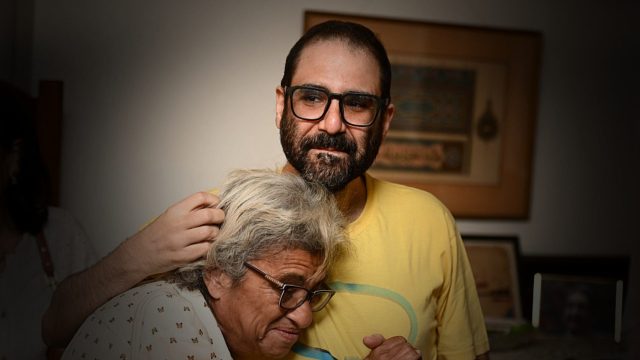
Alaa Abd El-Fattah with his mother, Laila Suief, whose British citizenship enabled him to obtain a British passport and diplomatic assistance. Photo: Getty





A decade and a half ago, the West’s media and diplomatic classes fell in love with the Arab dissident. These liberal- and democratic-minded young men and women had shaken or overthrown presidents-for-life and petro-despots from Bahrain to the Maghreb, pioneering a new model of social change in the process: improvised, decentralized, and powered by social media, especially the app then known as Twitter (now X).
Then it all curdled. The so-called Arab Spring empowered elected Islamists in some countries while plunging others into state failure and civil war. As if that weren’t dispiriting enough, Twitter, the same app that had rallied global solidarity for the movement, soon revealed something else: that the denim-clad, smartphone-wielding Arab dissidents were rarely liberal or democratic; indeed, when it came to hating the West, the “seculars” often outdid the Islamists.
No one embodied this dark turn better than Alaa Abd El-Fattah, the Egyptian blogger whose recent arrival in Britain so “delighted” Keir Starmer and his government. The 44-year-old El-Fattah — who’d spent the better part of a decade in and out of prison in his home country over his violations of restrictive protest laws — was a leading activist in the Arab Spring. He’s also an inveterate hater of Jews, America, and white people, and has publicly entertained violent fantasies about all three groups.
Starmer’s government made it a “top priority” to obtain El-Fattah’s transfer to Britain. The cause célèbre was also pushed by the likes of Judi Dench, Brian Cox, and Joseph Fiennes. El-Fattah had further support, it seems, from a small army of Whitehall bureaucrats, who in 2021 managed to secure a UK passport for him (on the dubious grounds that his grandmother had given birth in Britain decades earlier).
The resulting fiasco is an unanswerable indictment of the entire human-rights apparatus and worldview. Which is to say, it’s an indictment of the world that gave birth to Starmer’s career.
But El-Fattah’s history should not have come as a surprise. In the fall of 2014, when I was working as a London-based editorial writer for The Wall Street Journal, the European Parliament’s United Left-Nordic Green Left bloc nominated El-Fattah for the Sakharov Prize, named after the Soviet physicist and Nobel Peace Prize winner. I knew of El-Fattah by reputation, having researched the Arab dissident for an anthology I edited on the Arab Spring. El-Fattah for the Sakharov Prize? That was moral madness.
As I wrote in a Journal editorial urging reconsideration of the award, “Mr. Abdel Fattah may have been brave in confronting authoritarianism in his own country. But his rhetoric on Israel and moderate Arabs is another story. ‘One should only debate human beings,’ he tweeted in 2009. ‘Zionists and other imperialists are not human beings.’ In late 2010 he tweeted: ‘Dear zionists please don’t ever talk to me, I’m a violent person who advocated the killing of all zionists including civilians’.”
There was more, as the editorial noted: “‘My heroes have always killed colonialists’, Mr. Abdel Fattah tweeted in 2010, linking to a news article marking the death of Abu Daoud, the Palestinian terrorist who masterminded the 1972 Munich Olympics massacre of 11 Israeli athletes. In 2012 he wrote: ‘Assassinating [Egyptian President Anwar] Sadat isn’t something that should shame a man, but instead honor him.’”
The editorial, published in America’s largest newspaper by circulation, had the intended effect. El-Fattah’s name was withdrawn from the Sakharov list. “We get results,” one of my bosses noted in a triumphant internal email. I could scarcely imagine that, a little more than a decade later, the odious El-Fattah would be fêted by liberal elites once more, this time in Britain. And on an even grander scale that would include the right to call himself a “Briton”.
This, despite the man’s manifest hatred for his adopted land. He has repeatedly referred to the British as “dogs and monkeys”, for example, and urged Londoners to burn Downing Street. He has “joked” about taking over towns and “rap[ing] ur women” — just the sort of thing British social cohesion needs amid the backlash over migrant hotels and grooming gangs. And he’s called for killing all police, “hating white people”, and the “random shooting of white males”.
Much milder rhetoric than El-Fattah’s can get native-born Britons prosecuted and sometimes jailed by their government. That the same government would fight for El-Fattah, and even celebrate him, is intolerable. It renders the reality of two-tier treatment crystal clear.
It is now being briefed that the Prime Minister was unaware of El-Fattah’s tweets and regards them as “abhorrent”. Yet Starmer’s plea of ignorance does not exonerate him. After all, he pressed Tory governments on El-Fattah’s status while in opposition without apparently doing any digging into his background, not least the circumstances surrounding the withdrawal of the Sakharov nomination. But more than that, the El-Fattah affair is the logical terminus of the Prime Minister’s whole worldview: one in which empty proceduralism and rights talk substitute for moral and political judgment.
We live in a complex, multipolar world, much different from the bipolar Cold War order that gave rise to Helsinki Watch, Amnesty, and the whole model of human-rights politics that formed Starmer. In such a world, advocates either end up acting hypocritically (why champion Russian dissidents, but not those jailed by allied regimes like Saudi Arabia?). Or else they maintain consistency — free everyone, everywhere — and end up championing nasty figures like El-Fattah.
Amid the West’s internal agonies over immigration, assimilation, and social cohesion, moreover, bringing over the wrong sort of person can have explosive effects, as the Starmerites are no doubt learning to their chagrin. Their human-rights politics reflect the internal confidence and stability of the West in those late Cold War years. Things were so good “here” that we could afford to worry about poor souls trapped “over there”.
Movements like Brexit and Trumpism, however, showed that all was no longer happy and stable in the Western heartlands; that while elites had been busy pursuing the politics of human rights and liberal expansion abroad, millions had been left behind materially at home. What did a name like Jamal Khashoggi mean to a Rust Belt car worker pushed into wage, health, and retirement precarity by the “blessings” of free trade?
As the British public, if not the British government, could immediately identify, one of the aggravating features of the El-Fattah affair is the cheapness with which he acquired a British passport. Fawning Left-wing coverage is more likely to note that El-Fattah delivered human rights lectures in prison than that he obtained a passport only in December 2021, via his mother. Suddenly the “dogs and monkeys” were of use to him.
Most dangerously, the willy-nilly granting of a UK passport to a hater of the West debases the whole notion of British (and Western) belonging. It confirms the worst suspicions of those who insist that the legal processes of immigration and naturalization mean little to nothing when it comes to genuine loyalty to Britain and the West. If the Starmer government retains a scintilla of prudence, or even the most basic instinct for political self-preservation, it must revoke El-Fattah’s dubious passport and send him home. And if that results in further jail time for El-Fattah in Egypt’s brutish prison system, that should be his concern — not Starmer’s, and not the British people’s.
Sohrab Ahmari is the US editor of UnHerd. His next book, on The Triumph of Normal, is forthcoming from HarperCollins.
 SohrabAhmari