




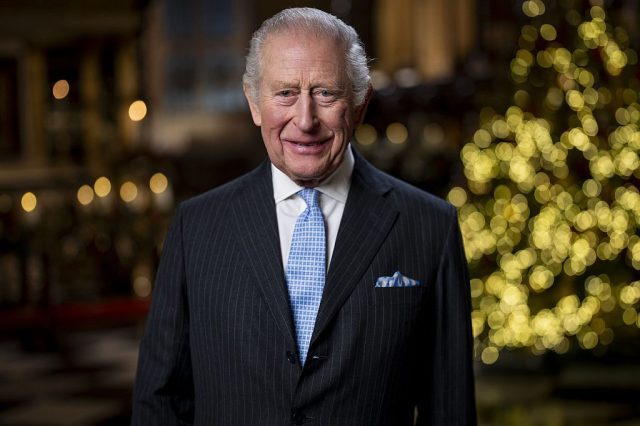
One argument in favor of the monarchy is that it provides a thread of continuity in an otherwise fragmented world. (Credit: Aaron Chown/WPA Pool/Getty)





King Charles is full of surprises. Just when everyone was eagerly expecting his Christmas Day address to deliver a sensationally detailed account of his brother’s trips on Jeffrey Epstein’s Lolita Express, a bemused nation gradually realized that he wasn’t even going to mention it. There was also an inexplicable silence about Prince Harry’s talents as an autobiographer. Or so I’m told. I didn’t actually watch the speech, but one doesn’t have to go to such absurd lengths to have a pretty good idea of what it was about. It would surely have made some mention of the family, since that’s what Christmas is all about, but not of the fact that the so-called Holy Family, a virgin mother and a husband who isn’t the child’s parent, might well be looked on askance in parts of the Home Counties if they moved in next door.
There would have been a word or two about the importance of community spirit, along with the recklessly controversial proposition that peace is to be preferred to war. Those who have behaved heroically in the past year would have been commended as an inspiration to us all. There would also have been praise for people who serve those less fortunate than themselves, punctuated by a few irritable comments about “this stinking autocue”. People enduring hardship would have been exhorted to persevere in their misery. Kindness and tolerance would have been elevated over conflict and brutality. There might even have been a mention of homelessness, though not of its social causes, or of antisemitism, but not of the fact that massacring Palestinians in their thousands doesn’t help in laying this monstrosity to rest.
The trouble with speeches by figureheads is that the moment they say anything definite they’re likely to be divisive. To avoid splitting the nation into warring factions, you have to keep your pronouncements as bland and vacuous as possible. The Pope, for example, has just denounced war, which isn’t likely to send many generals into a blind panic. Perhaps the King would do better simply to sit there nodding and smiling for five minutes, with the odd wave of the hand or twitch of his bat-like ears.
Or perhaps the whole concept of the speech should be overhauled so that it becomes a practical report on the nation. Charles might point out that two or three potholes still need filling in in Lower Staughton Street in Derby, and that St. Swithin’s primary school in Abergavenny could do with a few more slates on its roof. There’s still a petty thief on the loose in Beeston, Nottinghamshire, and a Mr Worthing of East Grinstead admirably resisted the temptation to ride his bike through a red light. All of this would be unbelievably boring. But so is the speech at present. And at least it would be saying something.
Why do we need a monarch? To symbolize the unity of the nation, some would argue. But the nation isn’t united, and nor should it be. People who are being ripped off and exploited shouldn’t reconcile themselves with their exploiters simply in the name of their shared nationhood. Teachers and pupils in schools which can’t afford to mend the roof shouldn’t feel solidarity with managers thinking of selling one of their several sports fields to a property developer. The idea of national unity is far too convenient for the minuscule elite who actually rule the country. If the King symbolizes the unity of the nation, then it is a bogus one. Most appeals to unity are attempts to displace attention from divisions rather than tackle them. The royals are a family, so the argument goes, and so is the nation. As a conscientious father, the King loves all his children equally, and is prepared to make a handsome profit out of any of them at all.
Nations are abstract phenomena, in the sense that nobody has ever clapped eyes on one or taken one for a walk, so it’s arguable that they need some tangible incarnation to persuade people that they exist. (Jesus Christ is supposed to have served this role for God.) And this is what the monarch provides. But so did Hitler. Countries can get along perfectly well without seeing a particular individual as incarnating their very essence. Nobody asks this of the banks or the railways. We continue to shop at Tesco even though there is no Mr Tesco to make us feel that buying a bunch of bananas is more than just a sordidly commercial affair. Tesco don’t fall apart because they have no figurehead to signify their unity. Besides, if there were a King Tesco it would have to be an individual, and the problem with that, as the royal family abundantly shows, is that the defects of the individual are always at risk of undermining the symbolic role he or she performs. King Tesco might turn out to hobnob with pedophiles or sell the possibility of an interview with his partner to a fake journalist for an eye-watering amount of cash.
The best way to avoid this problem is to select individuals for this role who are as boring and low-profile as possible. Kate Middleton fits this bill, as a demure, excessively well-behaved daughter of the Home Counties without an unconventional view in her head, as does her colorless spouse. Downplaying yourself has the advantage of turning yourself into a blank screen on which other people can project their fantasies; but if you press this blankness too far you end up with the likes of the former Prince Andrew, one of whose more minor defects is to look like everyone’s bank manager. The late Queen maintained a reasonable balance between individual personality and symbolic role by intimating that she had quite a bit of the former but was muting it in the name of the latter. She did this, of course, as a form of service to the nation, which these days is the chief rationale for royalty as a whole. It’s a scandalous piece of hypocrisy. As that other scion David Dimbleby lately revealed in his TV series, the Crown pumps an enormous amount of money out of the country, not least in the Duchies, only to present this rip-off as a selfless service. Cutting the odd ribbon is what it gives in return for this barefaced plunder. The King’s swollen retinue of cooks, valets, shirt-buttoners, trouser-zippers, senior sock adjusters, assistant armpit fresheners and so on is all in the service of the common people.
But the royals were always likely to run into headlong collisions with the modern age. One can see this conflict as a shift between two different meanings of the word “cool”. Before Princess Diana arrived on the scene, “cool” in royal circles meant emotionally restrained, as with the kind of public-school off-handedness which remains just an inch or two short of outright insolence. From Diana onwards, however, “cool” came to mean what Robbie Williams would mean by it. Charles is cool in the old-fashioned sense, whereas Harry is cool in the postmodern sense. That culture had begun to penetrate the inner sanctum of traditionalist Britain, and the path was prepared by the likes of Sarah Ferguson, who as a personality has about as much in common with the late Queen as Danny Dyer has with Jeremy Irons. The monarchy needed urgently to modernize, yet modernizing would nearly prove its downfall. All families, however sealed to outsiders, have a chink in their armor known as marriage, through which all sorts of potentially deadly viruses can enter. Had the royals but known it, a particularly lethal strain of infection was on its way across the Atlantic in the form of Meghan Markle.
Or, to put it another way, sham show business is now up against the formidable resources of the real thing. Real jewels contend with fake ones designed for the big screen. One kind of glamor and mystique is in the process of ousting another. It’s a battle between the values of Holyrood and those of Hollywood, and the latter has a lot more wealth, power and influence than the former. There’s more than the royal family at stake in this confrontation. Britain survived the loss of its Empire with its traditionalist values still pretty much intact. If it had lost Cecil Rhodes, it could still boast of Richard Dimbleby, father of David and suave, unctuous, eminently reasonable voice of the nation.
As for the younger Dimbleby, he’s surely living proof that nepotism isn’t always a form of corruption. No doubt his surname helped him into the BBC, but once established he proved himself at least the equal of his father. Now, though, even settled traditions like the Dimbleby dynasty are under threat from the eternal Now of a consumerist culture — with a series of recent assaults on the BBC just one sign of this onslaught. If it weren’t for his ample girth, Dimbleby would be turning over in his commentator’s box.
There are global forces at work behind this conflict. In a roundabout sense, the Harry and Meghan spectacle is a consequence of Margaret Thatcher. Her reign marked the beginning of the demise of traditional, one-nation Toryism in the face of a deep-rooted capitalist crisis. Yet it’s on this paternalist ideology that the monarchy depends. Throughout Europe, the kind of solid, long-established, cultivated bourgeoisie that Thomas Mann or Marcel Proust would have recognized and applauded has given way to an army of sharks, grifters, financial thugs and high-class swindlers. In royal circles, greed is no longer simply a matter of quietly siphoning off common resources by long-approved procedures but of selling yourself to media corporations. Nothing could symbolize this whole dismal situation more aptly than electing a New York real estate mogul to the most powerful position in the world. There was a time when the political class kept a certain discreet distance from the big capital in the name of which, by and large, it governs. That age is about as unlikely to return as King Arthur.
The split between traditional paternalism and capitalist acquisition runs right down the personality of Prince Harry. A man who remains the very epitome of the service ethic — loyal, honorable, full of military ardor and a passion for the so-called underprivileged — is also the helpless captive of Hollywood. If he’s an enemy of the media, he’s also an exploiter of it. His only alternative to the hidebound conservatism of the Palace is the commodity culture of postmodernity. There’s no middle ground between the stuffed shirts and the stars. Those who, like Jacob Rees-Mogg, are both city financiers and country squires don’t realize that in the long run the former role is scuppering the latter one.
One argument in favor of the monarchy is that it provides a thread of continuity in an otherwise fragmented world. Yet the very concept of continuity has been under fire for several decades now, in contrast to the notion of self-fashioning. Rather than drawing your identity from the past, you make yourself up as you go along. The idea of having only one self is as absurd as having only one handbag. Contemporary culture claims this is just the way identity is. It isn’t going to fall apart because we abolish the monarchy or the House of Lords. It’s in pieces already, and that’s simply how it works. The past is just a great storehouse of styles and images which we can draw on when we need to, but which provides us with no kind of moral guidance. This is a scandalous matter for the political Left, which as Leon Trotsky remarked has always lived in tradition. It’s simply that our traditions are those of the Jacobins, Chartists, Suffragettes and hunger marchers, rather than the Charge of the Light Brigade and the Changing of the Guard.