




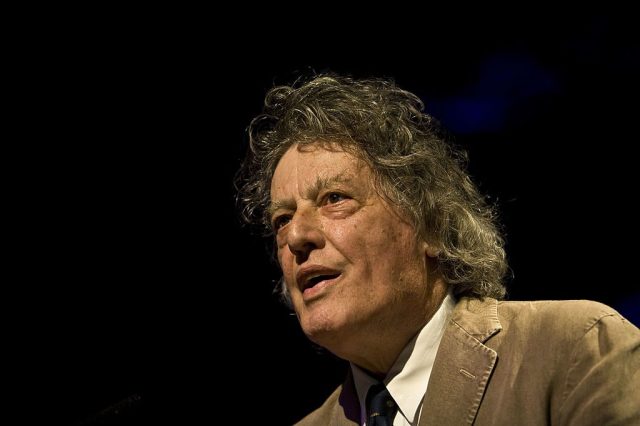
'What worries me is not the bourgeois exception but the totalitarian norm.' David Levenson via Getty.





Why didn’t Tom Stoppard win the Nobel prize? Every autumn, when conversation turned to the question, he was my go-to pick. An unanswerable nomination. Each year, of course, with ritualistic inevitability the Swedish Academy would identify another post-colonial blank-verse poet or Icelandic memoirist never before translated beyond his own village dialect and thrust the prize toward them instead.
Stoppard, though, was multiply disqualified from the Nobel. First, there were the scores of plays, film treatments and bon mots, all too obviously designed for the enjoyment of others. Popular without being populist, Stoppard’s career consisted in exercising an astonishing capacity for giving pleasure to millions of people. His plays were precision-made exhibitions of his own striking capacity for a kind of high-intellectual screwball: hard to devise, but not hard — not really, despite what people say — to appreciate.
That that is not a glib trick, but an unusual gift, is suggested by how few writers show much inclination to follow his literary or commercial example. Part of Stoppard’s trademark effect was to flatter his audience in the presumption that they were in on the joke, however esoteric. That alone — Stoppard’s talent to amuse — would have registered as a big no-no to the Swedish Academy.
It can’t have helped, either, when it came to judging his literary accomplishment, that Stoppard was so obviously at ease with his own talent and success, seeming to find it neither a burden nor a distraction. He was a global star, would commute if need be by Concorde, and each summer hosted legendary fête champêtres to which he would invite Harrison Ford, Alfred Brendel, Mick Jagger, the Duchess of Devonshire, and no more than 500 or so other close friends. “There is a god,” Stoppard once reflected, “and he looks after English playwrights.”
Perhaps the Swedish Academy, party to a widespread but pretentious prejudice, felt that true artists are not supposed to be so glamorous and palpably well-adjusted, nor so candidly attuned to the possibility of commercial reward. When asked by the press to explain what Rosencrantz and Guildenstern are Dead, his first major theatrical hit, was “about”, Stoppard is said to have replied: “It’s about to make me very rich.” At the height of his fame he became the well-rewarded script “doctor” of Hollywood producers — not just for Shakespeare in Love, for which he asked, and received, a $1 million repair-job fee — but also blockbusters such as Indiana Jones and the Last Crusade.
That the last in that franchise is arguably the best is in no small part due to Stoppard’s expert doctoring. Not every job had so much room for remedy. While he was working on Star Wars: Revenge of the Sith, he was less a script doctor than a battlefield surgeon. But even here, his trademark humor remained. Teased about whether Shakespeare would have written screenplays, Stoppard replied unembarrassedly. “No, he’d have rewritten them.”
And then, to pile discredit upon discredit in the eyes of the Swedes, there was Stoppard’s first career as a journalist, and worse still the damaging fact that he seems to have enjoyed it. According to an early interview, young Stoppard conceived of himself, in the late Sixties, as having “no higher ambition than to make a gaudy mark in Fleet Street”. Reporting on a regional paper, he felt delighted by the decidedly parochial glamour of “flashing his press card at flower shows”.
He was, briefly, the only motoring correspondent in the land unable to drive (“I used to review the upholstery”). And even then, too, there were early symptoms of the incipient dilettantish condition that critics would later claim to detect in his plays. Applying for a job at the Evening Standard, Stoppard found himself put on the spot by then-editor Charles Wintour who, perhaps doubtful of the true extent of Stoppard’s declared interest in current affairs, asked him to name the sitting Home Secretary. “Look,” came the prototypically Stoppardian parry, “I said I was interested in politics, not obsessed by them.”
Yet for the Swedish Academy, there remains something worse, much worse, than all these faults — the easy fame, the non-neuroticism, the indiscriminately wielded and brilliant talent. That was Stoppard’s resolutely anti-political aesthetic self-conception. Art, according to him, was not politics by another means. In contemporary theater, it is difficult to think of another writer who proved so clearly their ability to take art seriously without moralizing on its importance.
The ability to articulate a robust aesthetic theory is not a precondition of artistic virtue. But Stoppard’s was remarkably accurate in broad outline, and one he established early in his career. He was suspicious of the facile subjectivism about values that had been popularized in Britain by A.J. Ayer’s account of logical positivism, and which Stoppard ridiculed in his play Jumpers. In later life, he explicitly identified himself as a value “realist” in the philosopher’s sense of the term. He loathed communism, not least for its gratuitous imposition of extraneous social objectives onto the autonomous domain of intellectual creativity, and was repulsed by the homegrown anti-Western demonstrations of 1968. By the Eighties, Stoppard had committed the ultimate act of bien pensant sacrilege: he had expressed a sneaking admiration for Margaret Thatcher.
Stoppard was essentially a bourgeois artist, proudly owning the implications of the label, progressive literary cliches be damned. His discomfort with smuggling social commentary as literary creativity was an intrinsic, rather than incidental, feature of his outlook. Stoppard’s signature love of verbal play and “brittle” dialogue — his effort to make already erudite characters speak a notch or two more quickly and intelligently than anyone would in real life — was a natural development of his dislike of “the political”. At the same time, his rejection of naturalism was controlled enough to prevent his work degenerating into what he referred to, with apparently equal disdain, as “that child’s garden of easy victories known as the avant-garde”.
In a remarkable New Yorker profile of Stoppard, written by Kenneth Tynan in 1977, the playwright’s self-image as defiantly antithetical to political art seems to continually prickle his interviewer. It is “deeply embarrassing”, Stoppard insists, when a piece of work fallaciously assumes that it must be important simply because it gestures at some urgent social or political issue. “I used to feel out on a limb,” he adds of the heyday of kitchen-sink realism, “because when I started to write you were a shit if you weren’t writing about Vietnam or housing. Now I have no compunction about that.” “[My plays] must be entirely untouched by any suspicion of usefulness,” he adds with Wildean flair. “I should have the courage of my lack of convictions.”
By contrast with Wilde, too often seduced by the allure of paradox to articulate his background ethic in a clear way, Stoppard could easily switch into admirable frankness: in the end, he announced, he stood for “Western liberal democracy, favoring an intellectual elite and a progressive middle class and based on a moral order derived from Christian absolutes”. Many literary elites have attempted, both in Stoppard’s day and sense, to tell themselves a more extravagant story; Stoppard may have had too much intelligence, and easy access to his own mind, to sustain that kind of self-deception. “It’s a sheer perversion of speech,” he insisted, “to describe the society I live in as one that inflicts violence on the underprivileged. What worries me is not the bourgeois exception but the totalitarian norm.”
Already pronounced in Stoppard’s day, the collective cultural obsession of filtering aesthetic appreciation through a narrow range of social and psychological preoccupations has become one of the basic tenets of progressive art. It is tempting to think that many of these assumptions are now so widespread as to be scarcely noticeable, all while silently guiding judgments of comparative prestige, worthy subject-matter and literary seriousness. Stoppard’s shimmering, abstract verbal play could be all too easy to dismiss as symptomatic of a limitation, somehow meretricious or shallowly cerebral: making his plays, as one reviewer put it, into wonderful “Fabergé Easter eggs”. Though never Nobel-prized, the degree to which Stoppard was generally prized by the public suggests they didn’t poo-poo that dazzling gift.
