




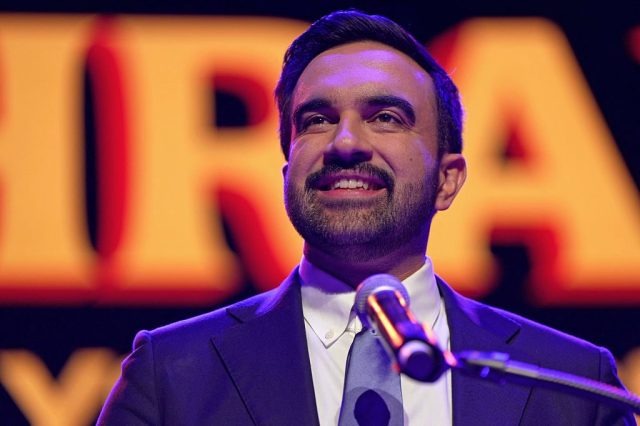
'New Yorkers don’t know what’s coming their way.' (Angelina Katsanis/AFP/Getty)





It is New Year’s Eve, and the SS Poseidon glides from New York to Athens on its final voyage. Rich Manhattanites clink glasses and blow paper horns. All is hunky dory. Unfortunately for the aging liner — and its bowtied passengers — it is shortly to be capsized by a midnight tsunami. We watch as a succession of ensemble characters are picked off by flooding, explosions and theatrical heart attacks until a small band of survivors is finally rescued.
A festive hit in 1972, The Poseidon Adventure was among a clutch of disaster movies that thrilled and chilled Seventies audiences. The optimism of the Sixties had dissipated; Vietnam was going down the toilet; New York was broke, with random crime and visible decline terrorizing the residents of Fear City and their horrified compatriots. Airport in 1970, Earthquake and The Towering Inferno in 1974: all mirrored the secret fears of moviegoers whose faith in authority had waned, who braced for catastrophe in a world gone dark with only their pluck to buoy them.
Two decades later, at the end of history, CGI inflamed the disaster-movie genre: Independence Day (1996), Armageddon (1998) and Deep Impact (1998) offered sweeping apocalyptic visuals — crumbling landmarks, waves dwarfing Midtown skyscrapers, cows mooing in the carousel of a hurricane. These were fantasies of Western annihilation, fantasies which peered into the White House situation room and caught the bead of sweat on the president’s forehead. At a time of relative prosperity and security — and before 9/11 — the focus was on the spectacle of destruction, how far directors could push newly available special effects. The usual bungling authorities still made an appearance: stock hawkish commanders, dumbfounded local cops — but unlike in many Seventies equivalents the threat was external, rather than a crumbling moral core.
These days the disaster blockbuster has fallen out of fashion. Covid killed the zombie apocalypse by bringing the weary realities of contagion to our doorsteps; climate anxiety shattered the comet careening through space with its promise of slow and sweaty demise. But visions of urban destruction have not disappeared; they’ve simply migrated to the news. The 2020s, so far the decade of disease, decline and demographic transformation, have taught us that the most psychically terrible threat is no longer immediate apocalypse — it’s the insidious, years-long erosion of protections and values taken for granted, whose loss is written on the sidewalks of London, and written on the wall for a New York City preparing to welcome an untested Millennial mayor.
In the real world, social contracts are not blown up but forgotten in the back of some dusty drawer. Personal safety is not, for the most part, violated by a lone attacker — it disappears when we acclimatize to the petty transgressions of normal people, those who press their bodies against us to shuffle in on our subway fares, who strut out of Tesco with bottles clinking in their pockets, who hock spit at minor officials when their toddler antics are reprimanded. Disaster happens, yes, when planes crash; but it also happens when they don’t — when dismal passengers rub their bare feet, puff clouds of sickly vape smoke into the cabin, rage at the stewardesses for no reason at all. Politeness, consideration, conformity: these are the casualties of a real-life disaster movie, a world forever changed by a lost expectation of a sensible and cohesive public. Citywide breakdowns recall riots, looting, mass catastrophe — but social orders can buckle under the weight of less spectacular tragedies, and barrier-bumpers, gum-spitters and participants in the pavement pissoir are all doing their bit to lower trust and heighten quotidian horror.
New York landmarks have been nuked, flooded and blown up countless times on screen. Lady Liberty has been decapitated (Cloverfield), buried in sand (Planet of the Apes) and entombed in ice (The Day After Tomorrow). She embodies a shining city, a way of life worth saving — but today that image reads differently, a dismal cliché, probably because the gleaming metropolis she represents has given way to a grimier reality. In the disaster movie, New York and London are depicted quaintly, sentimentally, flattened into tableaux of cheerful hot-dog vendors and chintzy tearooms, overcoats on Madison Avenue and urchins in the East End. The fantasy of the disaster movie is that, apart from the approaching asteroid or the mile-high tidal wave, nothing of note has ever changed in the endangered city. The person-sized disasters of managerial neglect, low-level lawlessness and economic hardship don’t exist.
Yet in 2026, disaster looks different. As New York prepares to inaugurate a 34-year-old, untested and catastrophically naive mayor on New Year’s Day, its merrymaking residents, much like the Champagne-popping revelers of the fictional Poseidon, don’t know what’s coming their way. Melodramatic, you might say — but consider how fragile is the order of the day-to-day. Even without a total naif in Gracie Mansion, life here rests on a knife edge: street-corner encounters turn violent without provocation, sly parcel-swipers continually invade hallways, and looking askance at the wrong commuter can earn you a slashed cheek or lit match. Mamdani has threatened to make the city’s buses, already mobile circus wagons full of antisocial sideshows, free — they could well go the way of the Central Park pool this summer, which became de facto baths for the “unhoused” and handy toilets for the disturbed. Men who pay for sex, ravaging the city’s desperates and driving women and girls into the hands of pimps, may no longer even be rapped on the knuckles: decriminalized “sex work” and scot-free soliciting could rob prostitutes of already scant protections under the guise of well-meaning toleration and sex positivity. And those beaten by partners might, if Mayor Mamdani’s campaign pitch comes off, be referred to swamped and bureaucratic social workers instead of police officers — shoved through a consequence-lite muddle of paperwork instead of their abusive partners being shoved into a cell.
These are the real disasters headed for the American city: a peek across the Atlantic is all New Yorkers need to envision the immediate possibilities of progressive mismanagement. Sadiq Khan’s London, a city swamped in antisocial miasma, shows us what happens when incompetent policing collides with vanishing public values, when going easy on the violent and depraved becomes cruelty to the innocent. Sexual offenses on the Tube up 10% in a year; violent crime up 40% in a decade; security tags on bottles of Persil. Of course, New York has its own charms — subway cars becoming sleeper trains for fent addicts with hands down their pants; guns. With Mamdani installed, the complaints of the law-abider look soon, as in London, to be drowned out by the appeals of our betters to see bad behavior as evidence of victimhood. As Fraser Nelson has pointed out, Khan has overseen a TfL whose staff are told not to intervene when riders vault or shove through barriers, creating a stark division — also visible in New York — between those who gleefully bump and those who sourly tap their way in. The Met have a similar institutional limpness when it comes to shoplifting; as Nelson puts it: “You can walk into a shop, steal anything you like, walk away — and the chances are you won’t be caught.”
Why do we love disaster movies? The blockbusters of the Nineties impart a strange comfort: they impress on us the value of what is under attack, how lucky we are to live unmolested by comets and quakes, how charming and functional regular life is. But how true is that today, when urban life is the way it is? While violent crime in New York is down since the Nineties, petty offenses — just like in London — have jumped since Covid owing to lax enforcement, creating the perception of depressing lawlessness. Maybe that’s why the big-budget disaster film has fallen out of fashion; the city no longer feels like the symbol of national or Western order, and the stakes of mass destruction seem lower when the target is itself a crucible of chaos. It is telling that the only recent cinematic success in this genre, Twisters (2024), jeopardized not a noble metropolis but a ramshackle rodeo town and the main character’s humble homestead. Today the atmosphere of the city more closely recalls the Seventies, when moral decline and distrust in authorities created the first true classics of the disaster genre. If the on-screen apocalypse has a third wind, it will be in this mold. As for reality, will 2026 be a disaster? Very possibly; the real question is whether those in London or New York, so accustomed to demoralizing, ubiquitous delinquency, will even notice.
