




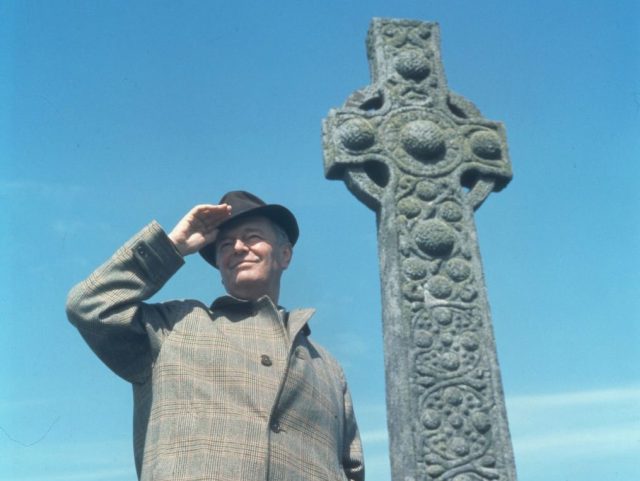
He knows it when he sees it. Don Smith/Radio Times via Getty.





It takes a special kind of genius to confuse the art historian Kenneth Clark with Kenneth Clarke, the jazz-loving, Hush Puppy-shuffling, Scotch-swilling former Tory Chancellor. Perhaps the Guardian reviewer of the latest spin-off of Clark’s great televisual catechism, Civilisation, had pulled up the wrong entry in the ODNB when she dryly informed her readers that the original 1969 series had been fronted by “a Tory politician in trilby and tie”. But the amusing solecism also inadvertently revealed something about Clark’s reputational arc. She isn’t alone in mistaking the lifelong Labour voter, Harold Wilson’s very own 1969 arts peer, for a Tory. Across the pond, for instance, one hack has described him as “an impeccably credentialed conservative”, no less.
Certainly, Clark cultivated the air of a man whose worst nightmare would be the loss of a good umbrella. He looked, sounded, dressed and carried himself like a plum-voweled Tory grandee. Vibe apart, however, he was a socialist, if one allows a very English, decidedly unstrident, institution-loving, patrician declension of socialism.
Born into a textile fortune in Grosvenor Square, Clark grew up in ginormous piles in Suffolk and Argyll that made Brideshead look cozy. It was an Edwardian upbringing that he later described as “vulgar, disgraceful, overfed, godless”. Winchester, then, came as a culture shock. There, at school, he acquired the habits of mind — a certain social conscience; commitment to public service — that his biographer James Stourton described as a kind of Wykehamical socialism, by turns patrician and progressive, of which Rishi Sunak is, after a fashion, a product. The school produced generations of civil servants, diplomats and a surprising number of Lefty intellectuals — Clark mingled with such socialist grandees as Hugh Gaitskell and Richard Crossman. “Winchester may not have had the Whig insouciance and Athenian elegance of Eton,” Stourton wrote, “but it had a high seriousness of purpose and an intellectual distinction that has produced generations of ambassadors, permanent secretaries, heads of Oxbridge colleges, and field marshals.”
Oxford added a second education, further nudging Clark towards the Left. An outsized influence was the classics don Maurice Bowra. Outrageous, erudite, and forever teasing the priggishness out of Clark with the delicacy of a surgeon removing shrapnel, he saw himself as the chief of the set he variously called the Immoral Front, Homintern, and the 69th International. Bowra widened Clark’s literary diet — Yeats, Rilke, Turgenev — and cemented his socialism. In later years, they would spend Christmases together. Clark never abandoned his self-styled Bowrista politics. It was a blend of the socialism of Clark’s older lodestars, William Morris and John Ruskin, both patron saints of his adolescence who dissolved his aristocratic complacency, as well as that of the Christian socialist R. H. Tawney, a name to reckon with in working-class reading groups of the Twenties. As a boy, Clark had regarded the local working men’s club as “a different species… as figures of fun” but Ruskin persuaded him by his late teens that beauty belonged to everyone. Art, he decided, was not a private indulgence but a universal right. This was the conviction he took into adulthood.
Already in his early twenties, Clark had traded the effortless connoisseurship of his class for something more serious. Under Charles Bell, keeper of fine art at the Ashmolean, and the incomparable art historian Bernard Berenson at his Florentine palazzo I Tatti, Clark shed the skin of a gifted amateur and emerged as a scholar. Promotion followed at an indecent pace: Bell’s job at 28, Director of the National Gallery at 31, Surveyor of the King’s Pictures shortly thereafter.
Life at the National plunged him into the social kaleidoscope of interwar London. There were weekends at Port Lympne with Philip Sassoon, whose Cape Colonial fantasia of a country house was the playground of what Clark called the “unorthodox Tory fringe”. It was here, amid Sassoon’s murals and monocles, that Clark acquired his reputation as the token Red in Tory circles and the token tweedy baron in progressive milieus.
War supplied him with a mission. At the Ministry of Information’s Film Division, Clark revealed a surprisingly deft hand for propaganda. Those years also exposed the marrow-deep socialism he rarely owned up to in company. “Every day makes me a more committed socialist”, he wrote to his mother, railing against “the present system, where private profit is the controlling factor”, before remembering that courtesy calls do not ordinarily fan out into plodding treatises: “however I mustn’t turn this letter into a Ruskinian tract.”
Yet a touch of Ruskin was unmistakable during his decade at the National, and even more during the war. It was Clark who orchestrated the evacuation of the entire national collection, hiding it in the slate caverns of Manod in North Wales like some modern monk protecting manuscripts from marauders. As the Luftwaffe reduced London to rubble, he transformed the emptied Gallery into a sanctuary of music with lunchtime concerts and then, with inspired theatricality, brought back one masterpiece each month — one work to remind a battered people that civilization was still flickering.
More radical still was what happened outside London. Clark sent touring exhibitions of masterpieces into the provinces, ensuring that miners in South Wales and factory workers in the Midlands could stand, unmediated, before a Rubens or a Rembrandt. It was redistribution, in a way — of beauty rather than wealth.
Meanwhile, his wife Jane set about decorating the so-called British Restaurants, those wartime communal kitchens, with murals by Duncan Grant and Vanessa Bell. Clark himself lent pictures from his own walls, ladling out high culture with cauliflower and carrots; East Ham alone received 22. His collectivist instinct even seeped into his sexual affairs. Collecting relationships as others did prints, he tangled himself in what Stourton coyly calls “a series of amitiés amoureuses”. Yet through all the flutter, Jane remained the center of his emotional orbit. He was, improbably, an uxorious philanderer.
After the war, he brooded incessantly on Britain’s future: how art and architecture might improve ordinary lives, how the state might support culture without turning it into a bureaucratic terrarium. Attlee’s victory thrilled him, even as he continued to cherish his Tory acquaintances. This delicate straddling of camps confused his contemporaries but is clearer in retrospect. Clark was an elitist who believed art should belong to the many. He never liked Marxism, distrusting historical materialism, but he admired the Marxist art historian Frederick Antal’s learning and found Marxist social history invigorating in small doses. His own view of art history was stubbornly individualist. “My approach to history,” he explained, “was unconsciously different from that now in favor in universities, which sees all historical change as the result of economic and communal processes. I believe in the importance of individuals, and am a natural hero-worshipper.”
At the same time, Clark believed, with an almost touching sincerity, that it was the state’s duty to safeguard the basic conditions necessary for human flourishing. This was not the language of the class warrior but the civil servant prescribing the correct temperature for afternoon tea. His faith in institutions — galleries, universities, libraries, the Beeb — bordered on the devotional. It was in this spirit that Clark, as chair of the Arts Council in the Fifties, inherited the cultural flank of the Attleeian welfare state. Before the war, England had no state opera, no subsidized orchestras, and no government spending on living artists. The cumbersomely titled Council for the Encouragement of Music and the Arts, later the Arts Council, changed all that. “The best for the most,” declared the Observer drama critic Ivor Brown when he joined CEMA, and Clark made it his credo. For him, the arts were not a luxury but a necessity, fully on a par with health and education in their claim on the public purse.
It was Civilisation, however, that distilled Clark’s singular worldview into a single decanter. It was a charmingly improbable premise: 13 prime-time episodes, funded by the license fee, in which a life peer guided viewers through Aquinas, Caravaggio, and the fall of Rome in chiseled sentences that never once insulted their intelligence. The Left accused him of Edwardian pieties; the Right embraced him as their mandarin mascot. Clark, delighted, insisted he had only intended to offer “no more than a sequence of pretty pictures in color”. David Attenborough thought the secret lay in Clark’s manner: “absolute mandarin prose” punctuated by colloquial jolts that revealed he actually knew how ordinary people thought. “People don’t necessarily dislike toffs,” Attenborough observed. “Toffs who speak directly are quite appealing.”
And Clark did speak directly. The miracle of Civilisation was not its grandeur but its assumption that the proles had brains. He presumed the nation could cope with Chartres, Gothic proportion, and the darker recesses of the Dark Ages. Beneath the feline elegance, the whole series was a collectivist sermon: that civilization is sustained by shared memory and shared institutions; that beauty is a public good; that culture is “our inheritance”. One could almost hear Tawney nodding with approval. One could not, however, prefigure Thatcher.
His professional colleagues were uncharitable. A few sneered reflexively at the art historian who elected to live in a castle and liked slumming it on the telly, wafting above their seminars like a benevolent archangel. Clark reciprocated in kind, likening their “scholarly minutiae to knitting”. Later, more assured as a master practitioner of the Reithian tradition of haute vulgarization, he offered a more measured response: “academics were furious at the simplification of their labors.”
Yet the public adored him at the time, even if his star has since faded. He became the national shorthand for art history, as if some kind of ambulant National Gallery. And this, as he knew, he owed to Ruskin, who taught him, above all, the heresy that beauty is everyone’s birth right. Clark carried this Victorian gospel into the 20th century in lapidary prose. But he was, in short, a product of Edwardian England: his socialism was Anglican and ethical, smelling faintly of pipe smoke and polished pews. Small wonder that when asked to tell the story civilization, he politely ended his tale in 1914, as if the guns of August had closed the cultural ledger.
But for all his paradoxes — the socialist in the castle; the elitist championing access; the bureaucrat preaching beauty — Clark believed one thing with utter conviction: civilization does not maintain itself. It requires guardianship. It requires money. It requires institutions. And it requires the shared belief that the best of human achievement belongs to everyone, not merely to the connoisseurs. In an age of conservative philistinism and progressive iconoclasm, that belief seems less reactionary than revolutionary.
Pratinav Anil is the author of two bleak assessments of 20th-century Indian history. He teaches at St Edmund Hall, Oxford.
 pratinavanil