




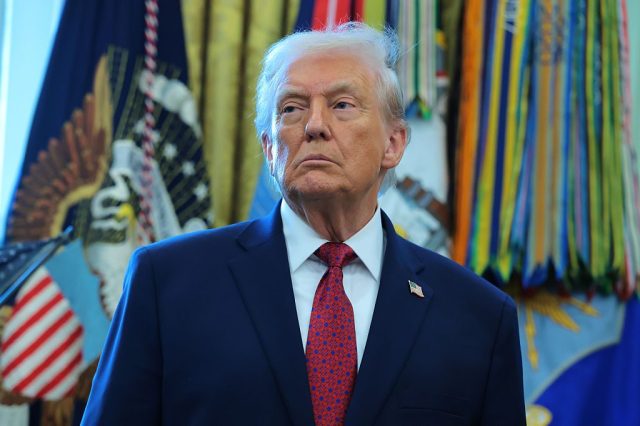
This is a personalist regime motivated by private advantage. Anna Moneymaker/Getty Images





The official “National Security Strategy” of the United States is released with some regularity, though generally such statements don’t matter much. They tend to be imbued with familiar, general foreign policy touchstones, which specialists sift through dutifully, hoping to glean insights into the priorities of a new administration. But on some occasions they do matter, and at those moments, the news is rarely good.
The 2002 National Security Strategy was one such moment. Clocking in at more than 12,000 words, only 12 of them really counted, as they articulated a dramatic new doctrine of preventive war. Preventive war is often casually conflated with preemption — striking first at an adversary that is about to attack — but it is something very different, and, as American practice, was radical and unprecedented: “America will act against such emerging threats before they are fully formed.” The 2002 strategy was written as window dressing for the soon-to-be-unleashed Iraq War — and it was an invitation to disaster. As I wrote at the time, the so-called Bush Doctrine “will backfire” and “transform world politics in a way that diminishes U.S. power and influence”.
The 2025 US National Security Strategy is another exception to the rule of the disposable démarche. Aside from a shared, counterproductive longing for intimate relationships with Persian Gulf oil sheiks, the two documents reflect markedly disparate dispositions. Yet the 2025 strategy will prove similarly consequential — and once again, it is a harbinger of ruin. The new missive accurately describes the United States as it now appears on the world stage: nakedly extractive, dismissive of friends, appeasing of adversaries, cozy with autocrats, profit seeking (with the ruling clan in on the action), and animated by a rancid, eugenicist-inflected, white-nationalist crusade.
As an articulation of strategy, however, it is less than coherent. The logic behind its fixation on two regions in particular, the Middle East and the Western Hemisphere, is opaque at best, and the document more generally is often inconsistent, commonly expressing contradictory notions within the same paragraph. It is, above all else, preening — a boatload of boasting buttressed by vague platitudes — although the emphasis on unchecked American unilateralism is a sustained theme.
Lurking behind all the bravado is something more disturbing. This administration’s release is reminiscent of another missive that came wrapped in an American flag: Sly and the Family Stone’s cry-for-help of an album There’s A Riot Goin’ On (1971), which was well described by one critic as “numbing” and “darkly self-referential” and by another as “an album made by a disillusioned, drug-addicted multimillionaire rock star going slowly mad in a mansion”. Unlike Riot, however, the 2025 National Security Strategy is so simplistic and puerile it is hard not to laugh at it — until you realize that it must be taken both literally and seriously.
As if written by a narcissist untutored in the most basic understanding of international relations, the document reveals a naive unawareness that international relations are recursive — actions lead to reactions, and thus understanding and anticipating those responses should inform strategy. Yet it begins with a dozen paragraphs that start with the phrase “we want” — sounding, fittingly, like a spoiled child pounding its highchair. These wants are expressed primarily via vacuous trash talk, which for the most part doesn’t much engage with actual foreign policy. There is a notable exception, the spit-take inducing “We want to maintain the United States’ unrivaled ‘soft power’ through which we exercise positive influence throughout the world that furthers our interests”, which is a more-than-curious aspiration for an administration that has seemed determined to insult and alienate its traditional allies and friends, starting with neighboring Canada, with which, until recently, the US enjoyed the extraordinary luxury of uncommonly close and warm relations.
A second set of petulant “we wants” define the administration’s “core foreign policy interests”, as well such a statement should. However, as noted, the logic behind these key choices is somewhat hard to fathom. The strategy emphasizes, and gives the lion’s share of its attention to, the importance of Latin America. It pronounces a “Trump Corollary” to the Monroe Doctrine, although it is not clear what that actually means as practical policy, beyond the President’s fetish for welding his name onto things — even institutions declared unnecessary, such as, recently, the US Institute of Peace, which his agents had previously raided, gutted and shuttered. But the world will take note of one important, declarative passage: the plan for “a readjustment of our global military presence to address urgent threats in our Hemisphere”. Prioritizing one thing requires reduced emphasis on others.
Indeed, an American retreat to the safe harbors of the Western Hemisphere is clearly afoot. This 19th-century instinct, however, faces a number of 21st-century challenges. Even if the US could somehow command the destiny of Latin America, it is an odd place on the table for a great power to place all of its chips. As the document itself notes, “the Indo-Pacific is already the source of almost half the world’s GDP”. The European Union (about two-thirds the size of the enormous US economy), accounts for another 15%. Whereas South America weighs in with about 4%.
Moreover, and ironically, the administration’s elbow throwing in its asserted backyard is more likely to reduce rather than enhance its political influence even on what it imagines to be its home turf, a region with deeply felt and long-standing sensitivities to US aggrandizement. And to the extent that the “Trump Corollary” is motivated by anxiety about the increasing economic influence of China in the region, it is distinctly ill-suited to push back against that tide. China is an enormously important export market for all the major South American economies — Brazil, Chile and Peru each export more than twice as much to China as they do to the US. Add to this the fact that the Trump Administration sees trade in zero-sum terms (at best), has been busy haphazardly slapping tariffs on countries all over the world, and views imports with a visceral hostility, and it becomes hard to imagine South American states lining up to undermine their trading relationships with the People’s Republic.
The new US doctrine will also have pernicious consequences for the rest of the world, encouraging what can be called “the dictator’s takeaway”. By announcing unquestionable geopolitical primacy over its near abroad and declaring repeatedly that the US will never allow itself to be constrained by international norms, laws and institutions, combined with its recent willingness to use force with impunity (and even criminally) as it sees fit, it invites other powers to do the same. Resetting the standards of what is understood to be legitimate behavior will have widespread consequences — even (or perhaps especially) when undertaken by a great power that sneers at the very notion of legitimacy that is not defined by the barrel of a gun. The lesson is clear, and will not go unnoticed by militarized powers who would seek to dominate their own neighborhoods, and, just as important, by smaller players who might face intimidation. From a US perspective, local spheres of influence are to be expected — and respected.
The thinking behind the administration’s second geopolitical priority, the Middle East, is even harder to grasp at face value, and the National Security Strategy itself struggles to strike a consistent tone in this regard. It touts America’s vast energy production, independence, and even “American energy dominance”, and notes, correctly, that US military commitments to ensure the flow of Persian Gulf oil might have made sense decades ago, but no longer do so today. Surely if there was a place to scale back US commitments in a changing geopolitical environment, this would be it. Yet instead it recites stale platitudes about (unspecified) threats by outsiders to dominate the region, and it is pleased to celebrate “President Trump’s successful revitalization of our alliances in the Gulf”, which involves the handing out of security guarantees like candy to local potentates.
This analytical knot is untied by the humbling realization that US foreign policy cannot currently be understood in terms of a state pursuing the National Interest (as realists like myself tend to imagine), but as a personalist regime motivated by private advantage. This is the most nakedly corrupt Executive Branch in American history, with policies for sale to the highest bidder, motivated to provide enrichment opportunities for the presidential family and its coterie of affiliates. Elites in the Middle East have been swift to both recognize this and provide the necessary largesse. This, along with the influence of powerful domestic constituencies (especially evangelical Christians), also likely explains why the security of Israel is defined as a “core” national security interest of the United States, despite acknowledging, with uncharacteristic understatement, that “the Israeli-Palestinian conflict remains thorny”.
If anything, beyond its two pet projects, the definition of US interests is even more inscrutable. It is one thing to abandon the idea of democracy promotion, an approach that always had its serious and thoughtful detractors, and which was practiced with more than a modicum of hypocrisy, as the US routinely sidled up to some unsavory regimes (at times gratuitously so — here’s looking at you, Dr Kissinger). But it is very much another to renounce the laudable values that the US has always espoused, and instead rearticulate the American disposition as one designed to make the world safe for autocracy.
This well describes the bizarre policy articulated with regard to Russia, which is: settle Putin’s war of aggression on the terms he lays out, and call it peace. Indeed, another “core interest” is defined as “an expeditious cessation of hostilities in Ukraine”, with the goal of reestablishing “strategic stability with Russia” (a phrase used twice in two pages). The eager, unconditional embrace of Russia is another would-be puzzle, but the logic of which falls into place in the context of the President’s unabashed admiration for personalist authoritarians; what falls under the category of legitimate international behavior; and, surely, some salivating at the perceived business opportunities that might lie on the horizon. Not since Neville Chamberlain has a world leader been so eager to “cut a deal” without interest in or regard for the implications and viability of its terms.
And if the rest of Europe is left less secure by a one-sided resolution that rewards Russian aggression, that would not ruffle the new American worldview. The Trump administration postures as one that will not lecture other states about their domestic affairs, which it renounces as “America’s misguided experiment with hectoring these nations—especially the Gulf monarchies—into abandoning their traditions” (like murdering journalists). There is one exception to this new hands-off tolerance, however — Europe. The administration can merrily break bread with the worst of the worst when it comes to human rights abusers, but the “elite driven” policies found in the liberal democracies of Western Europe it simply cannot stomach. And under the banner of “Restoring European Greatness” (nation rebuilding?), the US will do much more than simply hector. Rather, it demands — and its foreign policy will be designed to bring about — basic changes in how European countries choose to govern themselves. In particular, they must bend their regulatory structures to meet America’s needs (or at least the demands of US-based tech behemoths), take immediate and urgent measures to increase their whiteness (“we want Europe to remain European”), and, as JD Vance had previously lectured, to be nicer to the extreme far-Right populists in their midst.
As the US, following its new National Security Strategy, retreats to “its” hemisphere, counts the Middle East as a core interest, is increasingly protectionist and admiring of autocrats, and models the behavior that great powers should be unconstrained in dominating their neighborhoods by any means, the news for America’s traditional friends and allies in Asia cannot be good. They must contemplate the possibility that if a war breaks out, the Americans will not attend. Bullies tend to cower when confronted with an adversary that might be able to punch back.
Ultimately, the 2025 National Security Strategy of the United States reads like a living will. Its beneficiaries are Russia, China, and the Gulf States. As for America’s (former) friends, the message could not be clearer: we no longer stand behind you. We will, however, at times stand in front of you, menacingly, and inquire about your lunch money. Adam Smith quipped “there is a great deal of ruin in a nation”. Years from now, this may be seen as the moment when America finally exhausted its supply.