




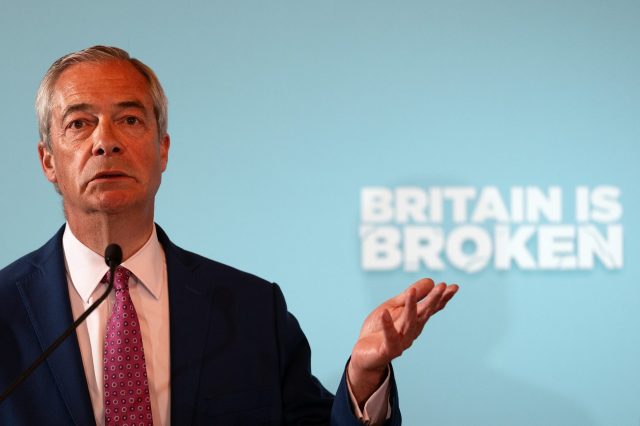
Nigel Farage and Reform UK could win another Pyrrhic victory. Credit: Carl Court / Getty Images





Drowned out by the noise of the Budget last week was the publication of a startling immigration report from the Office for National Statistics (ONS). It will prove to be of far greater political import than anything Rachel Reeves pulled out of her hat. From it, we learned that net migration to the UK (the total number of people arriving, minus the number of people leaving) in the year ending June 2025 was estimated at 204,000 — down from 649,000 in 2024 and 906,000 in 2023. This isn’t a gentle trend: it’s a collapse, a snap return to pre-Brexit levels of migration.
It means we should now be asking the question: what if the UK reaches Net Zero immigration before the next election? This seemingly outlandish suggestion could well dictate the future of British politics. The Boriswave is over; might the political ripples it caused (including the meteoric rise of Reform) now lose their momentum?
The Right-leaning media’s reaction to the ONS report, somewhat ironically since their paramount complaint is that immigration is too high, was to downplay the reduction and instead focus on a new panic about the higher levels of emigration of British nationals. Isn’t it time to cut through the “cope” and examine the facts?
This alleged “exodus” of British nationals certainly merits closer inspection. The Telegraph in their splash, claimed that the ONS data revealed young British workers were fleeing Labour’s high-tax regime. These youngsters, they speculated, have been “flocking to Australia” and to the “Middle East, where remote working is allowed”. For their part, the online Right asserted that the data laid bare the ongoing replacement of highly skilled white British workers with low-skilled foreigners from incompatible, faraway cultures.
Both narratives are precarious, to put it politely. There is no doubt that some skilled professionals are leaving — wealthy lawyers and bankers are constantly tempted by Abu Dhabi; ambitious entrepreneurs will obviously want to take their startup to the US, if it is doing well; and our junior doctors have long been swapping the grinding NHS for a better-paid stint in Australia. The competitiveness of our economy is a serious cause for concern; but these professional emigrants do not amount to hundreds of thousands in a year. Let’s be serious: 18-year-olds from post-industrial British towns aren’t leaving in their droves for Abu Dhabi to become digital nomads.
The ONS emigration statistics are, to be frank, pretty sketchy. Emigration is far harder to measure accurately than immigration — mainly because British passport-holders don’t need a visa to leave. In years gone by, the ONS would have used something called the “International Passenger Survey” to account for those departing the country, but it was notoriously unreliable. So now instead they scan the population for people who have gone dark and ceased to have any contact with the state — if, after a year, there is still no sign of them, the presumption is that they have emigrated. Since this new methodology was introduced in 2021, there actually hasn’t been much fluctuation in numbers: there has been no sudden surge in emigrating Britons. Complicating accurate measurements are the ‘Neets” who have simply disappeared from the states radar. It can be hard to tell the difference between them and those people who have actually left and as a result all sorts of guessed adjustments come into play: some of these presumed emigrants may just be people lost to the system; others will be young people going abroad to study, and who will return.
Most significantly, though, what everyone does seem to have ignored is the fact that many of the emigrating “British Nationals” will be immigrants or children of immigrants who have acquired British citizenship but have decided to return home. We know the main reason emigration numbers are so high in 2025 is that a chunk of the Boriswave migrants are choosing not to stay — 286,000 immigrants from outside Europe permanently left the UK in the past year alone — and, in addition, Europeans who settled in the UK pre-Brexit are still leaving in large numbers. If an immigrant has acquired citizenship and then chooses to go back to their country of origin, they are still counted as one of The Telegraph’s “exodus of young British workers”.
While the ONS does not provide details of what portion of the emigrating Britons are naturalized citizens or children of immigrants, thankfully there is another migration dataset we can look at, compiled every four years at enormous expense by the United Nations. If you look at their 2024 Global Migration Database and compare that census of British migrants around the world with the 2020 figures, you can see more clearly what is happening: 72,000 more British nationals have settled in Poland (an increase of nearly 40%) and 23,000 more British nationals have settled in Romania since 2020. It seems quite reasonable to conclude that these are Polish and Romanian immigrants to the UK who have returned home along with a British passport and in some cases a British family. The next big hotspot for emigrating Britons is… Bangladesh! Nearly 13,000 Brits have moved there in the past four years. Unless young Billy from Kent has decided, along with thousands of his friends, that Bangladesh is the new land of economic opportunity, these emigrants will be naturalized British citizens with Bangladeshi ties. By contrast, only 3,259 more Brits are living in the UAE than four years ago, and the numbers moving to America are up by only 1%.
The reality is: not all immigrants want to stay in Britain forever. Last week’s report from the ONS made that clearer than ever. And this underlying level of emigration will continue to affect net immigration numbers in the coming years right through 2029. It is hard to think of a single metric that could be more important at the next election.
Political pressure will persist, even with net migration at this lower level. Right-wing commentators are correct to observe that 900,000 arrivals in a year, notwithstanding 700,000 departures, is still much too high for most voters to bear. It was partly anxiety about a roughly similar level of immigration that led to the Brexit result in 2016. A figure of 200,000 net still means an additional one million people every five years — and our current mix of immigrants is now dominated by those from outside Europe, whereas pre-Brexit it was mainly Europeans. Asylum seekers are also at an all-time high of over 100,000 (nearly half of whom arrived on small boats) and are still hard to expel once they’re here. Anxieties about assimilation are well-founded. So, for now, there is still plenty for Reform UK to campaign on. But if the downward trend were to continue, things might start to look very different.
Reducing immigration is like fixing a roof with multiple leaks: each entrypoint is a distinct challenge, and the biggest entry-points are the legal ones. It was, after all, Boris Johnson’s relaxing of rules around care home workers and international students bringing over family members that led to the huge rise in numbers in 2022-2024, and credit for addressing this should go, unfashionably enough, to Rishi Sunak. His government’s changes to the rules concerning care workers, in October 2023, and international students, in January 2024, are the single biggest reasons for the end of the Boriswave. Further restrictions introduced in March and April 2024 are now having an effect: the key long-term visa grants in the latest quarter are down more than 50% since Q1 2024. Consider it Sunak’s parting gift to Keir Starmer.
The Labour government has continued the tightening, raising the minimum skills and salary thresholds for skilled worker visas — and this also is having an effect. Home Office data show that applications for skilled-worker and health-and-care visas are down to a new low. In October 2025, there were only 600 health-and-care visa applications, compared with a high of 18,300 in February 2022. In January 2026, there will be a further tightening, paired with a much longer 10-year wait for Indefinite Leave to Remain (ILR), which is expected to further discourage applications.
Data analyst James Bowes, from the University of Warwick, now forecasts that these shifts, combined with the long-tail effects of earlier waves of immigrants now leaving, could push the UK into overall net negative immigration by as early as this time next year. Madeline Sumption, director of the Oxford Migration Observatory, is more skeptical, and tends to think that the net figure is more likely to rise gently as the boomerang from the Boriswave settles down. In any case, if Keir Starmer has any desire for a surprise comeback, he should be obsessed with this goal — and be fully supportive of his Home Secretary, Shabana Mahmood.
Many things could yet derail this trend — chief among them a panic lurch to the Left by Labour after the May elections— but it is clear what the game-changer now looks like. For Nigel Farage and Reform UK there is now the chilling possibility of another Pyrrhic victory — just like the Brexit campaign before it — in which the change to national policy they campaigned for so effectively takes place, and that success removes the principal reason for their existence.
Freddie Sayers is the Editor-in-Chief of UnHerd and CEO of OQS Media. He was previously Editor-in-Chief of YouGov, and founder of PoliticsHome.
 freddiesayers