




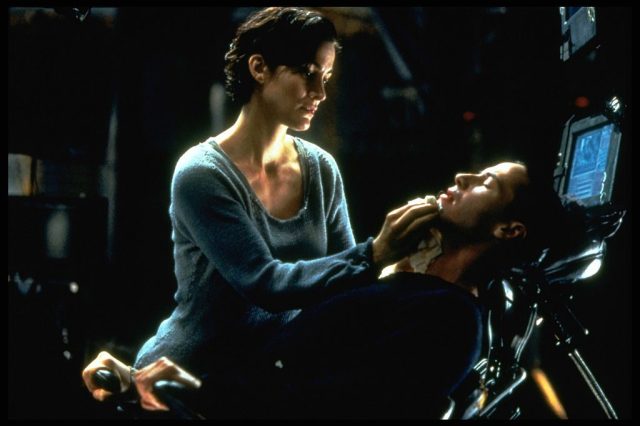
Carrie-Anne Moss and Keanu Reeves in 'The Matrix'. Credit: Getty





A quarter of a century ago, the blockbuster action film The Matrix presented its messiah-like protagonist, Neo (played by Keanu Reeves), with a heady dilemma. Would he rather swallow the red or the blue pill?
This was long before “red-pilled” got co-opted into a crude political metaphor for embracing hard-edged conservatism. The Matrix was never partisan; it was a product of the late Nineties, a time when artists still felt queasy about the idea of society being consumed whole by silicon-flecked capitalism. “Hey man, slow down,” Thom Yorke begged us on OK Computer, the technophobic Radiohead album. The Matrix likewise presented the acceptance or rejection of networked technology as the epiphanal moment of its hero’s journey. The blue pill offered Neo a sedative that would return him to blissful ignorance by wiping his memory and once again tuck him into a comfortable, simulated dream full of endless computer-generated novelty. The red pill offered a disturbing wake-up call to an unsettling reality: humans were literally being harvested as batteries for a machine-ruled world.
In the theater — remember that? — we collectively cheered for Neo to take the red pill. We rooted for the man who would rather shiver in a post-apocalyptic wasteland than live in a high-resolution lie. Yet, in the 25 years since, we have quietly, and almost universally, taken the blue pill daily ourselves, and chosen to live in the illusory comforts of the mediated online world, while the social fabric and material realities decayed around us. Or as author Jenny Odell poignantly asks in her book How to Do Nothing: “what does it mean to construct digital worlds while the actual world is crumbling before our eyes?”
But as 2025 draws to a close, we can see evidence of a rebellion afoot. Not a revolution, mind you, but a series of distinct signs that the internet-first mode of life that defined the 2010s and early 2020s is finally and mercifully on the wane. It’s the year of the Great Unplugging, if not for everyone, then for a growing cohort of red-pilled rebels.
Ironically, it was the reelection of Donald Trump that has the early adopters — the liberals — reaching for the red pills in greater quantities. For nearly two decades, anti-tech sentiment was most evident on the Right. Conservatives long bemoaned the influence of the media, Hollywood, and academia; and the platforms of Silicon Valley were the staging ground for their constant losses in the culture wars. During the first Trump administration, the content moderator was perceived as a defender of woke capitalism by the Right, but a hero of democracy on the Left. “The power of Big Tech is something that William Randolph Hearst at the height of yellow journalism could not have imagined,” said Ted Cruz back in 2018.
Meanwhile, the relationship between the Democratic establishment and Silicon Valley, especially during the Obama years, was a cozy, mutual-admiration society. The Dems embraced tech in every classroom, while Big Data’s Big Money fueled the campaign machines of neoliberal Dems. The firms themselves gatekept information in their favor, while insisting with a straight face that “reality has a liberal bias”. But that spell has definitively broken. When Elon Musk, the ultimate Silicon Valley turncoat, transformed X into a digital staging ground for the New Right and helped propel Trump back to the White House, and the other oligarchs of Big Tech kissed the ring at the inauguration, mainstream liberals underwent a sudden, violent conversion to Luddism-lite. They realized that the “connected world” they had spent 30 years helping build was no longer under their control. If they couldn’t control the simulation, they might simply unplug the machine.
The evidence of the shift is becoming impossible to ignore — manifesting in a visceral, street-level rejection of the tech-state alliance. In response to the Musk-led “DOGE Days” of the American government, the very people who once prized a Tesla as a sign of enlightened progress began staging Tesla Takedowns, sometimes with fiery results, literally burning the vehicles that were to save the planet from global warming.
Even the mainstream media is changing its tune on tech. Just in the last few months, there’s been a spate of articles questioning the status quo of tech maximalism of the 21st century, and suddenly issued whoopsie-daisies. Abundance, this year’s buzzy policy-prescription book for Democrats, by Ezra Klein and Derek Thompson, is a tacit admission that we need to rebuild the physical world outside of the one powered by software.
Twenty years ago, Wired was the unofficial house organ of Silicon Valley; now it is publishing essays from tech-hater Paris Marx. For almost two years, the liberal commentariat studiously ignored the work of Jonathan Haidt in his massively best-selling book, The Anxious Generation, regarding the dangers of unlimited tech for the young. His warnings were dismissed as “moral panic” or, more effectively, “Right-wing coded” — too close to the scolding traditionalism of the past to take seriously. Now mainstream commentators are suddenly aware that social media ruined the mental health of a generation, and that iPad kids are depressed, socially paralyzed, and — to put it bluntly — insanely dumb.
By 2025, the reassessment of Haidt’s conclusions has quickly moved from theory to practice. Across the country, Millennial parents have begun rejecting smartphones for their children and reinstalling landline phones at home, or opting for Tin Cans: simplified, screen-free Wi-Fi devices that allow kids to call friends without access to social-media feeds. Haidt’s own Anxious Generation website now lists over 50 grassroots organizations fighting for a phone-free childhood, including Appstinence, Screen Sanity, and Landline Kids.
In 2025, schools across the country — even in deep-blue cities — began taking Haidt’s warnings more seriously and banned phones. As of December, 35 states plus the District of Columbia signed or already enacted laws or policies limiting phone use in K-12 classrooms, tripling the number that banned them in 2024.
Australia’s decision to ban social media for teens and children under 16, which officially took effect on 10 December, was a watershed moment. It isn’t a perfect policy, and it will surely be circumvented by the tech-savvy, but it was a public admission by a major state that being “permanently online” is a public-health hazard, and it was time to treat it with the same skepticism as cigarettes or lead paint. Many countries, including the United States, are considering age-gating social media in similar ways. “We know the world will be watching,” Australian Prime Minister Anthony Albanese said in a September speech at the United Nations.
Let’s not pat ourselves on the back too hard, though. The internet has a hand in its own murder — death by its own contradictions, including the fact that it is the world’s most expensive apocalypse generator. Logically, you’d assume that a society living in a high-tech “gilded cage” of instant delivery and infinite entertainment would be the most complacent population in history. If the simulation is comfortable enough, why would anyone want to leave? But the great irony of the 2025 version of The Matrix is that instead of producing a world of happy consumers, it has produced a generation of Doomers — with many convinced that we are living in the literal End Times. If you lean Left, the algorithm hints that something called “late-stage capitalism” is a terminal disease that will inevitably lead to a climate-scorched wasteland. If you’re on the Right, the cage tells you that “Communism” is a shadowy, all-powerful force that has already hollowed out your institutions and is coming for your leafblowers next.
But this Doom Machine doesn’t even work as well as it used to do. As Cory Doctorow describes it, Big Tech is in so-called enshittification mode, meaning that as platforms mature, they prioritize extraction and monetization over a healthy ecosystem. AI has intensified this process, as it’s become incredibly easy to flood the zone with shit, to paraphrase Steve Bannon. Now social media feeds are increasingly a slurry of “shrimp Jesuses” and other AI-generated content that is frictionless, impersonal, and ultimately disposable. It’s so pervasive that Merriam-Webster named “slop” its 2025 Word of the Year.
There’s evidence that the internet’s slop era may be its flop era, as well: the growth of everything-all-at-once social-media networks that once appeared omnipresent is on the decline. A sprawling new study by the Financial Times, which tracked the online behavior of 250,000 adults across more than 50 countries, found that usage across the major social platforms has dipped nearly 10% since 2022. The share of people using these platforms for their original purpose, to actually meet or stay in touch with friends and family, has cratered by 25% over the last decade.
These apps are now anti-social media, which is likely why Pew says just 21% of Americans use X, down from 25% in 2021. Another report claims the social network saw its user base decline by roughly 10% since Musk purchased it. Bluesky? It now looks like an online hospice for shrill progressives. The tech companies themselves say the numbers are stable, but they’re Potemkin villages being artificially pumped via artificial means. Consider that automated and AI-powered bots surpassed humans in web traffic this year — meaning the web is increasingly a surreal space where robots imitate us to talk to each other.
Some of that decline is obviously due to the industry’s shift from Web 2.0 to ChatGPT and AI chatbots. But the AI takeover doesn’t account for other factors, such as the fact that the world of virtual play is facing a dopamine dead end. In November, the video game industry, once the 800-pound gorilla of the attention economy, endured its worst hardware sales slump since 1995. Total spending has plummeted 27% last month compared to November 2024, and Microsoft’s Xbox sales hit a historic low. Relatedly, the live-streaming giant Twitch, the social media network for an entire generation of gamer shut-ins, recorded its lowest monthly watch time in more than four years after it cracked down on bots.
This fascinating cultural shift is most prominent among the demographic most synonymous with the “eternal scroll”: young men. Gen Z is bifurcated. For every disgustingly elaborate Goon Cave, there’s a guy who is health-maxxing, led by a gospel of “Optimized Man” influencers like Andrew Huberman, the Stanford neuroscientist turned podcaster. The new status symbol among some young Gen-Zers isn’t pretending to be snipers and killing strangers in a PS5 video game; it’s a high cortisol reading from a morning ice bath and a deliberate, stubborn commitment to “touching grass”. Just ask Mark Zuckerberg, who, a few years ago, was trying to make his own trillion-dollar Metaverse happen but has spent 2025 “rawdogging reality”.
It’s not just the bros: a growing number of the rest of us are unplugging and joining social clubs — both public and private — at a rate not seen since the Second World War generation. They’re everywhere now: running clubs (“the new dating apps,” says CNN), pickleball clubs, book clubs, bougie “wellness” clubs — even anti-phone offline clubs. I run a bar-trivia company in Pennsylvania, and just recorded my first successful trivia meet-cute — a young couple that got engaged last week after first putting their heads together at my weekly pub quiz. Even print publications are making a minor comeback, promising to become what vinyl records were to the hipsters of the 2010s: a fortification against a digital world that can be easily “edited”, deepfaked, or disappeared at a whim. Playboy is now back in print after being killed during the peak Covid era (read it for the, ahem, articles).
Truthfully, this vibe shift was already happening even before the seismic political shift of the 2024 election. Much of it is a reaction to the online maximalist life we endured during Covid. How addicted to the internet were we? During our peak consumption in 2021, Americans spent more than seven hours a day staring at screens, nearly a third of their waking life. For those who worked in Corporate Laptop Land, that figure was much higher, as office drones habitually traded the “Bad Screens” of work by day for the “Good Screens” of entertainment at night.
The online-all-the-time days fueled a growing recognition across ideological lines that something in the bargain we made in the Nineties was false. In the end, infinite connection on the internet produced isolation, the frictionless convenience of apps flattened experience, and a life mediated through algorithms slowly hollowed out the self and society. By 2023, The Atlantic conceded that something in our culture had fundamentally changed, and that we’d quietly slipped into a dystopian Metaverse, where our politics, our social lives, and our very identities were replaced by a digital knock-off.
We were becoming like the “gargoyles”, characters from Snow Crash, Neal Stephenson’s 1992 sci-fi novel that was a precursor to The Matrix, and was once required reading for Facebook’s management team. For gargoyles, there was no “logging on” and “logging off” from the internet, and it destroyed their brains. “Gargoyles are no fun to talk to,” Stephenson wrote. “They never finish a sentence. They are adrift in a laser-drawn world, scanning retinas in all directions, doing background checks on everyone within a thousand yards, seeing everything in visual light, infrared, millimeter-wave radar, and ultrasound all at once.” If that passage strikes a nerve, it’s because Silicon Valley has been spending trillions of dollars to turn us all into gargoyles.
It won’t stop in 2026. The tech industry isn’t dumb. They know people are slowly escaping the Eternal Goon Cave, which is why they’ve launched an all-out assault on the human attention span by integrating gambling into every conceivable corner of the digital experience, in a brazen attempt at the total “casinofication” of consciousness. Major platforms have spent the last 12 months integrating “prediction markets” and “mini-wagers” into everything from political news to celebrity gossip. The recent news that CNN is partnering with prediction marketeer Kalshi to help bet on the news is a clarifying moment. If an algorithm can’t make you care through content, it will make you care through financial desperation. It’s a predatory loop that promises to transform the user from a citizen into a “mark”, and tether them to the screen with the desperate hope of a payout.
Luckily, this isn’t 2012 anymore. If the previous decade was the era of digital optimism over Web 2.0, and the early 2020s were the era of reluctant dependence — a time when we felt we had no choice but to inhabit the digital simulation — perhaps 2025 will one day be remembered as a new kind of Year Zero, when we rejected the dystopian cyberpunk element embedded in daily life now. That doesn’t mean we can, like Neo in The Matrix, desperately rip the cables out of our own spines to unplug from a system that numbs, distracts, and pacifies us. There are no simple red-pill/blue-pill binaries. But maybe, like Zuck, we’re rejecting the cyberrealm he built, and are now taking bold and committed steps towards rawdogging reality in The World 1.0.
