




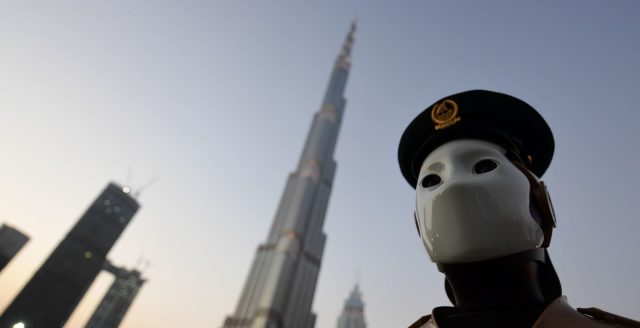





One of my favourite poems is ‘Waiting for the barbarians‘ by C.P. Cavafy.
It’s written from the perspective of a decaying civilisation awaiting the invader. A fatalistic ruling class is resigned to its fate and mounts no defence of their city – except for a display of finery, which they hope will impress their new overlords.
Their behaviour is both pompous and cowardly; and one hopes they get what they deserve (which in the poem they do, but more on that later).
‘Waiting for the barbarians’ has been interpreted as a satire on authoritarian paranoia – and its deep psychological need for a mortal enemy. But this is a misinterpretation. The poem satirises decadence, not paranoia.
The protagonists don’t so much fear invasion as long for it – seeking exaltation in subjugation. Indeed, there’s a special egotism in seeing oneself as the last in a long line – the culmination of an old order and therefore entitled to give it up without a fight.
Real world examples include the 20th century liberals who saw the triumph of socialism as inevitable. Or the appeasers who would have had us submit to Hitler. Or the post-war declinists who gave up on Britain and begat the euro-submissive establishment.
Today, we can see the same impulse in those who wait not for barbarians, but robots.
There’s a whole industry of experts predicting the obsolescence of the human workforce, displaced by the irresistibility productivity of AI-powered automation. It’s a disturbing, but also beguiling, prospect – a promise of leisure and luxury without limit. I’m half-attracted to it myself.
But is it inevitable? Writing for Bloomberg, Noah Smith sounds a sceptical note:
“The truth is, nobody knows how many jobs will be replaced by automation, or how automation will affect wages and inequality. There’s the possibility that AI, rather than replacing workers, will mostly just allow them to do their jobs more easily. And even as some jobs are eliminated, new ones will pop up, possibly at higher wages. That may involve painful, stressful transitions for people who have to switch jobs, but it doesn’t represent a robot apocalypse…”
It’s not that the relevant technologies aren’t already making advances. But whether they’re destroying jobs or not is an open question:
“…some countries that use more industrial robots, such as South Korea, Germany and Japan, have unemployment rates as low as or lower than that of the U.S.”
Exhibit A in the case that robots are replacing us is what happened to manufacturing employment in the 2000s. In America, a third of all factory jobs – nearly 6 million – were lost. As noted by Gwynn Guilford in an article for Quartz last year, there is no precedent for this rate of attrition, not even the Great Depression of the 1930s.
In seeking to attach blame, technology is an obvious suspect; but there is a plausible alternative – competition from, and offshoring to, low cost manufacturing economies (especially China). So how do we decide between them?
The standard view is that despite the job losses, there was a substantial rise in US manufacturing output in the 2000s – showing that America automated its jobs away (as opposed to exporting them to China). But as Guilford explains, the output statistics are misleading. That’s because they’re adjusted for the exceptionally rapid rate of product improvement in the computers subsector (Moore’s Law and all that):
“…the method statisticians use to account for these advances can make it seem like US firms are producing and selling more computers than they actually are. And when the computers data are aggregated with the other subsectors, the adjustment makes it seem like the whole of American manufacturing is churning out more goods than it actually is.”
Strip out this adjustment and the “apparently robust growth in manufacturing productivity is mostly a mirage”, which means we’re not looking at a productivity miracle:
“To be clear, automation did happen in manufacturing. However, throughout the 2000s, the industry was automating at about the same pace as in the rest of the private sector. And if booming robot-led productivity growth wasn’t displacing factory workers, then the sweeping scale of job losses in manufacturing necessarily stemmed from something else entirely.”
So that brings us back to China and some hard questions about the terms of trade and globalisation. This is Trump territory, but only because the ground has been vacated by more moderate politicians.
It’s all too convenient for those who do well out of globalisation to conclude that those who don’t are the victims of unstoppable technological change (as opposed to factors governments can do something about). Indeed, in the long-term, we needn’t worry about the world of work at all, if we assume there won’t be one. We can just theorise about things like ‘post-work’ and universal basic income instead. But what happens when it becomes clear that machines won’t be replacing us after all?
Sod the singularity, we must assume that the future of work will remain in our hands. When it comes, and if we’re still in charge, we’ll look very stupid if we have no idea what to do with it.
At the end of ‘Waiting for the barbarians’, some terrible news reaches the city from the frontier: there are no barbarians. The confused citizens return to their home, wondering what to do now the invaders aren’t coming:
“They were, those people, a kind of solution.”
Peter Franklin is Associate Editor of UnHerd. He was previously a policy advisor and speechwriter on environmental and social issues.
 peterfranklin_
It is all about perspective is it not. The first lesson I learnt in business is that if a customer decides to hate you and would tell his/her friends to not deal with me was to encourage that customer to do just that as I would not want them (the friends I mean) as customers. Perhaps the owners of media businesses would be well advised to adopt the same attitude.