









September 18 2026 - 1:00pm
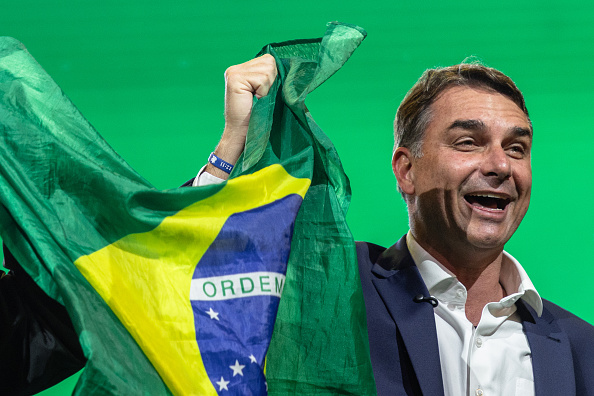
In the minds of many voters and pundits, elections are like choosing between the lesser of two evils. Plenty of Brazilians feel that way about the country’s presidential election early next month, with polling showing that more voters would prefer not to vote for the two main candidates, Left-wing incumbent Luiz Inácio Lula da Silva and Right-wing challenger Flávio Bolsonaro, than support either in the first round.
Lately, though, the deadlocked race has turned into something else: a kind of boat race between two leaky ships, in which victory will go not to the commander with the superior vision, but to whoever manages to plug the holes long enough to keep the whole enterprise from sinking before voters go to the hustings.
One might think that the Right should be losing this battle to stay afloat. Flávio Bolsonaro, son of former president Jair Bolsonaro — the ailing totemic figure of the country’s ideological Right, currently under house arrest for plotting a coup — launched his campaign amid a public squabble with his stepmother, Michelle Bolsonaro, an influential figure among the key conservative bloc of female evangelical voters. Most of the powerful, clientelistic center-right parties that rule in Congress have refrained from endorsing him, remaining focused on winning legislative elections.
Flávio is also under investigation in connection with the largest banking scandal in Brazilian history. Prosecutors are examining a $12 million transaction from disgraced financier Daniel Vorcaro to a US-based fund linked to Flávio’s brother Eduardo Bolsonaro, supposedly intended to finance a film about their father’s political career. The funds are now under scrutiny as part of the wider Banco Master investigation. (Flávio has denied any wrongdoing.)
Such lurid episodes have unfolded against a forbidding international backdrop, as Flávio and his family remain aligned with US President Donald Trump despite the latter’s continued battering of Brazil with tariffs. Just as Trump’s bluster wrecked the chances of Pierre Poilievre in Canada, the same script could play out in Brazil.
Still, Lula’s ship of state is passing through its own storms. Although the economy is performing well by the low standards of recent years, high inflation and interest rates are dragging the Brazilian President down, as are the dizzying levels of household debt. This is partly a hangover from the wildly popular consumer-credit revolution he oversaw during his first stint in office two decades ago. Almost everything in Rio de Janeiro can be bought on layaway, from plane tickets to microwaves to plastic surgery, in a country where the minimum wage is $315 a month.
These economic trends, running in the background, help explain Flávio’s seemingly confounding rise in polling in recent months. But Lula has much to lose from the widening scandal around Vorcaro’s shuttered Banco Master, which has implicated huge swaths of Brazil’s political class — even though neither he nor his cabinet officials have been caught in the dragnet thus far.
To explain why this is, it is important to remember how Lula made it back to the presidency in 2022: thanks to the efforts of an unlikely pro-democracy coalition uniting behind him, which included conservative heads of Congress and Supreme Court judge Alexandre de Moraes. It was these forces that stood firm against the Bolsonaro administration’s attempts to compromise the democratic process. Now Moraes, who has since done much to swell the already-inflated powers of Brazilian Supreme Court judges to absurd proportions, is under fire after leaked documents appeared to show him dealing out advice to Vorcaro, who signed a contract worth $26 million with Moraes’s wife, a lawyer.
The Vorcaro scandal has already implicated other Supreme Court justices, as well as figures in both Flávio’s Liberal Party and Lula’s Workers’ Party. Now it threatens a key figure in the pro-democracy coalition that safeguarded Lula in 2022, and which now seems at risk of collapsing entirely. The political consequences for the President are alarming, even though Moraes and Lula are hardly ideological allies.
A strange complacency seems to reign in the President’s inner circle regarding the court crisis, along with a sense of apathy and demobilization on Brazilian streets. It evokes shades of the US in 2024, when a house of cards collapsed on a hapless Democratic Party. But no one knows what will leak next; any outcome remains possible.
Nick Burns is associate editor at The Hedgehog Review and was previously editor at Americas Quarterly.
 NickBurns