









April 20 2026 - 10:00am
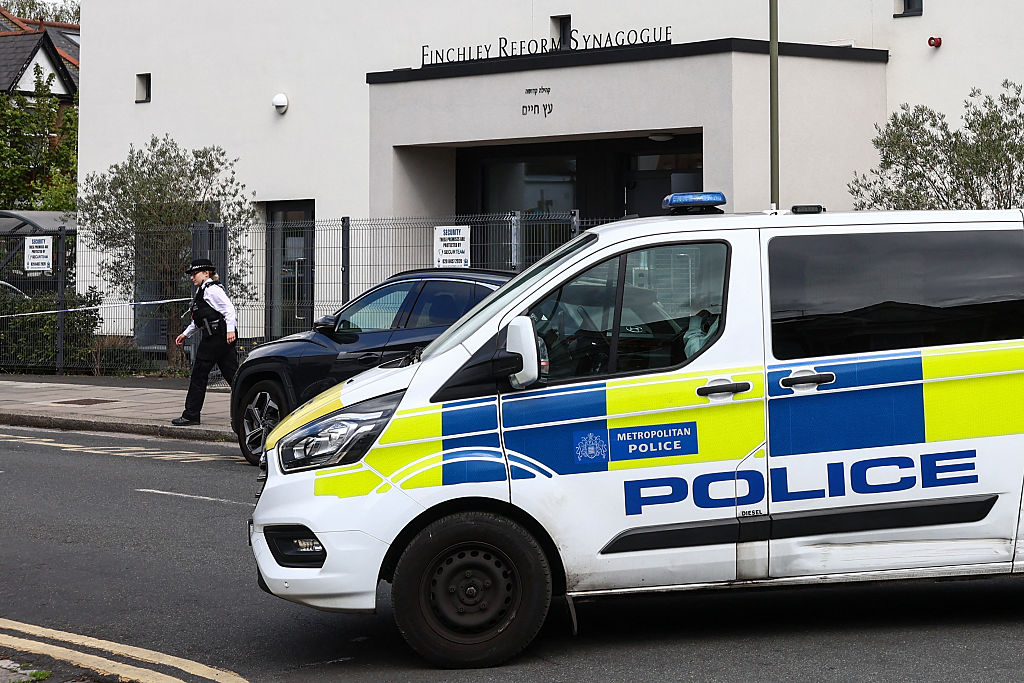
On Sunday, Kenton United Synagogue became the fourth Jewish site in London to be attacked in a single week. An incendiary device was thrown through its window, following petrol bombings at Finchley Reform Synagogue, an attempted arson attack on a Jewish charity in Hendon, and a “hazardous substances” scare near the Israeli Embassy. These incidents come less than a month after the torching of four Hatzola ambulances in Golders Green.
Each attack has been claimed by the same group: Harakat Ashab al-Yamin al-Islamiya, or Hayi. Chief Rabbi Ephraim Mirvis described the attacks as a “sustained campaign of violence and intimidation” against the UK’s Jewish community. Clearly, this is not a spree of disconnected hate crimes but a coordinated terror campaign.
The group’s latest Telegram video escalates matters by naming specific individuals, effectively designating them as targets. Keeping attacks below the threshold of casualties has been deliberate, maximizing fear while minimizing the security response and preserving Iranian deniability. That calculus may be shifting, however.
Hayi is not a traditional terror organization, and that is precisely what makes it so dangerous. It appears to have only emerged in Europe in March, shortly after the US and Israel began a military campaign against the Iranian regime. It has no apparent physical presence, and may be nothing more than a label — a front for Iranian state-backed terrorism. Its operations follow an outsourced pattern: footage of attacks is released to four pro-Iran Telegram channels with hundreds of thousands of followers, two of which are linked to Iraqi Shia militias with direct ties to Iran’s Islamic Revolutionary Guard Corps (IRGC).
The suspects arrested so far in Britain have not been ideologues. Most are young adults, petty criminals recruited through Telegram for easy cash — the same method Iran uses in Israel. They have no ideological footprint, no mosque associations, no known contacts. They are ghosts to conventional surveillance, invisible to watchlists, and unknown to counter-terrorism. They took a job online and were remotely directed by hostile actors.
Police forces have increased resources across neighborhoods with large Jewish communities, including enhanced stop-and-search powers. This might help the community feel safer, but it’s not enough.
The Government must now also proscribe Hayi under the Terrorism Act 2000. The group’s ghost-network structure is no barrier to proscription, which doesn’t target a headquarters or a membership roll but instead behavior associated with a name. Proscription would criminalize sharing Hayi propaganda and recruitment content, and expressing support for the group. It could also have a deterrent effect: currently, a person recruited to throw a petrol bomb at a synagogue faces an arson charge. The men who set the ambulances alight last month were charged not with terrorism offences, but with arson. If Hayi is proscribed, attackers face terrorism charges — a vastly more serious prospect with far longer sentences. That changes the risk calculation.
Proscription requires only that the Home Secretary be satisfied the group is “concerned in terrorism”. Four attacks on Jewish sites in one week, backed by militia networks abroad and a hostile foreign state, should settle that question. Ofcom should simultaneously use its powers under the Online Safety Act and force Telegram to remove the channels broadcasting Hayi’s terror content. The era of treating state-sponsored “outsourced” terrorism as mere hate crimes must end.
Dr Limor Simhony Philpott is a writer and researcher focusing on antisemitism, extremism and defence.
 limorsimhony