









August 13 2026 - 7:30pm
Who’s eligible to play in the WNBA? According to their collective bargaining agreement: “only players who are women”.
In simpler times — that is, before the proliferation of laws and guidelines that enshrined “gender identity” as a facet of, or replacement for, sex — no further clarification would be necessary. But these are complicated times, when the answer to “What is a woman?” is so hotly contested that Right-wing commentator Matt Walsh made a whole movie about it.
Now the WNBA is under pressure to come up with an answer of its own. That pressure started after WNBA star Sophie Cunningham offered her opinion on whether trans women — that is, males who identify as women — should be allowed to play on girls’ and women’s teams. Cunningham favored “protecting women’s sports”, which she said had nothing to do with “hating trans”.
“I think that I am here to extend love”, she said. “But I also think with that love is truth, being honest. And I want to protect young girls in a locker room, or young girls in sport who shouldn’t have to go against biological men.” Seemingly unable to believe that a woman could be so forthright, a reporter later gave her the chance to backtrack, but she stood her ground. “I said what I said and I think it’s kind of common sense,” she repeated.
Outrage ensued, but so did an outpouring of support for Cunningham; she was booed at some games, but her Adidas shoes almost sold out within a day of their release.
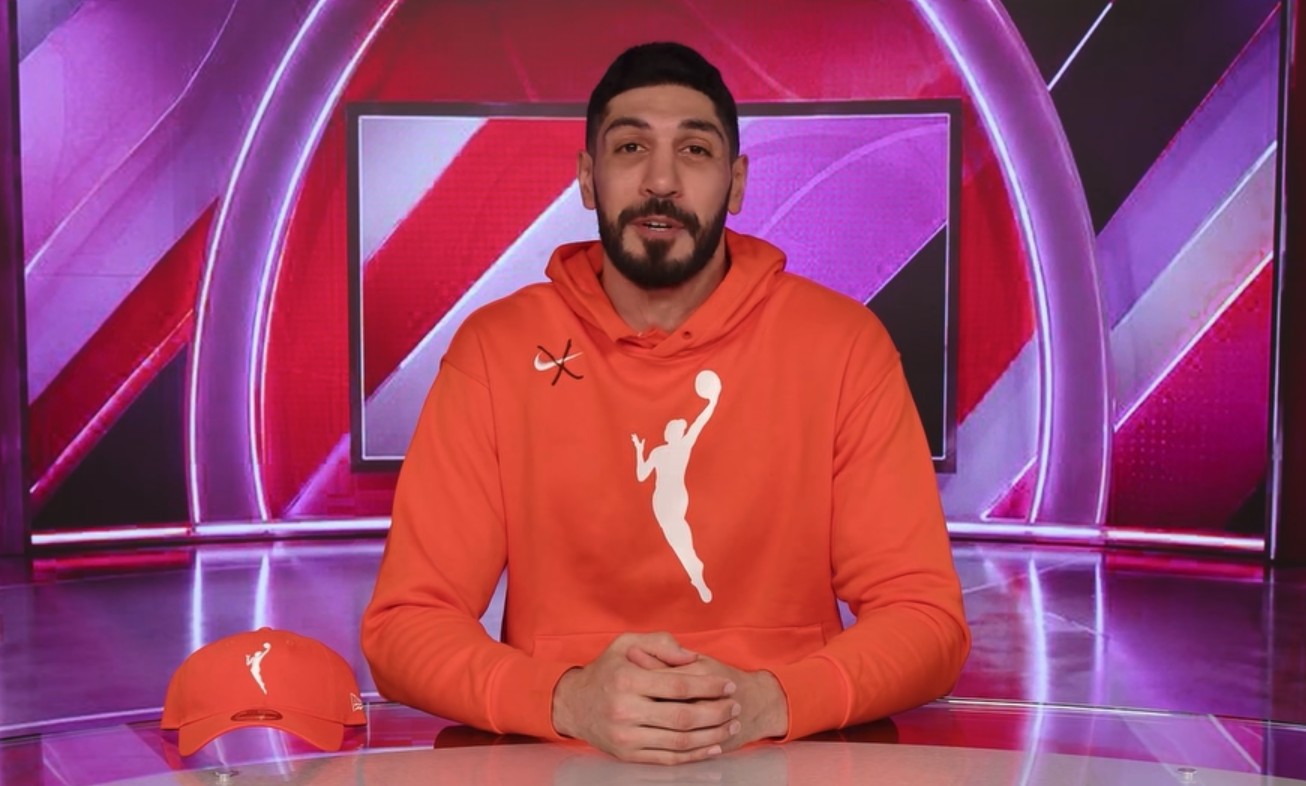
Piggybacking on the drama, former Boston Celtic Enes Kanter then declared himself — or herself — both a woman and a WNBA prospect. “If simply declaring who you are is all that’s required, then I meet every single requirement necessary to compete in the WNBA,” he wrote on X. “I am definitely not here to mock, make fun of, or disrespect any community or personal choices.” All he wanted was for the current rules, embraced by the WNBA, to be applied equally. He ended with: “See you at training camp.”
Not long after, Royce White, once the first-round draft pick for the Houston Rockets, announced his own intention to try out for the WNBA, predicting he’d be “unstoppable”. A third man, YouTuber Adam Francisco, declared his eligibility for the 2027 draft as well.
Their announcements put all the more pressure on the WNBA to clarify the definition of woman. This week, ESPN reported that the WNBA task force failed to establish eligibility rules for trans players. It was a punt — or, in basketball terms, a behind-the-back pass. It claimed that, since there are apparently no “immediate eligibility matters” to attend to — no trans women trying to join teams — then why hurry to craft a policy, or explain who fits the category of “woman”?
Except, of course, people including Kanter and White are doing exactly that. The WNBA dismissed these stunts as “bad-faith efforts to use these topics to demean or marginalize others”, but that could not be further from the truth. They are exposing the flaws of the very policy the WNBA is refusing to amend to keep them out. They are shining light on the loopholes.
Besides, as the mother of a high-school athlete, I can say from experience that policies allowing males to identify their way into girls’ sports — or that fail to define women and girls — create loopholes that allow boys to compete in girls’ sports. A few weeks ago, for example, my daughter competed against and lost to Alysa Liu’s younger sibling — a male identifying as female. But perhaps the worst part is what happens when girls object: they learn very quickly that they can’t make their feelings known, or they risk expulsion from teams. Any dissent about the inclusion of males leads to the exclusion of females.
This is why the WNBA must clarify that women are adult human females, and that only they can join the teams. Sophie Cunningham pointed out that laws like Title IX were designed to foster and protect women in sport. “That’s why you have some of the greats of women’s sports,” she said. Without it, men would be the ones winning medals and standing atop the podium. We’ve already seen former Penn swimmer Lia Thomas do just that.
If the WNBA doesn’t ensure that it remains a league for women, Cunningham could find herself guarding Enes Kanter next year. And, more likely than not, Kanter would be the one walking away with the win.
