









June 16 2026 - 7:00am
Palestine Action has had an eventful, if unhappy, few days. At the end of last week, the “Filton Four” were jailed, much to the fury of the online pro-Palestine Left. Then, yesterday, the Court of Appeal found in the Home Office’s favor on its decision to proscribe it as a terrorist group — more than 100 people were later arrested at demonstrations in central London against the decision. Much to the online Left’s chagrin, there’s some consolation for activists. First of all, the appeal route isn’t exhausted — the group’s co-founder, Huda Ammori, has pledged to take the case further. Secondly, some have suggested the Filton activists were given relatively generous sentences. Although it’s doubtful that Palestine Action will be looking on the bright side, they should take comfort in knowing who the real losers are. As usual, it’s the police.
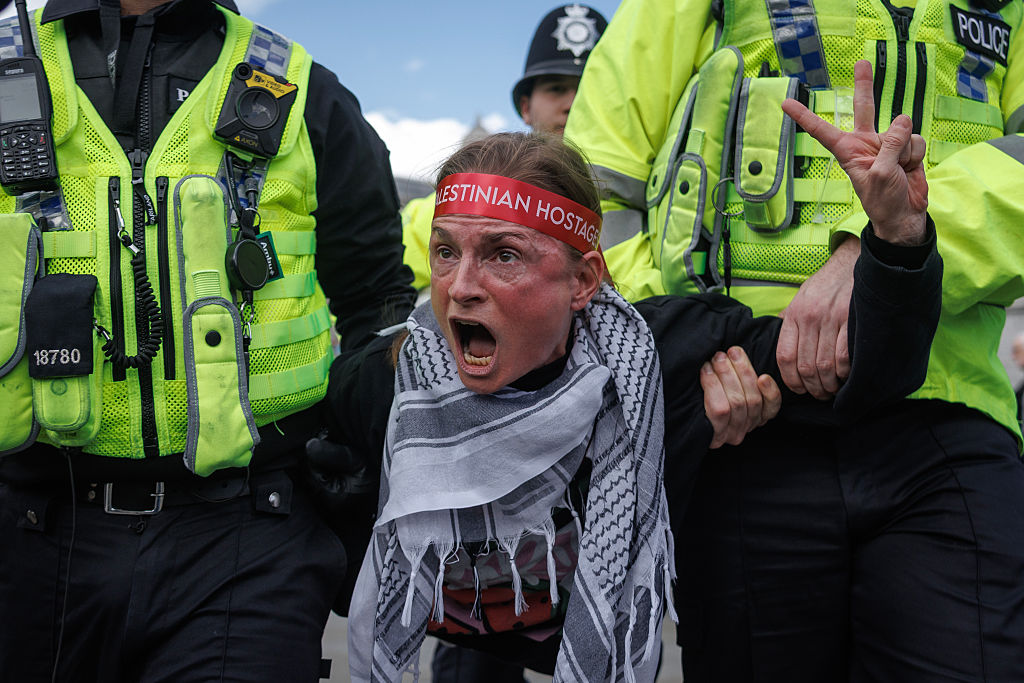
During anti-proscription protests last year, the police were confronted by hundreds of demonstrators committing de facto terrorist offenses by supporting a proscribed organization. “Street bail” was issued by officers unable to process the volume of offenders, many of whom were pensioners. The optics, even for those broadly supportive of Palestine Action’s proscription, were awful. Should the group continue down this route, using mass law-breaking as a form of protest, it will undoubtedly put more pressure on beleaguered police forces. After the Belfast riots, this is the last thing chief constables need.
Then there’s an even thornier issue: what of the hardcore Palestine Action activists prepared to take part in direct political action and violence? Counterterrorism officers will be considering whether the group will use even more cellular tactics, with a hardcore group going underground to escape detection. Such techniques might resemble the Animal Liberation Front of the Eighties and Nineties. Then, activists from the group attempted to stay off the law enforcement radar. Support groups and spokespeople were used to convey messages via “intermediaries”.
The group were, for nearly 20 years, remarkably successful. Never proscribed as a terrorist organization, the Animal Liberation Front nonetheless enjoyed a vein of popular support for animal welfare. Palestine Action, now, has similar traction among the mainstream Left. Another, perhaps more troubling, comparison might be the Baader-Meinhof group and the Red Army Faction. Ostensibly, there are similarities: both Palestine Action and the RAF featured educated, middle-class, Left-wing radicals. Like Palestine Action, the Red Army Faction was initially motivated by overseas wars. Radicalized by Vietnam, Baader-Meinhof terrorists soon pivoted to Palestine and anti-capitalism, echoing the modern Left’s “Omnicause”. Surprisingly, given their propensity for kidnapping, murder and bombing, a section of the German public was sympathetic to their cause.
These similarities won’t be lost on the police and security services. More worryingly, the authorities have no authority to speak directly to the concerns of Palestine Action either: that lies within the gift of the American and Israeli governments. Given the proscription, will the situation escalate?
At the moment, it’s not clear. A cellular Palestine Action, like the Animal Liberation Front before it, would have no “army council” to arbitrate strategy. Which, in a digital age of encrypted communications, means the security services might be forced back into the “old ways” of human intelligence and techniques such as embedding operatives within the group. Such work is risky and resource-intensive. And, for British police forces, it might well distract them from the legal burden of processing thousands of pensioners and students for holding up signs proclaiming their support for Palestine Action. After all, when everyone’s a “terrorist”, where do investigators begin to look?