







 Prefer us on Google

June 8 2026 - 10:30am
Activist students at Oxford University are furious that an Associate Professor of Law has been giving entirely lawful, public lectures on the law. Yesterday, Dr Michael Foran, who is also a Fellow of Keble College, announced that he was canceling the remainder of his series on “Sex, Gender Identity and the Law” following what he described as escalating disruption by protesters.
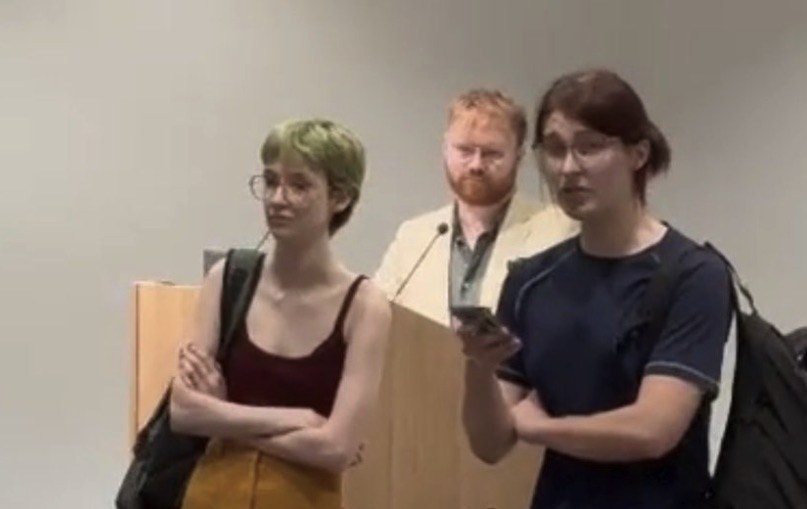
Footage from one of the protests, filmed inside the lecture theater, shows two activists marching to the front of the room to read out Foran’s rap sheet. His alleged offenses include being cited in the Supreme Court’s judgment on sex and the Equality Act, associating “heavily” with Women’s Rights Network, and “masking his transphobia with a veneer of academia”. One protester also complained that Britain has slipped down the international league table of LGBT rights.
Addressing the audience after Foran had left the podium, the activist added: “If you are here in a critical capacity hoping to challenge his ideas, thank you, but that is not the same as refusing to platform him… Please join me in walking out and refusing to platform this bigot.”
The obvious response is to marvel at the intellectual poverty which assumes that identifying as transgender confers a special and permanent state of vulnerability, and the right to never have one’s opinion challenged. Perhaps this is to be expected of students. Yet our elected representatives have spent the past week making the same points in Parliament.
During Monday’s debate on the EHRC Code of Practice, Liberal Democrat MP Marie Goldman described the guidance as operating “from a position of exclusion”. Labour MP Nadia Whittome claimed it “pushes trans people out of public life”. Like the Oxford protesters, MPs fretted about Britain’s position in international LGBT league tables. It seems activists inside and outside the Commons agree that if recognizing sex in law upsets them, then the problem must be the law.
That reality is proving difficult for many people to absorb. For much of the past decade, schools have taught children that gender identity trumps sex, while politicians, journalists and public bodies largely behaved as though this was already reflected in law. The Supreme Court’s judgment has exposed the gap between activist demands and legal reality. Trans activist undergraduates and academics are no longer operating in a world where institutions automatically defer to their claims. The central legal arguments on which self-identification depended have failed.
What has happened to Foran, unpleasant though it is, remains a far cry from the treatment meted out at the height of progressive hysteria. Foran’s Oxford colleague, Professor Selina Todd, required security protection on campus after questioning gender ideology, while Professor Kathleen Stock was hounded out of academia altogether in 2021. If anything, the protests are evidence that the balance of power has shifted. Rather than surrounding venues and banging on windows, today’s activists are left protesting the uncomfortable fact that the law was never on their side.
Perhaps most tellingly, both the protesters and those with similar views in Parliament frame disagreement as victimization, and substitute anecdotes and claims of “lived experience” for argument. The Oxford activists insisted that simply challenging Foran’s ideas was insufficient and that he should not be platformed at all. MPs responded to the EHRC guidance with stories of frightened constituents, warnings of stigma and predictions of exclusion from public life. The shared premise is that recognizing sex-based rights is an act of hostility rather than the law of the land.
This is the predictable consequence of suppressing debate. For years, academics, lawyers and journalists who pointed out what the law actually said were smeared, threatened or no-platformed. Had voices such as Foran’s been heard rather than shouted down, fewer students and fewer MPs might now be expressing shock that the Supreme Court has interpreted the Equality Act according to its actual wording. Universities, for all their faults, are slowly adjusting to the legal reality that sex matters. Westminster, by contrast, is proving a much slower learner.
