








February 16 2026 - 1:00pm
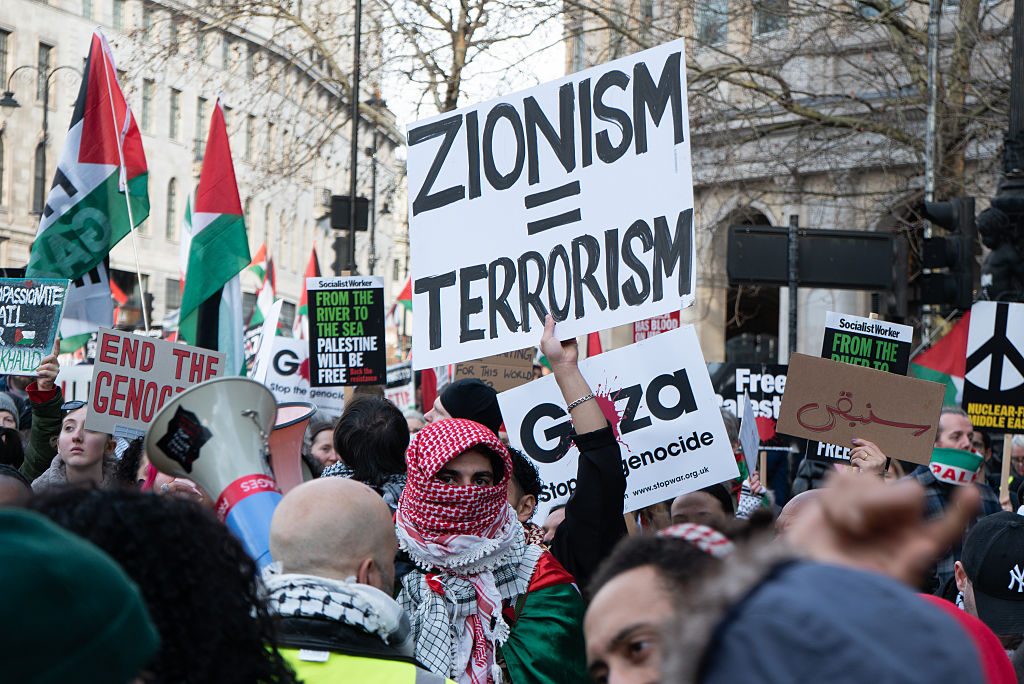
Over the weekend, the Telegraph reported that Green Party members are set to vote on whether Zionism should be recognized as a “racist ideology”. Of course, this is a mindless simplification of the idea of Zionism, and one which completely alienates the nuance needed to engage with the subject.
In fact, it would be better if the term were ditched altogether, as it overcomplicates and obscures the debate on Israel and Palestine rather than clarifying it. Zionism doesn’t have a clear meaning in the modern age, instead functioning as an empty signifier for a range of beliefs.
The kind of rhetoric adopted by the Greens harks back to the notorious United Nations resolution in 1975 that condemned Zionism as a “form of racism”. What lay behind this perspective, at the time, was the view that Zionism is central to the ideological framework behind the dispossession of Palestinian land; to stop this happening, it therefore must be ideologically dismantled.
Much of this idea is carried through to today. Some self-styled anti-Zionists treat “Zionism” as a paranoid category to be deployed as an accusation, as if denoting a coherent and unitary political constituency. Conversely, others will argue that “anti-Zionism” is inherently antisemitic for demonizing the very principle of Jewish national self-determination.
Anti-Zionism is, of course, a separate topic from most criticism of Israel. One can point to the country’s backing of the settler-colonization of the West Bank, its action in turning Gaza into a charnel house, and other abuses of human rights without getting bogged down in what “Zionism” is or is not. Asking, for example, whether it is legitimate for land to be reserved exclusively for Jews through the Jewish National Fund, excluding Arabs from buying or renting, is more politically concrete and useful than bloviating about whether one is for or against “Zionism”. These abuses can easily be understood in commonsensical liberal and democratic terms.
Many anti-Zionists will defend their stance by analogizing Israel with South Africa. But the difference is that everyone agreed on what apartheid meant, even its defenders. With Zionism, there is a clash of interpretations. People from Benjamin Netanyahu to Noam Chomsky, Ze’ev Jabotinsky to Albert Memmi, and Meir Kahane to Albert Einstein have called themselves “Zionists”. When an ideology embraces such a wide spectrum, it becomes very hard to pin down clearly.
To engage honestly in this debate, one should recognize that to identify Zionism with racism is, at most, only partially correct. Certainly, Zionism does not proclaim a propositional nation like the United States. It is an ethnic nationalism, premised on erecting a nation-state based on a Jewish majority, as the solution to the Jewish question in Europe. Zionism, like every nationalist idea, claims humanity is divided into numerous nations, each of which is supposed to aspire for political sovereignty.
Yet the Zionist idea doesn’t imagine that these nation-states fall into a hierarchy. The Jewish nation is equal to and can coexist with the rest of the family of nations. So while Zionism can sanction and rationalize racial discrimination, it is not intrinsically racist — at least no more so than any other ethnic nationalism.
It is perhaps ironic that, historically, Zionism was enmeshed with the Left. The real founding father of Zionism wasn’t Theodor Herzl but Moses Hess, a communist contemporaneous with Marx and Engels.
Part of the problem with the discourse over Israel and Palestine is that so much of it is ideologically disfigured and needlessly confusing. This is why the crude Zionist versus anti-Zionist dichotomy is neither helpful nor necessary. One can say what needs to be said against the Israeli state without relitigating Zionism. But that is unlikely, and depends on whether activists want to reach a broad public, or whether they want to engage in narrow ideological propaganda intended for fellow activists in their milieu. One suspects that, with the Greens, it’s the latter.
Ralph Leonard is a British-Nigerian writer on international politics, religion, culture and humanism.
 buffsoldier_96
Join the discussion
Join like minded readers that support our journalism by becoming a paid subscriber
To join the discussion in the comments, become a paid subscriber.
Join like minded readers that support our journalism, read unlimited articles and enjoy other subscriber-only benefits.
Subscribe