








December 6 2025 - 8:15am
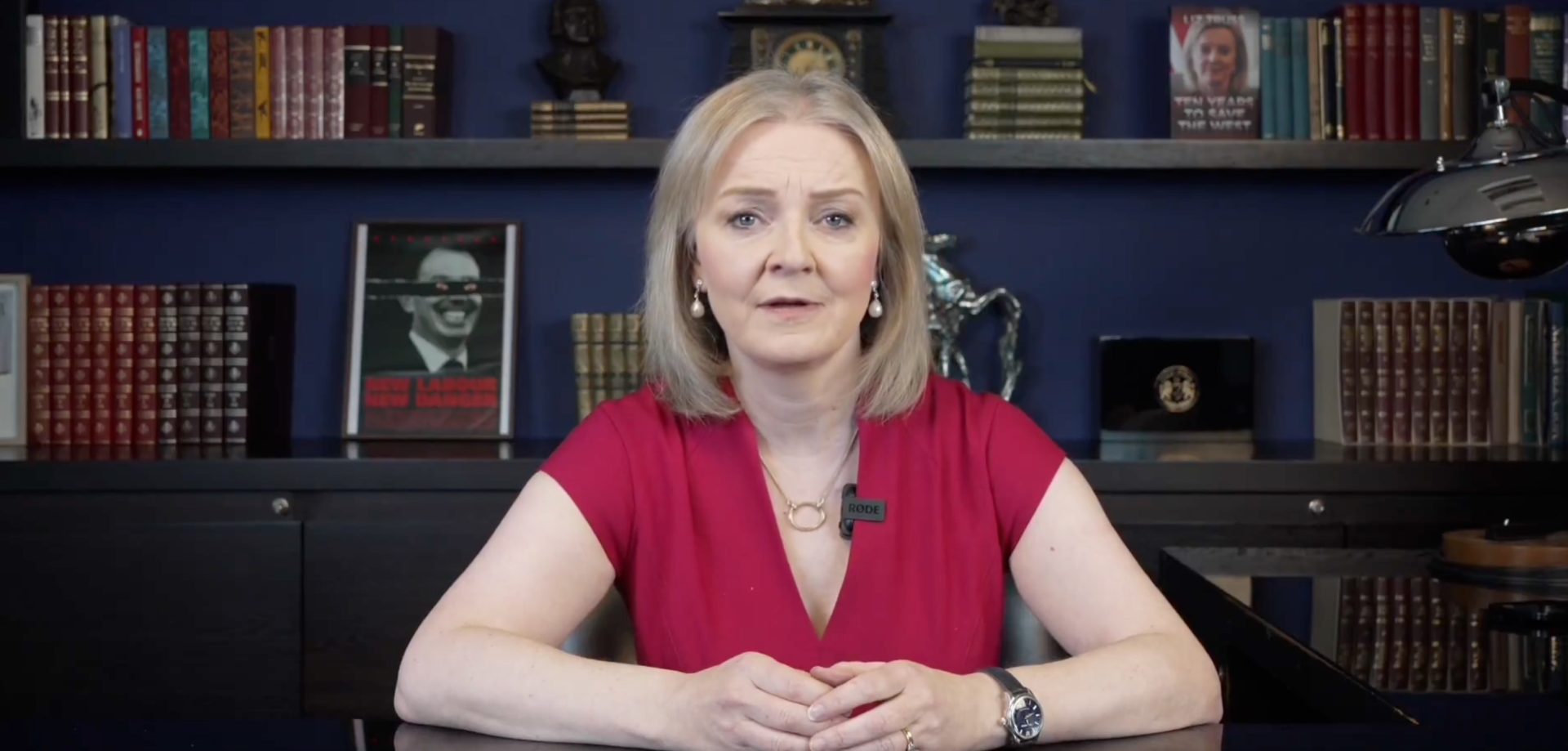
At this point, it’s fair to ask whether Liz Truss enjoys the humiliation. Since the ignominious end of her brief premiership in 2022, she has been unable to go gentle into that good night. The former Tory MP has made regular appearances in America, written a book, and noisily defended the decisions that led to her being forced out of Downing Street. Now she’s launching her own online talk show, The Liz Truss Show, the first episode of which was released yesterday evening with the title “London is Falling”.
The program, she claims, is an opportunity to “push back” against the “Deep State that tried to destroy me”. In her opening monologue, Truss rails against the governing elites — not only the “personality-free zone that is Keir Starmer” but also the Conservatives in name only whose ambition amounted to being “the heirs to Blair”, as well as the “communist” Zack Polanski. She also suggests part of the problem is that everyone in this bureaucratic apparatus lives in “enclaves” in London and the Home Counties, where they can “blank out the truth about what is happening”.
Truss then promises to offer “first-hand accounts from witnesses on the fall of Britain”, not to mention detail on how those Deep State “evildoers” plan to replicate the process in Europe and America.
Yet for someone with such apparently well-developed diagnoses, the interviews which follow are more free-ranging and less forensic than one would expect. The guests of Matt Goodwin, Peter McCormack and Alex Phillips — entertainment value aside — are hardly challenged to provide the counter-revolutionary blueprint promised by Truss. Instead, they each recite sweeping criticisms of the many things that have gone wrong in Britain. Names are not named, patterns are not identified, and only impotent broadsides against cultural Left-liberalism are offered. Far from a fresh challenge to the governing elites, this is just another podcast.
For Truss, though, this new show is less about charting a new redemptive path than it is about rewriting the story of her humiliation. She is a figure defined entirely by her public fall from grace, her ostracization from the political class she had dedicated her life to joining, and her increasing status as a source of derision in the nation she genuinely — if naively — believed she could save. This is more about providing her with a coping mechanism than her viewers with thought-provoking content.
In the introduction to his 2020 book Remaking One Nation, Nick Timothy describes how his public ousting as Theresa May’s joint chief of staff resulted in personal attacks, media briefings and social media mockery. “Few people,” he wrote, “think about the human consequences of this kind of media onslaught.”
Timothy was out of the news headlines in five minutes. More than three years on from her spell as PM, Truss is still the butt of tired jokes on television, radio and at the dispatch box. She probably will be for the rest of her life. It is fair to assume that those years have not been a healthy experience for her — but life, even in the public eye, must go on. Can we really blame her for trying so desperately to come to terms with her public humiliation, even if it is only to soften the sting of responsibility? Can we begrudge her use of podcasting to exorcise the pain of her political failure? After all, it worked for Alastair Campbell.

Join the discussion
Join like minded readers that support our journalism by becoming a paid subscriber
To join the discussion in the comments, become a paid subscriber.
Join like minded readers that support our journalism, read unlimited articles and enjoy other subscriber-only benefits.
Subscribe