









April 16 2026 - 4:00pm
HBO is beginning to develop a tradition of Left-coded shows that, in fact, constitute quietly conservative art. Lena Dunham spent six seasons of Girls insisting she was a progressive provocateur, while her show methodically documented the wreckage that follows from a generation raised without any of the old constraints.
Sam Levinson’s Euphoria is doing something similar — and in some ways doing it more brazenly. The show is not conservative in its tone or aesthetics. It is loudly offensive, hypersexual, and soaked in rave-like neon. Its characters are drug addicts, sex workers, and deeply damaged young people doing deeply stupid things to themselves and each other. It does not directly or moralistically preach restraint. But it shows, with unflinching honesty, what life without restraint actually does to the people living it.
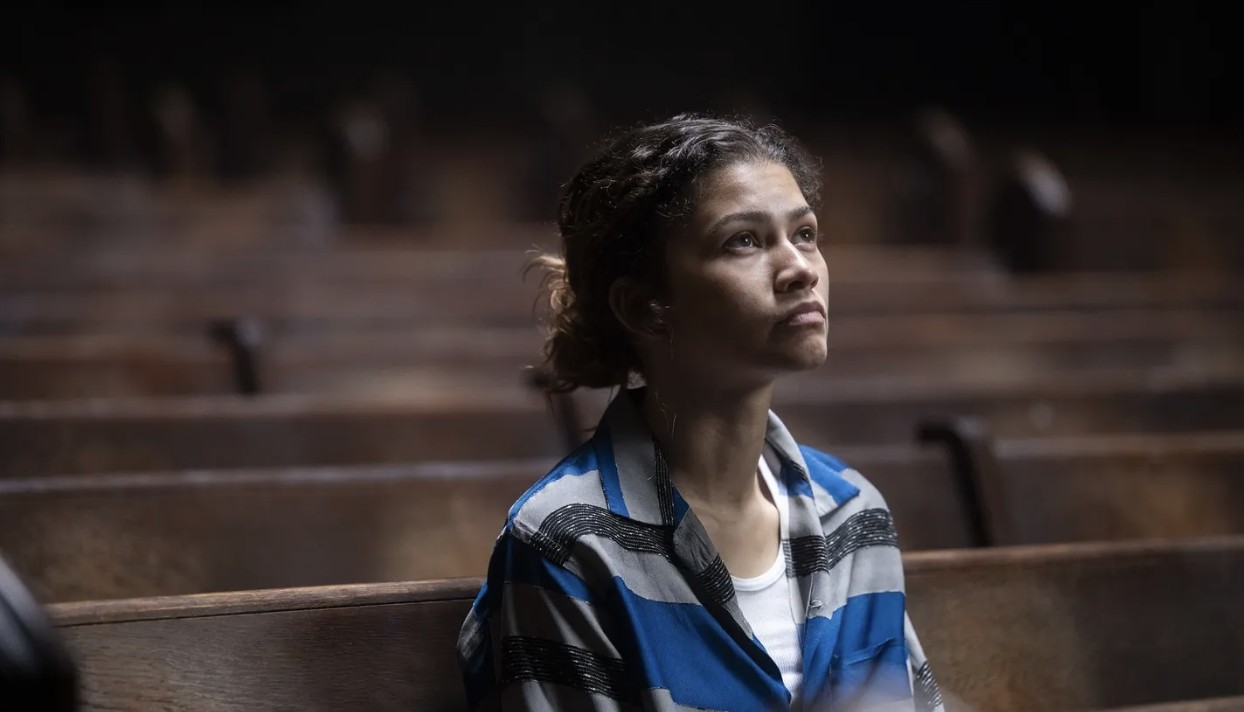
The first episode of the new season, which premiered on Sunday, makes this argument with great clarity. Early in the episode, Rue — Zendaya’s character, a not-so-recovering addict now working as a drug mule — finds herself in dire straits while transporting narcotics across the US-Mexico border. She ends up sheltering with a white Christian family living in rural Texas: many children, a modest home, a life organized around faith and simplicity. To gain their trust, she invents a cover story: she’s a college journalist writing about the drug crisis and the evil pouring across the southern border. They welcome her in. They feed her. They put her on a Greyhound bus. They ask for nothing in return.
Rue finds this unsettling. By the standards of today’s world, or at least her world, this family is strange. Their being happy and healthy registers as a kind of abnormality. There is purity in their house. There is something that functions like grace. When she leaves them and re-enters her own world — with some pause — the contrast is immediate and annihilating: addiction, exploitation, moral squalor.
Later, Rue speaks with her AA sponsor, a religious man played by Colman Domingo, who is framed as a steady, authoritative presence. He tries to articulate the internal logic of some of the Bible’s harsher passages, particularly those concerning homosexuality. Opposite him sits a younger figure whose instinct is to reject any religious framework that falls short of libertine orthodoxy — reflexively indignant, and unwilling to engage with complexity or ambiguity.
Then there is the scene in which Rue confides in her friend Lexi, played by Maude Apatow, that she is beginning to explore religiosity. Lexi responds in a hostile manner, telling Rue that she could never be friends with a Christian because Christians are judgmental. The irony is not subtle.
Levinson, it’s worth noting, is himself a recovering addict. He credits his faith as part of what keeps him clean. All of which reveals something curious about the show’s critics, who divide into two camps. On one side, there is the Megyn Kelly contingent: deeply offended by the show’s explicit content, apparently unable or unwilling to read what the show is doing with that content. On her podcast, Kelly called Sam Levinson “sick” for a scene in which Sydney Sweeney’s character Cassie, in a forthcoming episode, appears dressed in an infantilized costume as part of a sexual fantasy (the implication being that Levinson is wallowing in this material rather than interrogating it).
But that is precisely the point. If the spectacle of an adult woman infantilizing herself for a sexual audience registers as grotesque, it is by design. Euphoria repeatedly renders sexual deviance in forms so exaggerated, stylized, and aesthetically heightened that they read less as titillation than as a kind of visual satire.
On the other side sits the progressive Left, where a chorus of liberal voices across the media has bristled at the show’s refusal to glamorize the very behaviors it depicts. What unnerves them is its moral seriousness — the fact that it treats hedonism as a condition to be examined rather than a lifestyle to be affirmed. A show that portrays women making choices that destroy them is, in this framework, an act of misogyny. The possibility that it might be something more like the truth is not entertaining. Beyond that, there’s abundant frustration that Levinson is a Jew who doesn’t hate Israel and Sweeney is a hot blonde who doesn’t hate America.
Both factions share something: a refusal to sit with ambiguity. Both prefer their culture to confirm what they already believe. The whiny podcaster Right and the progressive Left have, for all their apparent differences, converged on a remarkably similar aesthetic demand: give us content that flatters our priors, or we will call you sick.
Euphoria shows a world without structure, faith, or any of the old limiting rules — and it shows you, with great visual intensity and absolutely no sentimentality, what that world actually looks like from the inside. You may not want to call that conservative. But you’d be hard pressed to call it anything else.