








December 4, 2025 - 10:00am
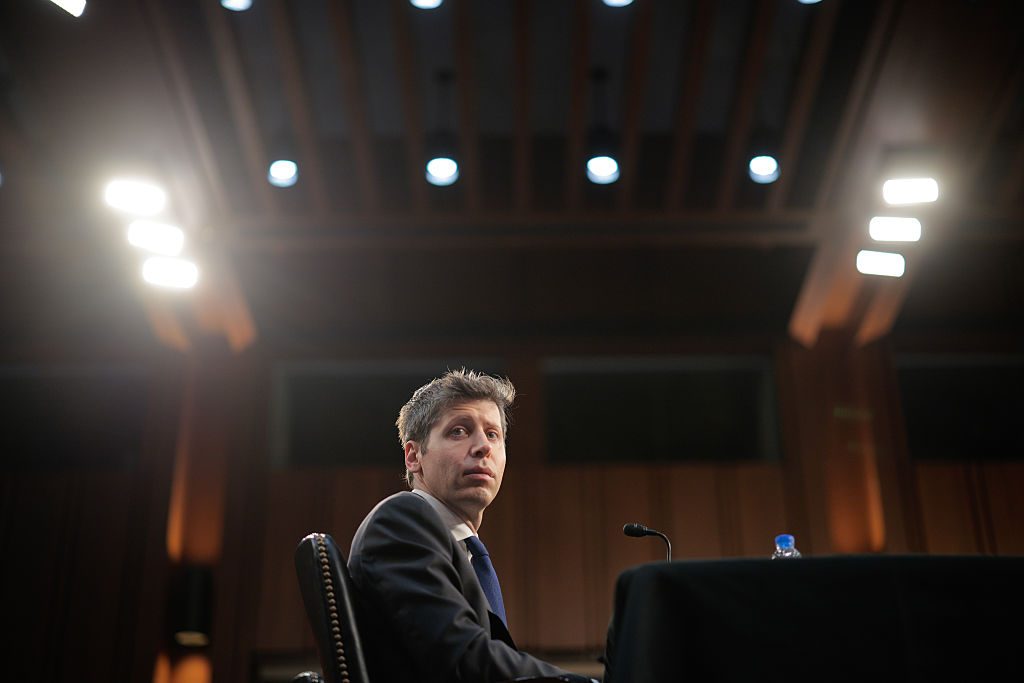
OpenAI’s early lead in artificial intelligence is coming under serious threat, and it appears the pressure is catching up with its CEO, Sam Altman.
On Monday, an internal memo was issued at Altman’s behest asking employees to channel their focus on improving the company’s leading AI chatbot ChatGPT-5. This would help the company, now valued at $500 billion, maintain its position after industry benchmarks showed that Google’s Gemini 3 and Anthropic’s Opus 4.5 outperformed OpenAI’s GPT-5 in several areas.
Reports say Altman stressed the urgency of the moment, urging teams to delay work on autonomous agents, advertising and other projects so that OpenAI could concentrate its resources on improving ChatGPT for reliability, speed and personalisation.
The memo paints a portrait of a far more unsettled Altman, who, when asked about competition last year in an interview at Harvard University, projected a near-stoic confidence, stating that “if other people want to chase to where we are right now, I don’t think that’s going to be a great strategy.” But now that confidence is being tested by a revitalised Google and a widening field of frontier AI labs. Gemini 3 has attracted praise for reasoning, coding and complex problem-solving, while Anthropic’s latest model has impressed users seeking advanced coding tasks. A younger European player, Black Forest Labs, has also drawn attention with fast progress in multimodal imaging. The combined effect is a squeeze on OpenAI’s once comfortable lead.
OpenAI has not commented publicly on the leaked memo, but its Head of ChatGPT, Nick Turley, echoed the internal shift in a post on X yesterday, boasting that “ChatGPT is the number one AI assistant worldwide, with around 70% of assistant usage.” It’s hard not to notice that Turley’s posturing betrays an organisation attempting to solidify its flagship product as competitors gain momentum.
Beneath all of Turley’s bluster lies a bigger risk that goes beyond competition between AI companies. When the leading AI start-up signals panic, the danger is that it might pull the entire sector into a race for speed, a pattern that recalls Washington’s desperate rush to match the USSR after Sputnik. Under intense political pressure to prove it was not falling behind, the United States hurried a public satellite launch with the Vanguard rocket in December 1957, two months after Sputnik was successfully launched into Earth’s orbit. The vehicle rose only a few feet before it collapsed and exploded on live television. The Sputnik-style response epitomises how urgency and national anxiety can override technical dexterity, readiness and safety margins. The same dynamics could play out in the AI sector if laboratories choose to accelerate simply because their rivals have moved faster.
This risk is amplified by the structure of today’s AI ecosystem. Training costs continue to rise, specialist talent is scarce, and investors expect constant progress and revenues that impress Wall Street. Governments are also treating AI performance as a marker of geopolitical influence. Google’s ability to integrate Gemini across search, cloud and mobile ecosystems gives it scale that OpenAI cannot easily match. Altman’s decision to pull staff back toward ChatGPT shows how tight the competitive margins have become.
If this code-red moment sparks a new phase, global AI development may soon be driven purely by the instinct to stay ahead, with far less room allotted for safety, transparency and public oversight.
Join the discussion
Join like minded readers that support our journalism by becoming a paid subscriber
To join the discussion in the comments, become a paid subscriber.
Join like minded readers that support our journalism, read unlimited articles and enjoy other subscriber-only benefits.
Subscribe