









August 17 2026 - 1:00pm
With frontline gains minimal, the Russia-Ukraine war has shifted to a battle fought in the skies and cities. Ukraine yesterday launched its largest-scale attack of the year, with the Russian Defense Ministry claiming to have shot down 1,478 Ukrainian drones in 24 hours — the highest total yet. Moscow Mayor Sergei Sobyanin reported that 600 drones were targeted in the region surrounding the capital, of which 201 were eliminated.
Such a barrage is technically impressive yet unsurprising. Russia also launched its own drone and missile attacks, having intensified its strikes across Ukraine over recent weeks. Meanwhile, Ukraine has also been upping its use of drones to strike far within enemy territory.
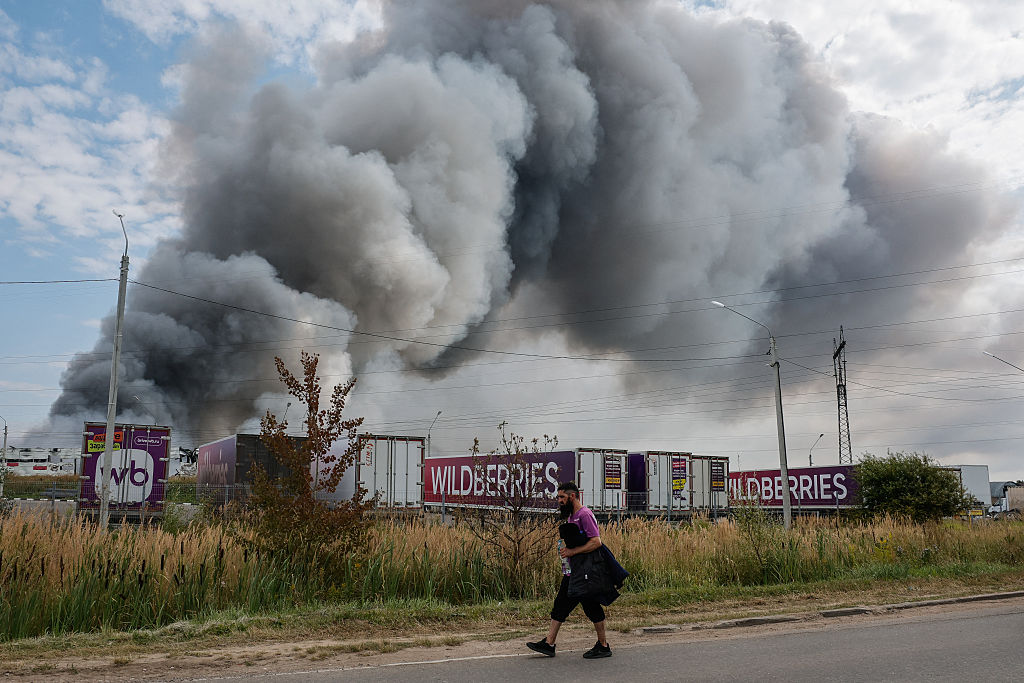
Lest these seem intended merely to degrade one another’s morale, such strikes do serve a military purpose. Kyiv continued to hit Wildberries warehouses, claiming the online retailer furnishes the Russian military with drone components and navigation equipment. Eager to protect its advantage, Ukraine also attacked a military airfield and rocket center supporting Rassvet — Russia’s nascent space-based internet network — which Moscow hopes will eventually prove a competitor to the Starlink system assisting Ukraine.
Then there is the other front line that Ukrainian President Volodymyr Zelensky must always consider. Such a headline-grabbing strike is also likely to seize the attention of the US President. Always one to back a winner, Donald Trump will be impressed by Ukraine’s initiative and competence, thereby building upon the positive engagement generated by recent bilateral meetings. All of that is useful for Zelensky as he seeks to persuade Washington to provide more Patriot interceptor missiles. Just as Ukraine’s stocks are running low, Moscow is exploiting the shortfall by intensifying its ballistic missile attacks. Kyiv is bracing for another long and difficult winter.
But is all this, combined with mounting domestic pressure following Ukrainian strikes on Russia’s energy infrastructure, enough to bring Vladimir Putin to the negotiating table? Peace talks would seem unlikely in the current, escalatory climate. The Russian president would be reluctant to appear weak or give the impression that he had been forced to back down. He is not alone. Past behavior suggests Russia’s military bloggers are likely to continue venting online over the effectiveness of Ukraine’s strikes and argue that the Kremlin should consider a tactical nuclear strike.
None of Putin’s behavior suggests a man looking for an off-ramp, regardless of whether he believes the inflated battlefield gains reported by his generals. According to the Ukrainian leadership, Moscow is seeking to further escalate the war by increasing ballistic missile production, turning to North Korean military equipment and preparing for mobilization. Ukrainian intelligence indicates that Putin has already been laying the foundations to mobilize up to 500,000 more soldiers. The Kremlin is likely to wait until after September’s parliamentary elections before taking the unpopular step. However, there have already been cases of increasingly coercive recruitment tactics being used on Russian streets over the summer.
As a show of strength, Ukraine’s strikes will serve Zelensky well in his relations with both Russia and the US. They demonstrate that Kyiv can still impose serious costs on Moscow, while strengthening the case for continued American support. Yet Putin’s behavior suggests he is only looking for ways to escalate the war, both by intensifying strikes on civilians and strengthening Russia’s might on the battlefield.
