









October 15 2026 - 10:00am
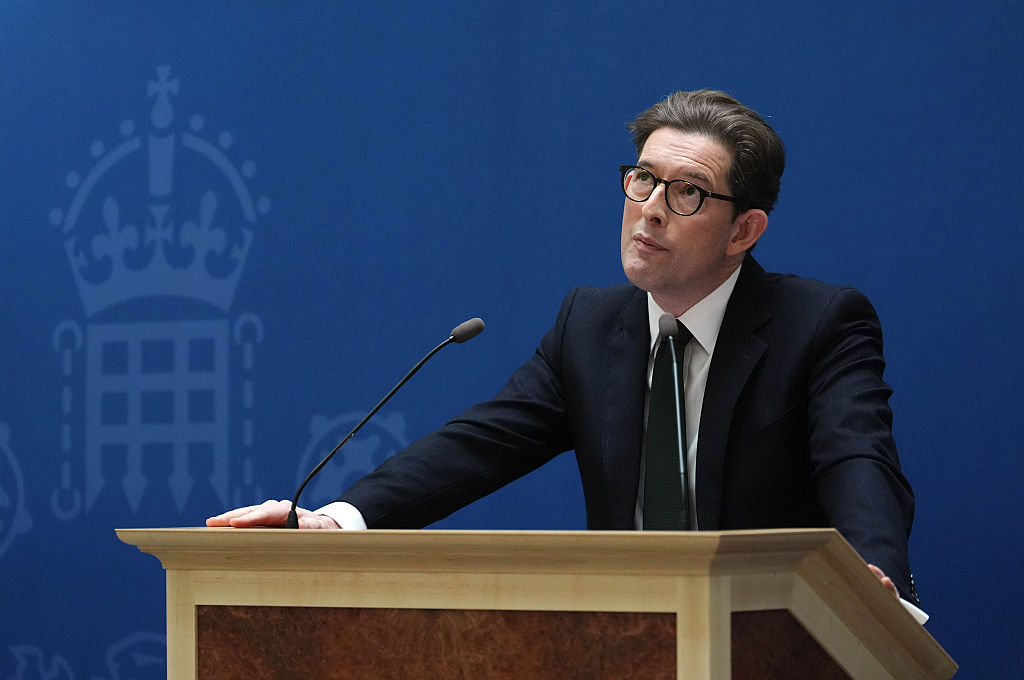
MI5 Director General Ken McCallum’s speech in London on Tuesday read like the script of a spy movie. The UK’s chief domestic spook warned of “terrorists seeking to exploit AI to improve reconnaissance and attack methodologies, with AI-enabled drones adding a new twist”, as well as, even more alarmingly, AI-empowered bioweapons. McCallum also highlighted MI5’s success at thwarting a growing number of far-Right terrorist plots. What he didn’t mention was that most are successfully disrupted because they occur online, allowing them to be nipped in the bud.
Perhaps appropriately for a speech which addressed disinformation, McCallum took a gentle swipe at the Prime Minister. Andy Burnham’s appearance on The Rest is Politics podcast this week featured claims around Russian propaganda’s impact on the 2016 Brexit referendum. “The Russian trolls who didn’t appear to do all that much at various points over the years, they’ll be delighted they are front-page news once again,” McCallum commented. I worked alongside the Security Service on and off for 20 years, and that’s the closest I’ve seen an MI5 DG to giving a sitting PM a public rebuke. Perhaps McCallum is asking for Britain’s political elites to lead by example and turn down the heat.
What, then, is MI5’s position on the UK’s national security? The agency prefers to steer clear of Westminster soap opera, but it isn’t apolitical: officers are still, essentially, a subtype of civil servant. Its primary mission, alongside defending the state, is to ensure its survival in a cutthroat public spending environment. After all, elements of evolving AI technologies will overlap with their sister agency, and occasional funding rival, GCHQ.
Yet the depth and breadth of threats McCallum mentioned, from AI to bioweapons to foreign espionage and “grey area” warfare, should trouble the Service. The modestly sized MI5 and its counter-terrorist policing colleagues are already hard-pressed chasing spies, saboteurs and terrorists. The new-model “active measures” preferred by Russia and Iran are cheap, nasty and dirty. They require a flexible, hard-nosed response.
Britain, as ever, is its own worst enemy here. The threat from Russia, for example, was incubated by successive UK governments. Working on the Alexander Litvinenko investigation in 2006, I saw how dirty money blinded politicians to the alleged excesses of oligarchs linked to the Russian government and intelligence agencies. Similarly, the post-Cold War MI5 Russia desk was shrunk to a handful of officers, the state turning its resources to combating Islamist terrorism — again, a domestic threat developed over several decades.
Along with the reticence over banning Iran’s IRGC, with its extensive network of UK contacts, a timorous British state has long had an unfortunate habit of tolerating the enemies in its midst. As for China, the UK’s wealthiest frenemy is viewed by Jekyll-and-Hyde British governments as simultaneously a threat and a potential golden goose, leading to confusion and weakness.
The state has, however, taken measures which are cheap and within its comfort zone. One involves legislation, such as the National Security Act. The other is public awareness campaigns around preparedness and “social cohesion”. Neither of these things are unimportant, but nor are they a replacement for core security activity: surveillance, aggressive counterintelligence, agent-recruitment and police operations.
McCallum’s Tuesday speech suggested, in his typically diplomatic way, that Britain’s security posture is wanting, mentioning how “my adrenaline thresholds are set pretty high, I’m not easy to alarm and neither is my organization.” The atomized, hyperglobal Britain of 2026 is the ideal playground for sabotage and terrorism. McCallum’s adrenaline levels will therefore be heightened sooner rather than later.