








March 15 2026 - 7:00pm
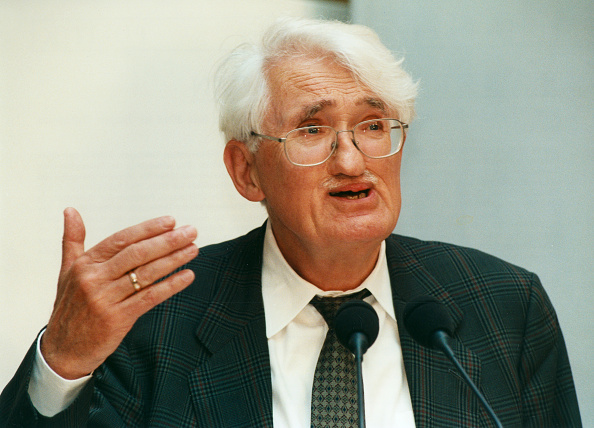
Authentic public intellectuals are a rare and endangered species. Alas, with the death of Jürgen Habermas yesterday, a titan of the German intellectual world and modern political philosophy, another has left us. During his life, he wasn’t simply treated as a philosopher but as a moral authority of post-war Europe. His enduring theories can be seen as a critique of the failed promise of the internet and provide valuable lessons in interpreting the whole structure of modern society.
It’s easy to see why he acquired this reputation. The common thread throughout his work up to the very end of his life was an effort to redeem the emancipatory promise of modernity and the Enlightenment against the disillusionment with it from the horrors of the 20th century.
In his seminal 1985 essay, “Modernity: An Incomplete Project”, Habermas proposed that modernity was not a “failed project”. Rather, the modern project of freedom that the Enlightenment brought had come into crisis. This did not mean a “return to tradition” or a celebration of fragmentation and nihilism. Instead, the project of emancipation needed to be rejigged, not through simple affirmation, but through a renewal of its basic assumptions.
He suggested an important difference between communicative reason and instrumental reason. Communicative reason is about people freely discussing ideas in public and reaching shared agreement without pressure. This idea comes from Kant’s view of public reason, where people decide things together as equals. Instrumental reason, by contrast, focuses on creating the most efficient systems to achieve a particular goal.
Now, one can certainly criticize the limits of Habermas’s political stances. He highly valued the EU as a vehicle of post-national social democracy, which is now a relic of the neoliberal era. Some of his critics on the Left express disappointment and allege that he betrayed a Eurocentrism because he said that Israel’s actions against Hamas after October 7 were “justified in principle”.
Perhaps the clearest strand of Habermas’s work was his theory of the public sphere in his seminal work, “The Structural Transformation of the Public Sphere”. For him, the bourgeois public sphere was a space distinct from the state. The citizens of civil society could gather to discuss matters of concern through open, rational debate in the public sphere. However, the development of mass society and the welfare state has led to a profound intertwining between the state and society, which has undermined the public sphere and its independence. Politics becomes less an engagement between citizens over their common life in society and more of a bargaining process between different organized interest groups.
Social media has amplified these problems. On one hand, social media seems to fulfill the promise of a Habermasian public sphere. “The public” could encompass the whole world, and even the most marginalized voices could participate in this republic of characters. The reality, though, is that rather than resuscitating a shared public sphere, the effects of social media have revealed its fragmentation. People are sorted into a cluster of smaller “publics” that live in radically different universes without any sense of a shared framework or references. Furthermore, the dominance of these platforms by an oligopoly and the distortion of communication by algorithms and monetization, which turns it into “data”, vindicates Habermas’ fear that instrumental reason colonizes communicative rationality.
The most important question Habermas can provoke in us is to ponder how to overcome the crisis of modernity. How can we fulfill the promise of freedom? The legacy of the Enlightenment haunts us, and we are compelled to realize its full potential. However, the creep of the internet, rather than liberating us, has encroached on private spaces and stifled meaningful public debate. To abandon this monumental task would be to fall short of Habermas, let alone the thinkers who shaped him.
Ralph Leonard is a British-Nigerian writer on international politics, religion, culture and humanism.
 buffsoldier_96
Join the discussion
Join like minded readers that support our journalism by becoming a paid subscriber
To join the discussion in the comments, become a paid subscriber.
Join like minded readers that support our journalism, read unlimited articles and enjoy other subscriber-only benefits.
Subscribe