









December 8 2025 - 1:00pm
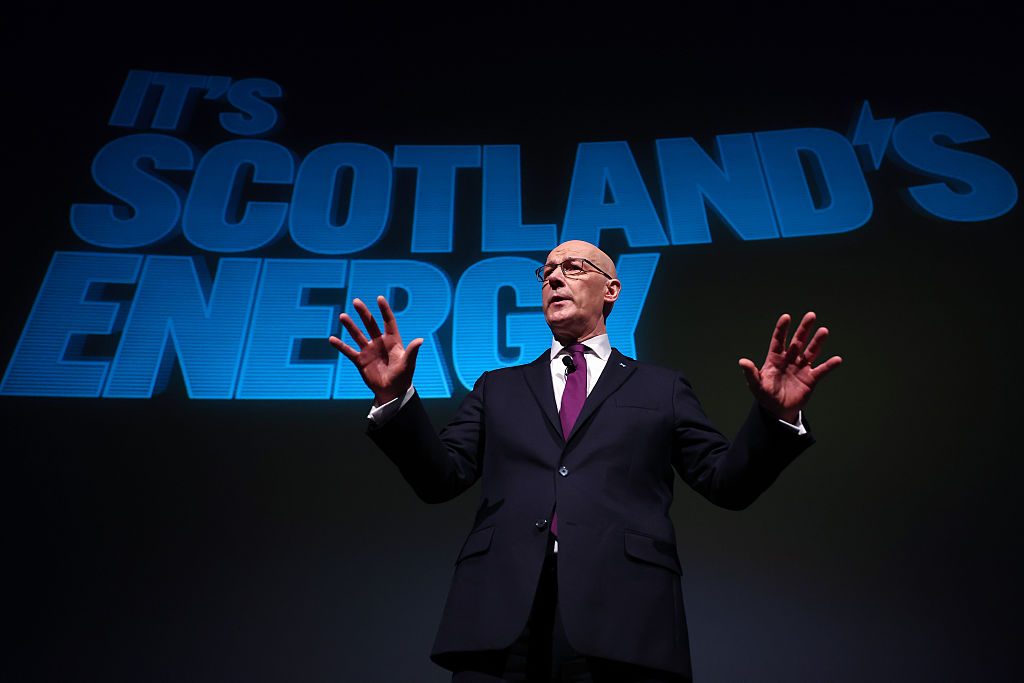
These are golden times for Scottish First Minister John Swinney. Speaking in Glasgow this morning, the SNP leader effectively launched his party’s campaign for the Scottish Parliament elections in six months’ time. He once again called on Scots to make this election the one that will deliver a second independence referendum, even though he knows the UK Government won’t agree to it. Despite this, his party will likely cruise to a fifth consecutive term in office.
One step toward winning emancipation from Westminster is through energy independence, which was the focus of Swinney’s speech today. The SNP leader claimed that the collapse of the North Sea oil and gas industry is all the fault of the UK Government’s windfall tax on oil profits. “It’s Scotland’s energy,” he declared. “If Keir Starmer does not change course he will enter our national story as a second Thatcher, a second destroyer of industry, a second destroyer of communities, and Scotland will not forget.”
Yet it is successive Scottish governments that carry much, if not all, of the blame for the steep decline of the industry. SNP ministers have for years been running down the North Sea on the grounds that fossil fuels are causing irreversible climate chaos, while Scotland’s last oil refinery, Grangemouth, closed earlier this year.
After COP26 in Glasgow in 2021, then-SNP leader Nicola Sturgeon announced a “climate emergency” and opposed any new oil and gas drilling in Scotland’s waters, such as the Rosebank and Jackdaw fields. Yet Swinney claimed today that if only Scotland were independent, the crisis in the industry would be halted and that “energy bills for Scottish consumers could be cut by a third.” Anyone who believes this would have to be incredibly naïve or be suffering from fairly serious memory loss.
A closer look shows that the SNP has actually been losing popularity. It is standing at around 33% in the Holyrood polls, down from the 47% it won in the constituency ballot in the 2021 Scottish Parliament elections. The SNP is not the force it was, but its decline has been masked by the crisis in the rival parties. The Scottish Tories have been flatlining and the Scottish Labour Party, which only last year looked likely to take over in Holyrood, has collapsed.
The big factor in Scottish politics right now is the emergence of Reform UK as a serious contender north of the border. A party that scarcely existed two years ago in Scotland now looks likely to win a solid bloc of Holyrood seats in May. Some recent polls have even suggested that Nigel Farage’s party could become the official opposition there. That a Right-wing anti-immigration party led by an English nationalist should be upsetting the applecart of Holyrood politics indicates just how much Scotland’s sociopolitical character has changed in the past couple of years.
Still, the headline beneficiary of this remains the SNP, which is losing some votes to Reform but not many. The other Scottish parties, the Greens excluded, are being crucified. The solution to the conundrum of the SNP’s success in failure is therefore simple: Swinney is riding back into Bute House on the back of Nigel Farage.
Iain Macwhirter was political commentator for The Herald between 1999 and 2022, and is the author of Disunited Kingdom: How Westminster Won a Referendum But Lost Scotland. He was Rector of the University of Edinburgh from 2009-12.
 iainmacwhirter