








December 14 2025 - 7:00pm
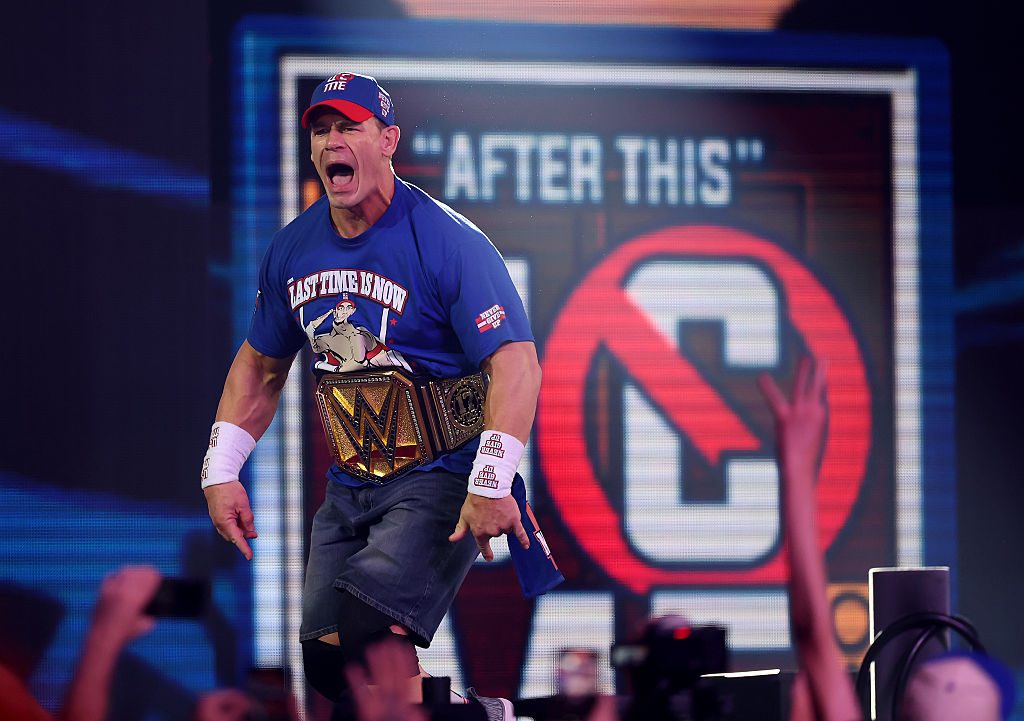
John Cena took his last bump on Saturday night in Washington DC. Entering his final match at 48, with 17 world championships and more than 650 Make-A-Wish requests to his name, Cena represented something that professional wrestling will never produce again: a genuine crossover star who belonged to everyone.
The man they once called “The Prototype” during his developmental years earned that nickname honestly. Cena looked like someone created in WWE impresario Vince McMahon’s build-a-Hulk Hogan laboratory. And for nearly two decades, he threaded the needle between children wearing his “Never Give Up” merchandise and adult fans who booed him relentlessly for representing corporate wrestling’s sanitized vision. The dueling chants of “Let’s go Cena!” and “Cena sucks!” became as much a part of his act as the five-knuckle shuffle.
Cena existed in a space where political neutrality remained commercially viable. He expressed muted dismay at the prospect of a second Trump term but has never formally endorsed anyone. He has stayed carefully in his lane, hawking Hondas and Experian credit reports, and filming Mandarin-language apologies when he accidentally acknowledged Taiwan’s sovereignty. The hustle he prided himself on was relentless and entirely apolitical.
Perhaps he learned his lesson from watching wrestling’s first great crossover star’s turbulent final decades. Hulk Hogan, who died in July at 71, spent his final years as a MAGA evangelist, ripping off his shirt at the 2024 Republican National Convention to reveal a Trump-Vance tank top. The man who once embodied Reagan-era unity became a partisan symbol for half the country and a villain to the other half. That will now become a more common path.
The company Cena leaves behind bears little resemblance to the operation he joined in 2002. WWE now sits under the TKO Holdings umbrella alongside UFC, a $25 billion portfolio that has transformed into what amounts to MAGA’s national sport. When Donald Trump entered UFC 309 flanked by Robert F. Kennedy Jr. and Elon Musk, it was as much a political rally for the “based” base as a sporting event. Meanwhile, Triple H, the former wrestler who now serves as WWE’s chief content officer, recently appeared at the White House to announce the return of the Presidential Fitness Test alongside RFK Jr.
The numbers tell a grim story about WWE’s future without Cena-level stars to anchor it. Raw’s Netflix debut in January drew 5.9 million global viewers. By late autumn, that figure had cratered to 2.3 million, a 59% decline, with the show failing to crack Netflix’s global top 10 for consecutive weeks. WWE’s $5 billion streaming deal was supposed to represent the future. Instead it has revealed how much the company was coasting on legacy appeal. The median age of a wrestling viewer has nearly doubled since 2000, climbing from 28 to 54. Look at WWE’s main event picture and you will struggle to find anyone under 30 of either sex. The roster lacks distinctive personalities.
Perhaps some current stars will find bit parts in films, but no one is going to jump from comic relief in forgettable movies like Trainwreck to mainstream success in fronting feature films and HBO’s Peacemaker series, as Cena has. Expect no more Cenas, no more Rocks, no more figures who can open a movie or sell a stadium of their own accord. The pipeline has dried up because the company that once manufactured myths now preaches entirely to the converted, manufacturing content for second-screen viewing by long-time fans, relying now on a MAGA-coded base.
Cena’s catchphrase was “You can’t see me”. For most of his career, it served as a taunt. On Saturday, it became a prophecy fulfilled. As he walked up that ramp for the final time, slower and stiffer than the man who debuted against Kurt Angle 23 years ago, wrestling lost the last star capable of uniting a fractured country around something as simple as watching a man in jorts pretend to fight. Politics and hyper-partisanship have seeped into every aspect of American life. It’s the “real Americans” who are worse off for it.
Oliver Bateman is a historian and journalist based in Pittsburgh. He blogs, vlogs, and podcasts at his Substack, Oliver Bateman Does the Work
 MoustacheClubUS
Join the discussion
Join like minded readers that support our journalism by becoming a paid subscriber
To join the discussion in the comments, become a paid subscriber.
Join like minded readers that support our journalism, read unlimited articles and enjoy other subscriber-only benefits.
Subscribe