









December 9 2025 - 6:30pm
Next year’s midterms are shaping up nicely for the Democrats. The party is overperforming in special elections and off-year contests up and down the ballot. Its lead in the generic ballot poll is growing, albeit marginally, and it may be winning the gerrymandering battle.
But one important place where Democrats have a taller mountain to scale is the US Senate, an institution that has long had a rural — and thus increasingly pro-Republican — bias. For Democrats to win back the Senate, they must not only defend all of their seats and flip the two GOP seats considered “toss-ups”, which would get them to 49 seats. They must pick up at least two more seats from states which voted for Donald Trump by double digits just last year, such as Alaska, Iowa, Ohio, or Texas.
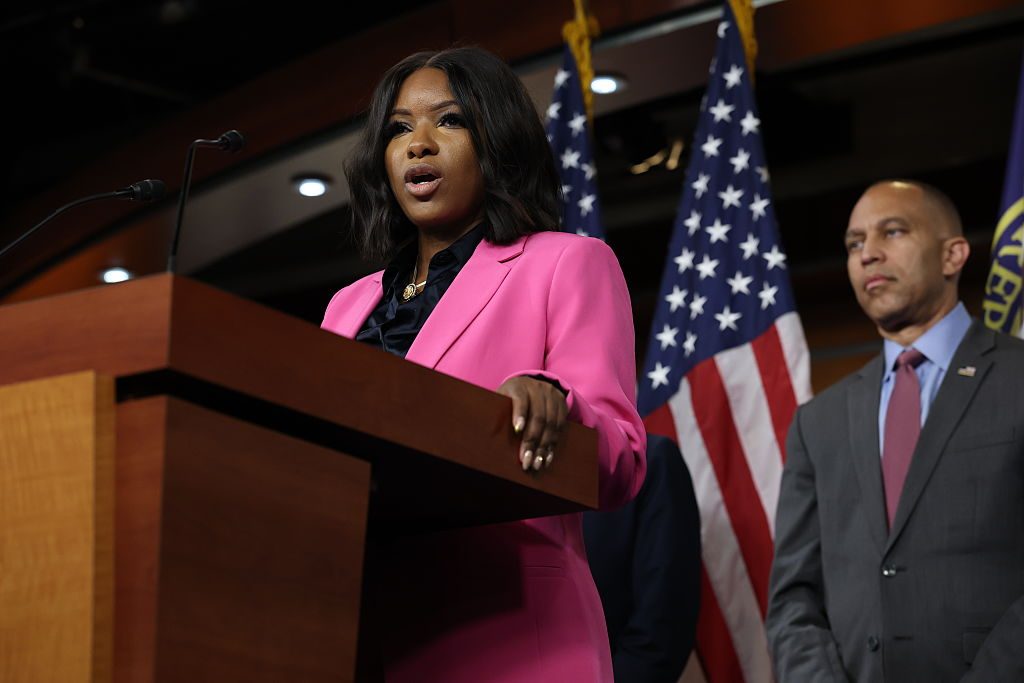
Enter Congresswoman Jasmine Crockett, who yesterday announced her candidacy for the Senate. The progressive Democrat has made a name for herself since arriving in Washington in 2023, largely by grabbing the spotlight to lob rhetorical bombs in every direction. Earlier this year, she mocked Texas Governor Greg Abbott for using a wheelchair. Last year, she said that Hispanics who voted for Trump — roughly 50% in Texas — have a “slave mentality”. More recently, she incorrectly accused EPA Administrator Lee Zeldin of taking money from Jeffrey Epstein (later claiming she never made the accusation), and suggested that black men who married white women were “whitewashed,” adding that “some of our skin folk are not our kin folk.”
Even in a state or district sympathetic to the Democrats, these comments would be non-starters for most people. To state the obvious: Texas is not a Democratic-leaning place. And early polls show that Crockett faces an uphill battle before her campaign has even taken off: just under half (49%) of voters in the state say they would “definitely not” vote for her in the race.
So, how does Crockett plan to win? Most Democrats running in states which lean Republican might have a strategy for winning over voters who backed Trump last year. But Crockett has a different view. In an interview with CNN this week, anchor Laura Coates asked her how she would win over Trump supporters, to which Crockett said it “wasn’t her goal” to convert the group. When asked whether she needed to, Crockett replied: “No, we don’t.”
Considering that Texas is a Republican state, this is a deeply misguided approach. The Texas Congresswoman seems to prefer a strategy of mobilizing a lot of “non-voting” racial minorities who would obviously vote for the Democrats if only someone convinced them to turn out. The issue is that several other progressive Democrats have tried and failed to replicate this in recent elections. One of the more high-profile examples was Stacey Abrams’s two campaigns for governor in battleground Georgia, both of which she lost, including one in a Democratic “blue-wave year”. But even in Republican-leaning Texas, Democratic Senate candidates have been trying to find success with this formula — to no avail.
Meanwhile, it’s also not clear that Crockett is running on any kind of agenda, as evidenced by the first ad of her campaign, which includes no speech from her. Rather than introducing herself to voters who don’t know her and who may be skeptical of her candidacy, the 45-second ad simply trains the camera on Crockett and overlays comments Trump has made about her.
Like trendy “Resistance” candidates of years past, Crockett is almost certain to attract extensive media attention and raise large sums of money. And early polling suggests she is an early favorite to win the Democratic nomination. But history shows that this success can be meaningless when a candidate is a bad fit for their state. Crockett also trails both of the top Republican candidates in the race by eight points.
Texas may have always been a long shot for Democrats, but running a candidate as polarizing as Crockett virtually ensures it won’t be an option for them this cycle. And they can’t say they weren’t warned.
