








February 17 2026 - 10:55am
A recurring theme at the Munich Security Conference last weekend was the resolve of European countries to rally together amid Russian threats and uncertain American security commitments. Yet, the conference was barely over before the German Foreign Minister, Johann Wadephul, criticized the French on Monday for “insufficient” defense spending. Unity at the heart of Europe may be desirable in principle, but it’s hard to come by in practice.
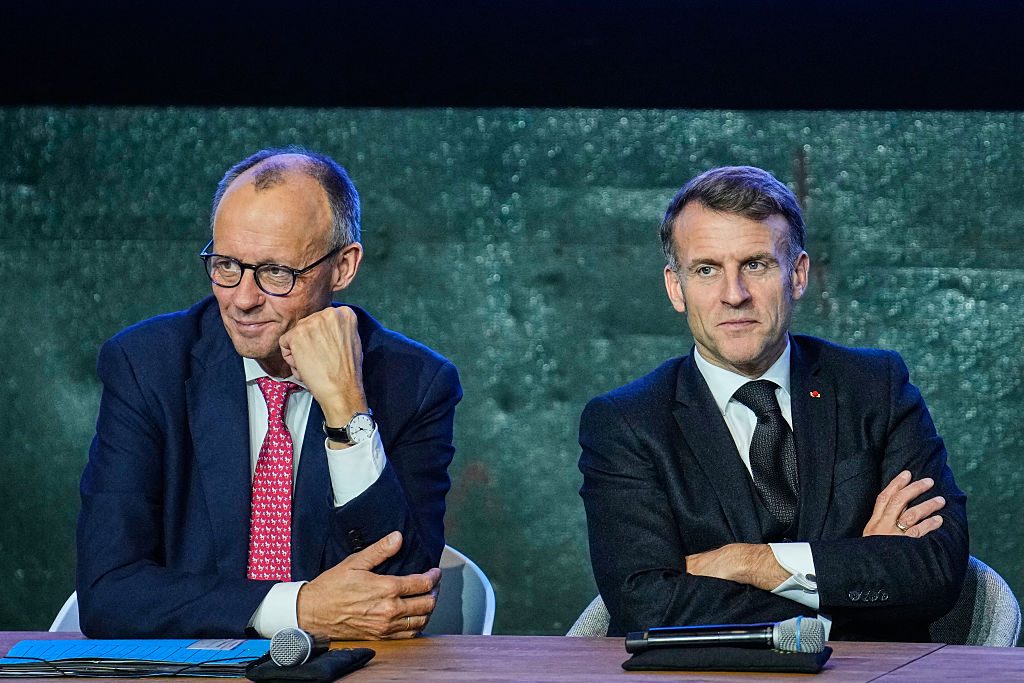
Wadephul’s comments come at a critical time for the Franco-German relationship. He criticized French President Emmanuel Macron for “repeatedly and correctly referring to our pursuit of European sovereignty”, without following through with a significant boost in defense spending. “Anyone who talks about it needs to act accordingly in their own country,” he added. But also on Monday, the two struck a somewhat different note when a German government spokesperson announced that Macron and German Chancellor Friedrich Merz were in talks over creating a joint European nuclear deterrent.
What appears to be a mixed message is the result of a fundamental mismatch between ambition and reality at the heart of one of Europe’s key alliances. After decades of visible tension, last year both Merz and Macron appeared keen to reboot the Franco-German relationship. They even managed to convey the new spirit so convincingly that the duo were dubbed “Merzcron” by some in the international press. But, despite these friendly lines, key problems remained under the surface.
France currently spends around 2.1% of GDP on defense, and has pledged to raise it to 3% with a view to extend raising spending beyond that. Germany, on the other hand, after decades of massive underspending, has upped its budget to 2.4% with a view to reaching 3.5% by 2029 and Nato’s new 5% commitment by 2035. To do that, Berlin exempted defense spending above 1% of GDP from its regular budget, funding the huge increase through debt. France can’t afford to do that. It already has the EU’s third-highest debt burden as a proportion of GDP after Greece and Italy, a figure which is almost twice the size of the EU’s 60% debt ceiling. France clearly has no room to maneuver.
The problem is fundamentally that Germany knows this and yet still publicly calls on France to raise this spending. This leaves only two ways to fund French rearmament. One is a deep economic transformation driven by welfare cuts and pension reform. This has always been wildly unpopular among the French public, even in times of economic prosperity. It’s evident in the past years of incredible political turmoil that there is no prospect of this happening anytime soon. Alternatively, EU debts could be pooled, something Macron has repeatedly called for but Germany won’t agree to. As the continent’s largest economy, it would have to shoulder France’s expenditure and somehow sell that to its own disgruntled electorate.
Even if money were no object, Paris and Berlin have subtle ideological rifts that are stopping progress. As an economy hugely dependent on exports, Germany also isn’t keen on France’s drive toward protectionism. Recently, the Mercosur trade deal between the EU and Latin American countries caused significant tensions between the two, with Berlin seeking new business opportunities while Paris was concerned about domestic farming and pushed for a “Made in Europe” preference. These examples only scratch the surface of a long list.
The desire to stand shoulder to shoulder is genuine and obvious in the emotion both French and German leaders often express when discussing the relationship between their two countries. But the reality of the two has a habit of getting in the way of idealism. The Franco-German relationship has never been straightforward. As the two are increasingly pushed into a corner by the world’s largest powers, closer cooperation is becoming an inevitability. But will the two waste valuable time squabbling over minor differences in the meantime? It looks likely.
Katja Hoyer is a German-British historian and writer. Her latest book Weimar: Life on the Edge of Catastrophe will be released in May 2026.
 hoyer_kat
Join the discussion
Join like minded readers that support our journalism by becoming a paid subscriber
To join the discussion in the comments, become a paid subscriber.
Join like minded readers that support our journalism, read unlimited articles and enjoy other subscriber-only benefits.
Subscribe