









April 12 2026 - 4:15pm
Dublin
On Saturday morning I visited Dublin, as fuel protests across Ireland entered their fifth day. In response to alarming price rises caused by the conflict in the Middle East, farmers and haulers have blockaded the oil refinery at Whitegate in east Cork, as well as fuel depots in Limerick and Galway. Traffic is near standstill on many of the country’s motorways, and 600 petrol stations are dry. Taoiseach Micheál Martin has told RTÉ that “because of these blockades, we are now on the precipice of turning oil away from the country.”
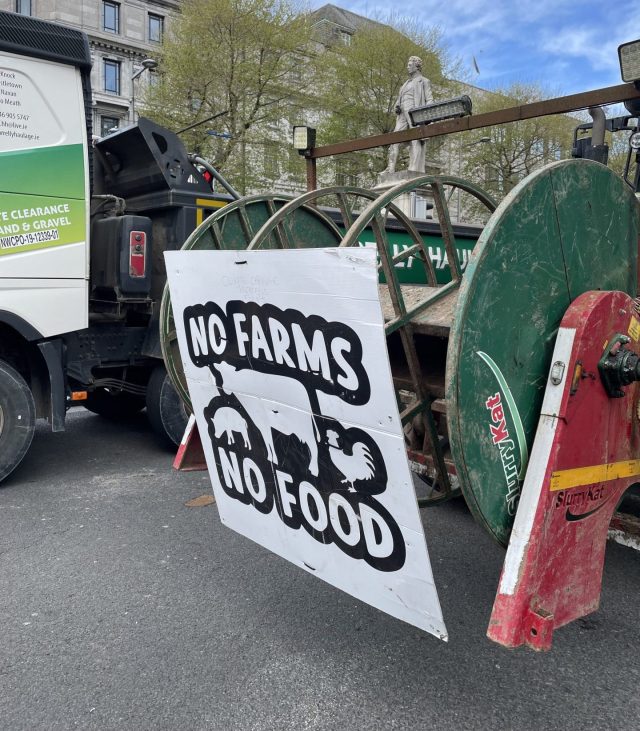
Yesterday morning, O’Connell Street was still occupied by a motley assortment of tractors, lorries, vans and coaches. The vehicles were frilled with bunting and tricolor flags. Signs hung from tractor cabs and car windows: “Taxed to Extinction”, “No Farms, No Food”, “Can’t Afford to Move”, and “Government – Remember Who You Work For!!!”
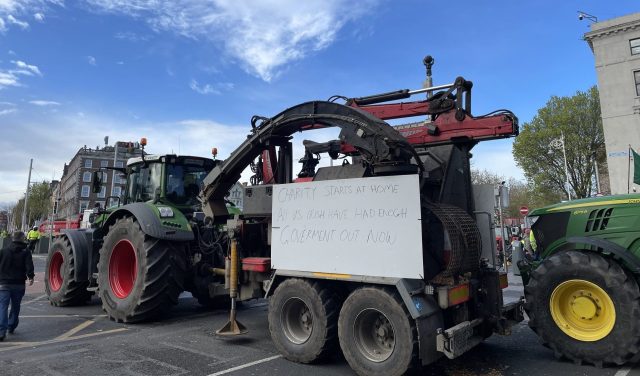
The mood was cheerful. Shops and cafes were open as normal. Ned Kelly’s Casino was blasting Katy Perry onto the street a little before 9am. A woman measured herself against a tractor’s rear wheel, laughing at the sheer enormity of the tire. Gardaí maintained a light presence at the southern end of O’Connell Street, where the blockade had spread to the bridge over the Liffey.
I met John beneath the bronze and granite O’Connell Monument. He had driven down from his home in County Cavan that morning. “It’s 20 tolls a week,” he told me. “That’s €200 cost before I put bread on the table. Every time you fill the tank, more than half of it goes to the government. And then there’s every other tax. The government gets more out of your wages than you do.” Acknowledging a need for wider change, he added: “We’re trying to make it sustainable to work for a living here.”
Seamus, another Cavan man, is a softly-spoken farmer. “We are here to get this corrupt government out,” he told me. “Diesel prices have practically trebled since they took power, and they don’t want to listen to us at all.” As in the UK, the economics of Irish farming have gone from bad to appalling. Often, according to Seamus, it is cheaper to let land lie fallow: “We have no margin left. Actually, we were going to be down money by plowing a field. It’s better to just walk away and leave it there.”
The protests began over the cost of filling the tank of a tractor or lorry, but they have become an opportunity to articulate a broader range of issues. John stressed that heating oil prices remain high. “If we want heat on in the house now, it’s €2000,” he said. “And this side of the winter, we’re just not doing it. So it’s hot water bottles — that’s the reality.”
Seamus bemoans the importation of cheap beef from Brazil. A recent scandal, when Brazilian beef raised on a banned growth hormone entered the Irish food chain last year, has not been forgotten. Among these protesters, trust in government is gone. When I approached one young guy for a chat, he was polite but firm: “There’s been enough talking.”
A temporary Fuel Support Scheme is planned, on the understanding that it will only be rolled out when protests end. Government ministers met with the Irish Farmers’ Association and the Irish Road Haulage Association on Friday. Seamus was bemused by the fact that Christopher Duffy, one of the protest movement’s most vocal spokesmen, was excluded from those negotiations. “They will have to talk to him,” the farmer insisted.
Whether or not Seamus is right, it remains to be seen how long the momentum of these protests can be maintained. Sympathetic onlookers may well feel differently when the reality of dry gas stations sinks in. And the government seems ready to take a harder line in the coming days. On Saturday afternoon, protesters were removed from the Whitegate refinery, and a water cannon sent to Cork. By Sunday morning, Gardaí had cleared O’Connell Street too.
Beyond the blockades, another challenge waits for the government — addressing the lack of faith in both Micheál Martin and Ireland’s broader political class. “I have more faith in the pigeons that’s walking around the street here,” John said. “And that’s the truth.”