










March 9 2026 - 10:30am
Austin, Texas.
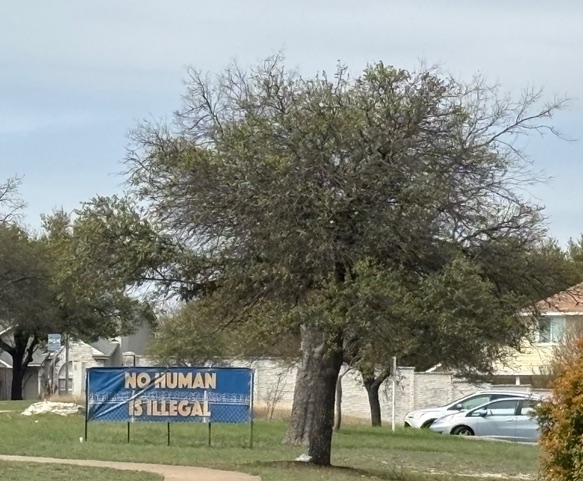
From the street, Saint Andrew’s Presbyterian Church — of which James Talarico, the newest star of the Democratic Party, is a member — is a humble affair. A small church in a North Austin suburb, with a “No Human Is Illegal” banner on the lawn, it is easy to miss when driving past. That said, the sign by the entrance, which states that while everyone is welcome, federal agents need a warrant from a judge to enter, struck me as impressively spicy.
Last week, immediately after Talarico won the Democratic nomination for the Senate, clips of the baby-faced seminarian taking theological stances began to spread. They are, shall we say, unconventional for a Texas politician. Talarico was seen preaching on the importance of trans abortion rights, citing the Gnostic Gospel of Thomas with approval, and explaining why God is non-binary.
Yet, despite the week’s dramatic events, Sunday’s service got off to a calm, conventional start. There was no victory lap, not even a mention of Talarico. Instead, newcomers were welcomed, and empathetic statements were made about the recent mass shooting in Austin. After a short puppet show for the children, we sang some wishy-washy modern songs about unity, love and community that studiously avoided direct mention of God. It was all very inclusive. Around 200 people were in attendance — mostly though not exclusively white, a mix of young and old. Given that Presbyterianism in the US is in steep decline, Talarico’s church seemed to be bucking the trend.
I did wonder if anyone would ever get around to talking about the Bible, though. That finally happened when we got to the reading, from Mark 14 (as translated in the “Inclusive Bible” version, of course). In this passage, Jesus, in the Garden of Gethsemane, predicts that Peter will disown him three times before morning. The preacher then spoke of her own experience living in denial, both in 12-step programs and — due to her internalized homophobia — as a lesbian in a cisgendered, patriarchal world. She then made a sudden switch to talking about Germany in the Thirties, and the parallels with modern America. She performed all the classics: Hitler, Trump, the patriarchy, Pastor Niemöller, the threat of Christian nationalism and, at the end, threw in a bit of “No Kings” for good measure.
The service was drawing to an end, and Jim Rigby, the Saint Andrew’s minister and a mentor to Talarico since he was a child, stepped forward to add a few comments. The sermon was not too political, he said, because Easter is an inherently political story, as Christ was the victim of state violence. Saint Andrew’s would soon become the focus of a lot of attention, but he cautioned the members that the most dangerous moment is when you are winning, because you could get too confident and make mistakes. Some shout-outs were made to Buddha and Muhammad, and then everyone was invited to communion. Christ didn’t intend to start a religion, said Rigby: a lot of stuff was added later by others.
Many have pointed out the parallels between “wokeness” and religion, so much so that the comparison has become a cliché. And yet here it was, wokeness as actual religion, with the tenets of the Apostle’s Creed supplanted by those of an “In This House We Believe” lawn sign and contemporary pieties dressed up in the clothes of sacred ritual. In recent months, many Democrats have attempted to downplay ideology, preferring to talk about affordability, education and healthcare. So far, it has been a successful strategy. Yet in interviews, Talarico’s eyes gleam with the earnestness of a true believer. With so many clips in public circulation, whether he will be able to successfully pull off such a maneuver himself remains to be seen.
Daniel Kalder is an author based in Texas. Previously, he spent ten years living in the former Soviet bloc. His latest book, Dictator Literature, is published by Oneworld. He also writes on Substack: Thus Spake Daniel Kalder.
 DanielKalder