









6 Nov 2026 - 4:00pm
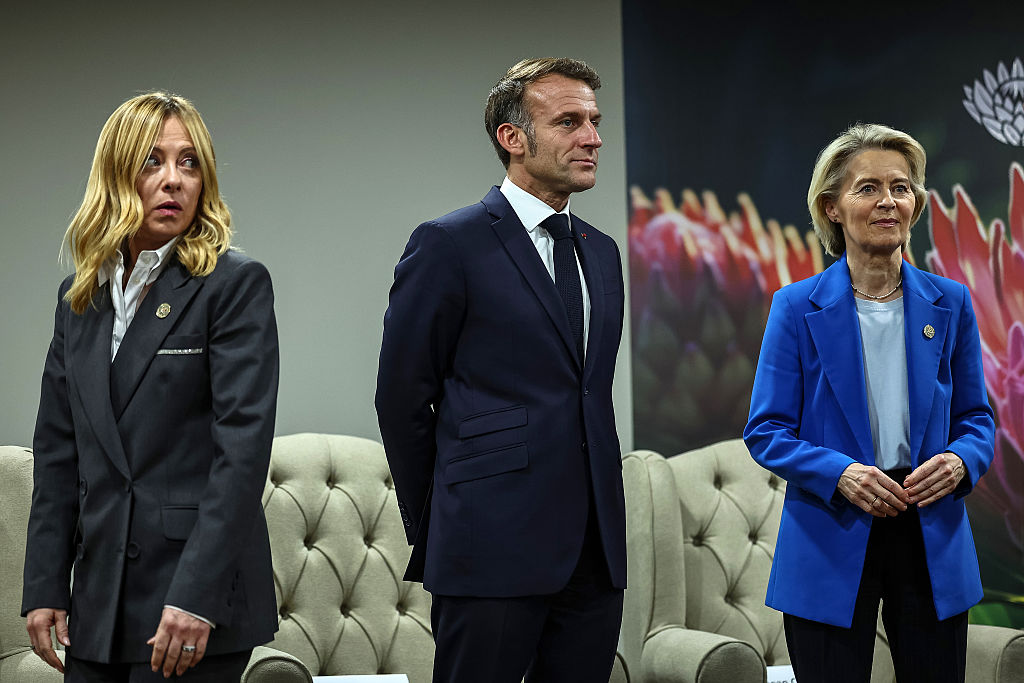
Italian Prime Minister Giorgia Meloni is not happy about the European Union’s approach to Ukraine negotiations. In a letter to European Council President António Costa this week, she demanded a discussion on who will lead the EU in coming talks, arguing that the bloc’s current fragmentary approach leaves it powerless.
“By projecting the image of Europe acting in an uncoordinated manner, we’re doing nothing but serving the interests of those who want this war to continue,” Meloni wrote. Her criticisms come in the wake of a messy cluster of European attempts to contribute to Ukraine talks. These include French, German and British participation in discussions between the US and Ukraine in Miami, a meeting of European states in Oslo, and a phone call with Vladimir Putin held by Finnish President Alexander Stubb and Norwegian Prime Minister Jonas Gahr Støre late last month.
With the US set to mediate talks between Ukraine and Russia in Abu Dhabi next week, Meloni rightly fears that the EU — which bears the financial brunt of supporting the war, and which arguably has a much greater stake in Kyiv’s future security than the US — risks being “condemned to irrelevance”. She called for “a decision to be made once and for all as to who sits at the negotiating table representing the EU, and with what mandate”.
Meloni is, in typical fashion, stating an obvious truth that much of the EU doesn’t want to face. The bloc is, rather pathetically, insisting on a “seat at the table” — but nobody knows which of its many representatives speak for its interests. The same can’t be said for the other key players: Ukraine, the US, Russia and China all have powerful leaders bearing individual responsibility for their sweeping decisions. The EU, by way of contrast, is the very definition of “rule by committee”.
Yet even agreeing to a negotiator won’t solve this problem. Many favour nominating a national leader, or group of leaders; Stubb and Støre have been mentioned, as have Czech President Petr Pavel and Meloni herself. Yet with voters across the bloc struggling to see eye to eye on so many fundamental issues, including the Ukraine war, the elevation of a national leader to hold EU-wide authority becomes problematic. A Vox supporter in Spain or a Die Linke voter in Germany may well ask why their interests should be represented by the president of a country they have never visited.
This brings us to the elephant in the room. The two most relevant leaders of the EU machinery, Commission President Ursula von der Leyen and foreign affairs chief Kaja Kallas, can both claim an EU-wide mandate, even if it’s a flimsy one, having been approved by the elected European Parliament. Speaking bluntly, one might ask whether representing the EU in such matters is not the whole point of Kallas’s job.
Yet Kallas has painted herself into a corner on Ukraine with her famous hawkishness, having repeatedly made statements to the effect that Russia cannot be allowed to gain anything at all from its invasion, and that any compromise with the aggressor is unacceptable. Von der Leyen has taken a similar stance; for both, refusal to engage with Putin except from a position of dominance has become axiomatic. As Pavel himself pointed out last month, the Russian President “doesn’t want to talk to Ursula von der Leyen, he doesn’t talk to Kaja Kallas”.
António Costa is seen as a “more honest broker” by EU diplomats, but he appears timidly reluctant to take up the authority that some wish to thrust upon him. Now these EU leaders, by turns too reticent or too inflexible, have left the bloc’s very seat at the table in doubt.