








January 7 2026 - 10:45am
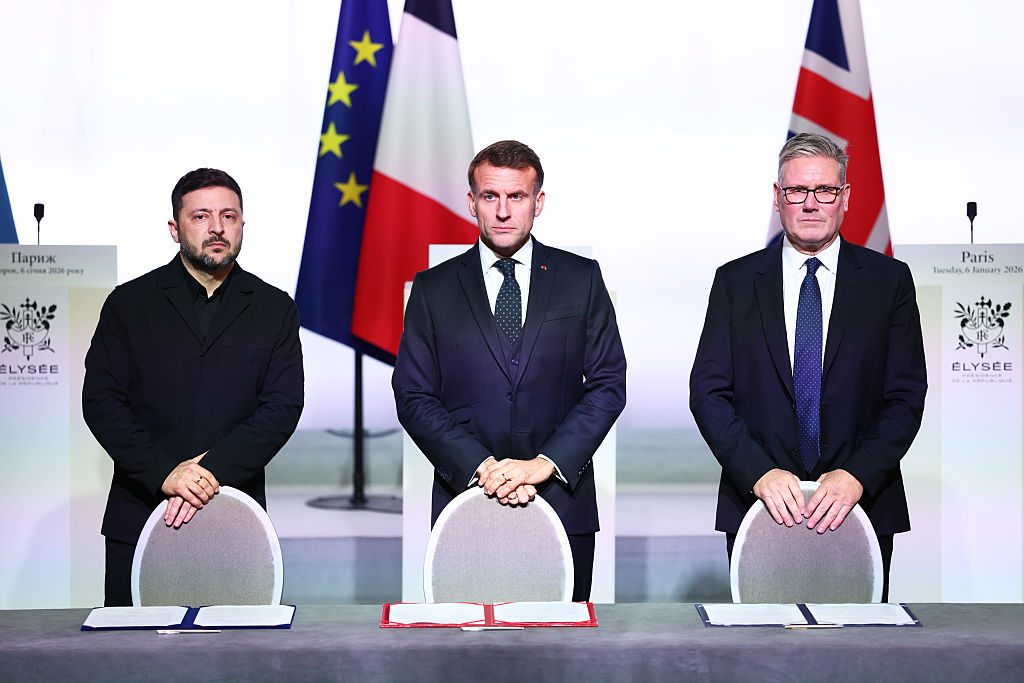
Yesterday at a meeting in Paris, Ukraine’s allies appeared to agree on security guarantees for the war-torn country in the event of an end to its war with Russia. A joint statement from the “coalition of the willing” declared that there will be “reassurance measures in the air, at sea and on land and for the regeneration of the armed forces of Ukraine”. It also said that “these elements will be European-led”, but aided by non-European members of the coalition with “proposed support” from the US. But this statement contained some critical ambiguities.
These ambiguities are presumably intended to make the future Western military commitments to Ukraine strong enough to reassure Kyiv and allow Volodymyr Zelensky to claim victory. At the same time, the commitments are intentionally weak enough to avoid both a commitment by the US to go to war with Russia and for the Europeans to actually place significant forces in Ukraine. Both France and Britain have committed to “military hubs” in Ukraine and boots on the ground, although no numbers have been given. Yet even with the tentative language of the joint statement, the present British and European strategy is running enormous risks.
It should be noted that the statement only talks of “proposed” US support, and of “reassurance measures” without saying exactly what — and more importantly, where — they will be. This is significantly vaguer than the European draft statement leaked to AFP before the meeting. It allowed German Chancellor Friedrich Merz, for example, to make the farcical “commitment” that “Germany will keep contributing politically, financially and militarily”. As an example of cryptic doublespeak, he added: “This could, for example, include deploying forces to Ukraine on neighboring Nato territory after a ceasefire.”
Keir Starmer appeared to go much further, stating that the joint declaration “paves the way for the legal framework under which British, French and partner forces could operate on Ukrainian soil”. When it comes to British and French military hubs, they could merely refer to Nato weapons dumps guarded by a small number of Nato troops. It is unlikely to involve substantial ground forces, as Britain and France cannot provide them without dedicating their entire armies to the effort. If so, it is conceivable that Moscow could agree to this, but Russia would demand precisely the sort of concrete, detailed limits on these forces that the “coalition of the willing” so far appears determined not to provide.
The Europeans clearly think that even the limited US endorsement they received in Paris represents a significant success. It may, however, turn out to be a Pyrrhic victory, and not only because Russia is likely to reject any such peace framework. It is because US support for the coalition will come at a price, and the price could be Greenland.
In another joint statement on the sidelines of the Paris talks in response to US threats, six European leaders declared that “Greenland belongs to its people”. “It is for Denmark and Greenland, and them only, to decide on matters concerning Denmark and Greenland,” the statement read. Within hours, the White House stated that “acquiring Greenland is a national security priority of the United States, and it’s vital to deter our adversaries in the Arctic region”.
Danish Prime Minister Mette Frederiksen said on Monday that if the US took Greenland by force, Nato itself would collapse. In these circumstances, it seems truly weird for European countries to be asking for US guarantees for European troops in Ukraine, which would be totally dependent on US support.
For if dependence on the US over Ukraine forces the Europeans to acquiesce in a US seizure of the territory of a European Nato member, the humiliation would be so deep that the very idea of Europe as a significant player in world affairs would vanish. In order for American protection, Europe would have to concede that Washington can take any piece of land it wants. The incompetence of European statecraft and diplomacy over recent decades makes this predicament unsurprising. Future generations are likely to see it as evidence of collective insanity.
Anatol Lieven is a former war correspondent and Director of the Eurasia Program at the Quincy Institute for Responsible Statecraft in Washington DC.
 lieven_anatol
Join the discussion
Join like minded readers that support our journalism by becoming a paid subscriber
To join the discussion in the comments, become a paid subscriber.
Join like minded readers that support our journalism, read unlimited articles and enjoy other subscriber-only benefits.
Subscribe