









July 20 2026 - 6:30pm
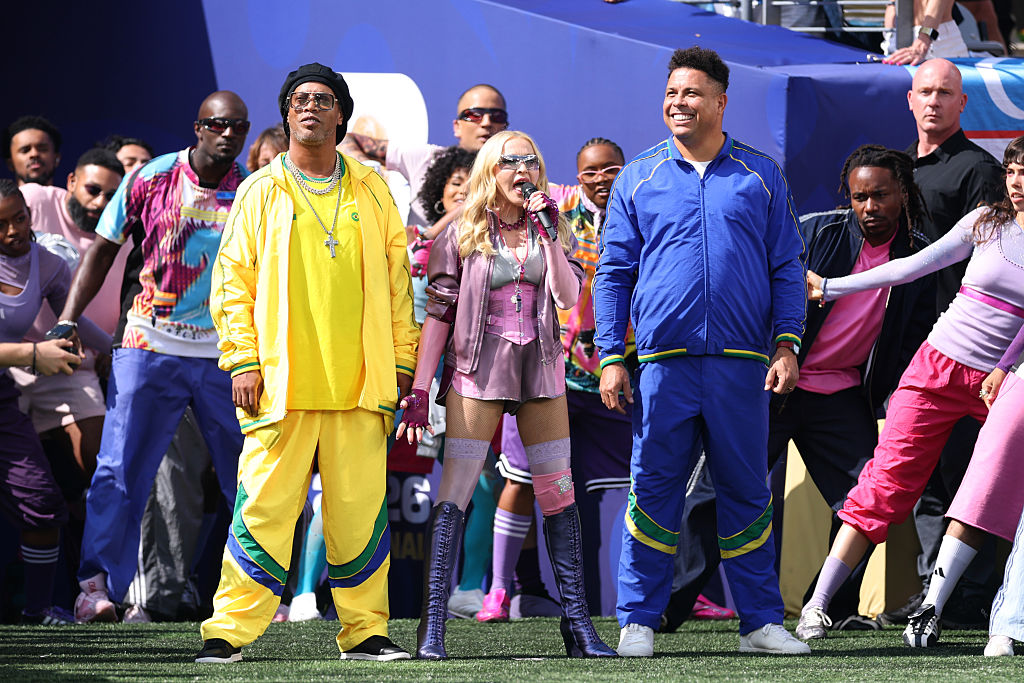
During yesterday’s World Cup half-time show, as a 67-year-old Madonna appeared on the MetLife Stadium jumbotrons in a mini-skirt, riding atop a neon-purple vehicle driven by Brazilian footballing legends Ronaldinho and Ronaldo “El Fenómeno”, it was hard not to think: “This is fun. Why not?” However, that would be the take of the clod who eats his Soylent Green and thanks his captors for only poisoning him a “little bit”.
Here’s why not. Part of the World Cup’s appeal is the sacredness that comes from being the last mass ritual the entertainment complex hasn’t colonized. International football is so beloved because it is — or rather was — anti-commercial by design: two unbroken 45-minute halves, no ad breaks, no half-time entertainment show. The game’s refusal to stop was the whole point.
What 2026 makes undeniable is that Fifa no longer respects any of that. The world’s game is transforming into “soccer”. In other words, it’s getting Americanized from top to bottom. Before his death, the Argentinian footballer Diego Maradona predicted that “the Americans want to make the football four quarters of 25 minutes, for the advertising.” Few offhand remarks have proven more prescient. Even though many of the US stadiums have enclosed roofs and air conditioning, the 2026 World Cup introduced “hydration breaks” in every match — a device Fifa first trialed in the heat of Brazil 2014, now made standard even in climate-controlled domes where no one is in danger of anything other than boredom.
Not only do the breaks disrupt the flow and continuity of the game, but they allow coaches to play a much bigger role, which makes the sport more reminiscent of American gridiron “football” — a militaristic sport where coaches function like generals and the only player allowed to make his own decisions on the field is the quarterback, who operates like a field lieutenant.
Football is nearly the opposite. Tactics matter somewhat, but as Welsh maestro Gareth Bale admitted in a recent interview, Real Madrid won three Uefa Champions League titles with minimal coaching tactics. More than any other sport, football is an organic team game where the physical and psychological communion of the players on the pitch decides the outcome. Not after 2026, though. Now coaches can insert themselves into the action, just as in basketball, volleyball, and gridiron football — making the experience less organic and fluid.
Then there’s the surveillance layer. The 2026 World Cup will almost certainly be remembered as the tournament where VAR transformed the sport into one that offered an answer to Big Brother. The tournament’s more than a dozen controversial goals disallowed after the fact feed the Americanization of the sport. Video reviews of refereeing decisions began in NFL hand-egg “football” and migrated from there to the NBA. And while the NFL has recently improved its process, many NBA fans and commentators are so frustrated with their sport’s endless reviews of mundane calls that they’d rather go back to the days when people accepted that mistakes would be made.
Now, in a truly American experience, Fifa offers its fans the worst of all worlds: time-consuming reviews that disallow legitimate goals, as well as a suspicious reluctance on calls that might undermine superstars like Lionel Messi, whom officials might wish to elevate. Fifa has embraced spectacle, profit, and cronyism over the purity of the world’s most beautiful game. The rest of the world should resist — loudly, and now — because America’s entertainment complex only devours in one direction. Nothing it colonizes returns to form. Fans will not be pleased with how things devolve from here.
B. Duncan Moench is a writer and scholar of American political culture. He also writes the Producerist Substack.
 DuncanMoench