








January 5 2026 - 1:00pm
The US capture of Venezuelan President Nicolás Maduro was likely also intended as a warning for other governments which, in Defense Secretary Pete Hegseth’s words, are seen to be “effing around” with Washington. Now, Donald Trump has returned to musing about the Arctic island of Greenland. “It’s so strategic right now,” the US President told reporters yesterday, reiterating that control of the territory is central to defending American — and Western — security interests against the twin threats of China and Russia. For years, Beijing has shown strategic interest in the territory. “Denmark is not going to be able to do it,” he added, in reference to defending Western interests.
In contrast to the “one dog sled” that Trump mockingly claims Denmark has added to bolster security, an expanded US presence might entail a return to — or even an extension of — Cold War-era basing of strategic bombers and long-range strike capabilities.
The Scandinavian and Baltic response was immediate and unwavering. “The US has no right to annex any of the three nations in the Danish Kingdom,” said Denmark’s Prime Minister Mette Frederiksen, urging the Trump administration to “stop the threats against an historically close ally”. On X, the prime ministers of Norway and Estonia stressed that “Greenland is an integral part of the Kingdom of Denmark”. Swedish PM Ulf Kristersson chimed in: “Sweden naturally stands by its neighboring country.”
Yet the issue is not as black-and-white as these leaders suggest. Instead, it was Stephen Miller, Trump’s Deputy Chief of Staff, who captured the uncomfortable truth with a provocative comment: “Not long after World War II the West dissolved its empires and colonies and began sending colossal sums of taxpayer-funded aid to these former territories.”
This has certainly been the case for Denmark, whose relationship with Greenland has become steadily more decolonized in the decades following the introduction of limited home rule in 1979. In 2002, former Greenland prime minister Lars Emil Johansen said that “we’ve had enough of others deciding over our heads,” accusing Denmark — the “colonial power” — of “not realizing that Greenlanders can speak, think and negotiate [on their own]”. Seven years later, the island was granted full self-rule, the most consequential feature of which was the right to terminate its relationship with Denmark should it so choose — even as Copenhagen continued to contribute substantial funds to its budget.
The Self-Government Act was ceremonially handed over to Greenlanders by Queen Margrethe II of Denmark, who described it as “a big moment, also, for me”. Other members of the Danish establishment joined in the celebrations. Dressed in traditional Greenlandic garments, then-Prime Minister Lars Løkke Rasmussen insisted: “We are building on the premise that a people takes responsibility for its own country. It is now up to Greenland itself to build further.”
This notion that Greenland constitutes a sovereign political entity has since been reinforced not only rhetorically but increasingly at the institutional level as well. Since 2023, Greenland has maintained its own representative in Nato’s headquarters in Brussels, meaning that the island is in practice being treated as a distinct participant in the alliance irrespective of Denmark’s formal membership.
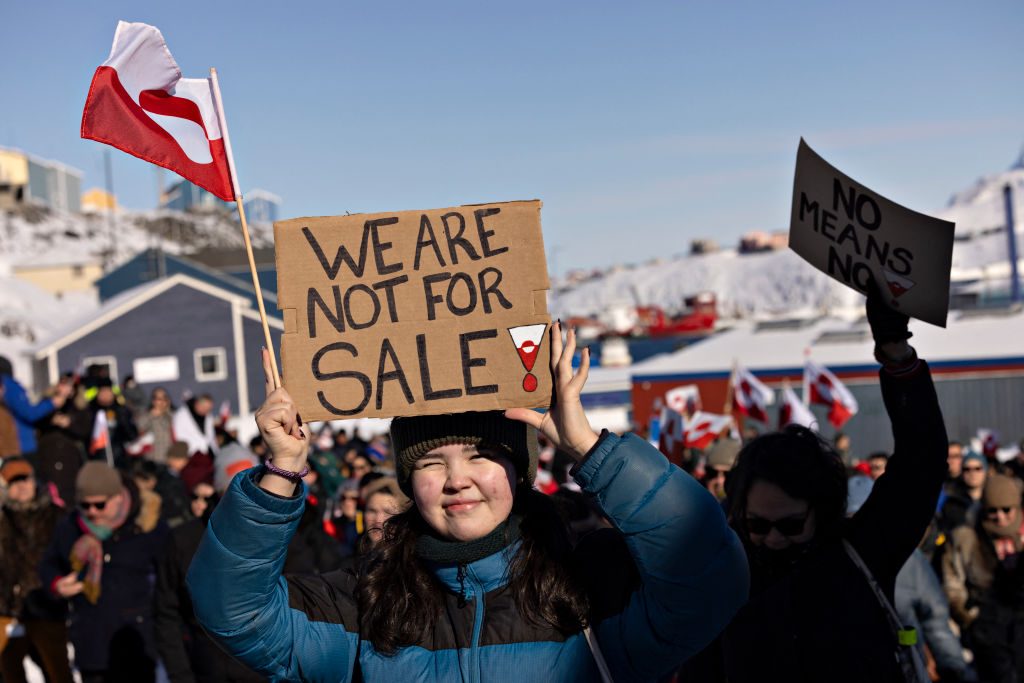
Against this backdrop, the heavy-handed response from Denmark and neighboring states to Trump’s designs on Greenland is surprising, and not a little counterintuitive. Why not let Greenlanders themselves respond to America’s overtures, as they have repeatedly demonstrated they are able to do? Statements to the effect that Greenland is an “integral part” of Denmark, alongside demands for “full respect for the territorial integrity of the Kingdom of Denmark” and the recent decision to alter the royal coat of arms to give the island greater prominence, instead imply that there are in fact limits on the freedom of choice formally guaranteed to Greenlanders under the 2009 Act. But if so, why embrace the language and symbolism of postcolonial politics at all?
Denmark would be in a stronger position to assert its claim over Greenland — if it genuinely believes it is better placed than the US to shield the island from Russian and Chinese competition — had it not worked so deliberately to cultivate and legitimize Greenland’s political autonomy. There is a lesson here, perhaps, for other European powers burdened by colonial guilt.
Johan Wennström is a Research Fellow at the Swedish Defence University and author of the The Stay Behinds: Sweden’s Cold War Guardians.
 johanwennstrom
Join the discussion
Join like minded readers that support our journalism by becoming a paid subscriber
To join the discussion in the comments, become a paid subscriber.
Join like minded readers that support our journalism, read unlimited articles and enjoy other subscriber-only benefits.
Subscribe