









June 12 2026 - 4:00pm
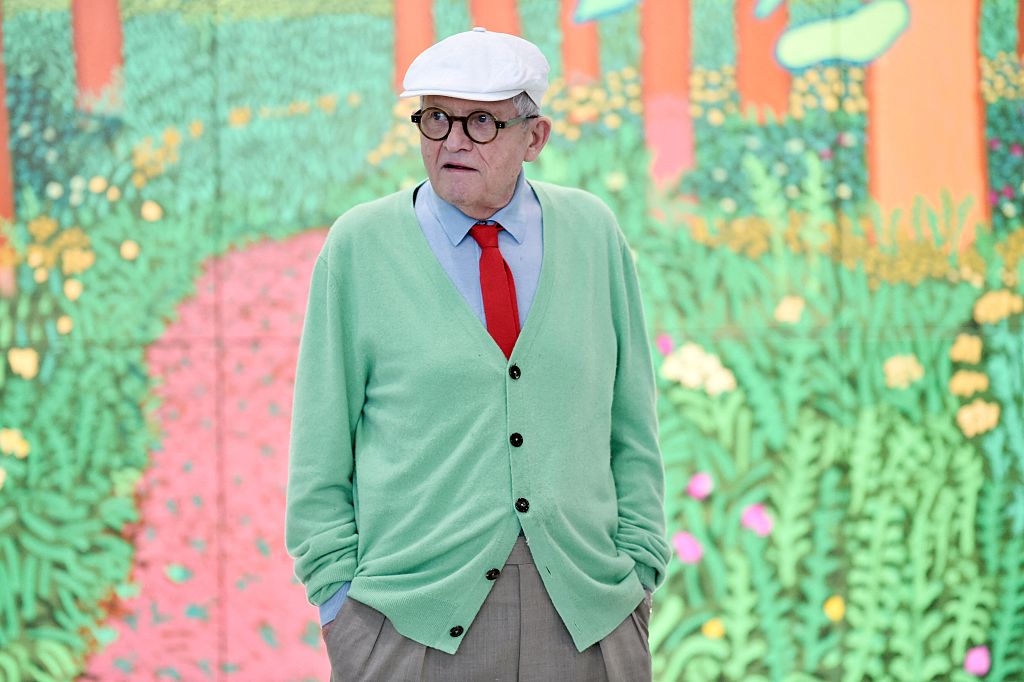
The achievement of David Hockney, who has died at 88, was to attain that rarest form of fame: recognition not merely among the glitterati and gallery-goers but among the gormless philistines who know only where the gallery café is. The platinum hair, the round spectacles, the cigarettes whose virtues he extolled in these pages, the Yorkshire accent untouched by metropolitan varnish: all formed part of one of the most recognizable public personae in British cultural life.
His death marks the passing of a distinctly British cultural type. There was a time when painters occupied a surprisingly prominent place in our national imagination. One did not need to know much about Bacon, Freud or Hockney to know who they were. Their names escaped the pages of the Burlington Magazine and entered ordinary conversation.
Today, by contrast, painters are largely confined to the world of curators, patrons and foundation boards. Hockney belonged to the last generation for whom artistic fame retained something of its older authority: the assumption that a painter might have something worth saying not merely about art but about life itself. The point, always, was to remain intelligible even to the analphabetic in art history.
Yet beneath the bluffness lay one of the most consequential artistic careers of the postwar era. Hockney became the public face of a Britain shedding several old inhibitions at once. When he entered public consciousness, Britain was a country of shortages and prohibitions, deference and pudeur. By the time he became a national institution, Britain was an altogether wealthier and more permissive society. Few artists came to embody that transformation more vividly. Hockney was openly gay long before such openness became unremarkable; unapologetically sybaritic in a culture singularly hostile to pleasure; and mesmerized by the aesthetics of prosperity at a moment when many of his loftier compatriots still regarded consumer society with disdain.
This helps explain the extraordinary resonance of the Californian paintings. Their subject was not really swimming pools but America itself — or rather, a certain idea of it, as viewed from across the pond. Hockney, a petit-bourgeois Bradford boy, arrived in Los Angeles in the mid-Sixties fresh from the drab afterlife of austerity Britain. There, he encountered a world of palm trees, modernist villas, young men in short shorts, and the curious spectacle of vast quantities of water devoted entirely to leisure. The shock of discovering what the art critic David Sylvester called “Coca-Cola culture” never quite left him.
The premise of A Bigger Splash is simply that there is enough water here to maintain a private swimming pool in the desert. Viewed from postwar Bradford, this bordered on science fiction. Hockney’s great asset was his glorious Britpoor gaze. Nobody has ever painted affluent America with greater gratitude.
He was, crucially, not merely a Yorkshireman abroad but a gay Yorkshireman abroad. His artistic maturity coincided with a Britain in which homosexuality remained criminalized. California, therefore, represented not simply opulence but liberation, offering freedoms both pecuniary and sexual. Where his snooty coevals back home saw America as a vulgarly materialistic dystopia, Hockney saw an abundancemaxxing society of affluence and disinhibition. In this respect, he was doing more than painting California. He was helping Britain learn to regard prosperity without embarrassment.
There was, admittedly, a danger in all this. The Californian paintings were so perfectly realized, so completely attuned to a particular historical moment, that the rest of Hockney’s career can sometimes feel like an extended coda. Yet perhaps it was to his credit that he abandoned his signature style almost as soon as he had found it. Lesser artists spend their lives repeating the picture that made them famous. Hockney, however, turned to producing photographic “joiners,” assembling dozens of images into fractured wholes that owed as much to Cubism as photography. Later came the vast Yorkshire landscapes, multi-screen video installations, and iPad paintings.
Not every critic was persuaded. During the high tide of conceptual art, Hockney’s popularity often counted against him. He seemed too cheerful, too accessible, too committed to beauty. Yet, with the sophistication of hindsight, it is evident that Hockney inspired an affection that exceeded admiration. Ordinary Brits genuinely liked him. He seemed to personify many of the changes that transformed the country for the better: the provincial who became a global celebrity without surrendering his accent; the homosexual who no longer felt obliged to conceal himself; the self-styled “anarchist-socialist” who enjoyed worldly success. There was something reassuringly postwar British about all this.
Above all, however, Hockney enlarged the realm of the permissible. We owe him no small debt for helping free us from the constraints of a lingering puritanism, even for those of us who never quite managed to see American suburbia as Arcadia.
Pratinav Anil is the author of two bleak assessments of 20th-century Indian history. He teaches at St Edmund Hall, Oxford.
 pratinavanil