









October 6 2026 - 10:00am
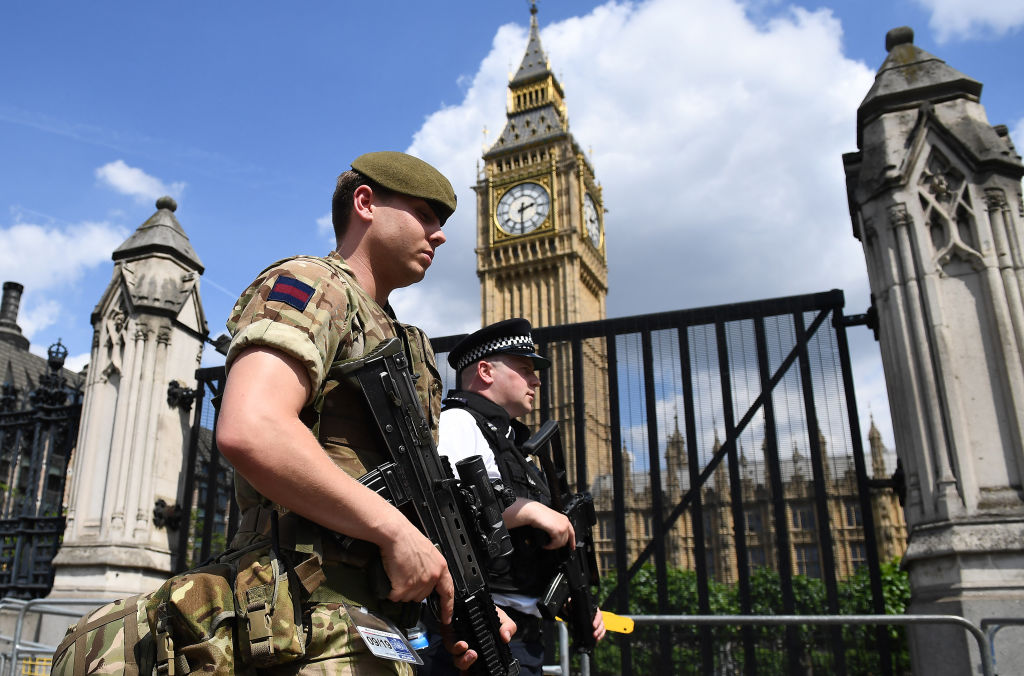
Britain finds itself in a peculiar position with regard to terrorism. That word has been used for the past 25 years to justify creeping police powers, surveillance, and other measures imposed on British citizens. Yet the country is now facing a rising threat of terror attacks, and appears paralyzed.
The news this past weekend illustrated Britain’s exposure to various sources of political and ideological violence. Two Iranian men who entered the country by small boat have been charged over an alleged bomb plot against the Jewish community in Manchester. Meanwhile, police are still investigating a suspected terror plot at RAF Fairford, the Gloucestershire airbase from which American planes have been launching missions against Iran. The US has deemed the base vulnerable enough that it has now removed its aircraft from the location.
Yet another terrorism story concerns the young man charged with murdering Ann Widdecombe this summer, who has now also been charged with preparing an attack against Nigel Farage. Even the Omani pilot last week accused of hijacking a plane bound for Israel has a peripheral link to Britain, having completed a long-distance course at Buckinghamshire New University three years ago.
In response to this disturbing situation, the Government will continue proscribing organizations and handing more powers to the police and security services, yet its impotence is only becoming more apparent. There is a refusal to secure the country’s borders against illegal entry, or to reform an asylum system that is open to abuse, which means that potential attackers like the two men charged last week will continue to slip through the net. It was only last month that a senior Hamas operative was revealed to be living as a refugee in Britain, where he had been plotting terror attacks.
Nor has the wider political class united to defend Britain’s Jewish community from Islamism, as demonstrated by the Green Party’s new policy declaring Zionism to be racism. For all the resources devoted to surveillance, the state clearly cannot interdict every radicalized and violent individual either.
What’s worse is that Britain’s polarization has advanced to the point where, although outright support for terrorism remains rare, there is a growing tendency to treat violence as understandable in the circumstances. Since the October 7 massacre by Hamas in Israel, parts of the Left have leaned towards this stance on Islamist attacks. Meanwhile, far-Right terror incidents have been sporadic and mostly foiled in advance, but one does not need to look far in conservative circles to find people who regard such violence as an understandable response to mass immigration.
Conversely, when attacks are prepared or perpetrated by lone individuals, some people avoid discussing their ideological leanings altogether. In April, after two Jewish men were stabbed in Golders Green, Zack Polanski shared a post criticizing the police for their treatment of the assailant, which was described as “kicking a mentally ill man in the head”. Clearly, deranged attackers are often regarded as a force of nature that we simply have to put up with. The assumption that Joshua Kerry, the man accused of murdering Ann Widdecombe, falls into this category likely explains the relative lack of discussion surrounding that heinous crime.
However, the most depressing aspect of this situation is that even terrorism with clear political motives is being greeted with weary resignation. That the country contains groups of people who may side with its enemies is a fact about contemporary Britain which now seems so established that the best we can hope for is to manage it.
Wessie du Toit writes about culture, design and ideas. His Substack is The Pathos of Things.
 wessiedutoit