









June 20 2026 - 4:00pm
A major diplomatic breakthrough was achieved on Wednesday when Governor Maura Healey signed an executive order making Massachusetts the first US state to legalize haggis. Since 1971, any American hoping to eat the Scottish dish has been forced to eat an ersatz version without the quintessential ingredient of sheep’s lungs, due to USDA regulations. The Scottish government, with an eye on the lucrative export market, has long lobbied to overturn the ban. Where it failed, though, the Tartan Army has been triumphant.
Well, not quite — the executive order was a bit of fun. But it is still a testament to the extraordinary success of Scottish football fans as cultural ambassadors. The team has played its opening two games at the Boston Stadium in Massachusetts, most recently losing 1-0 to Morocco on Friday evening.
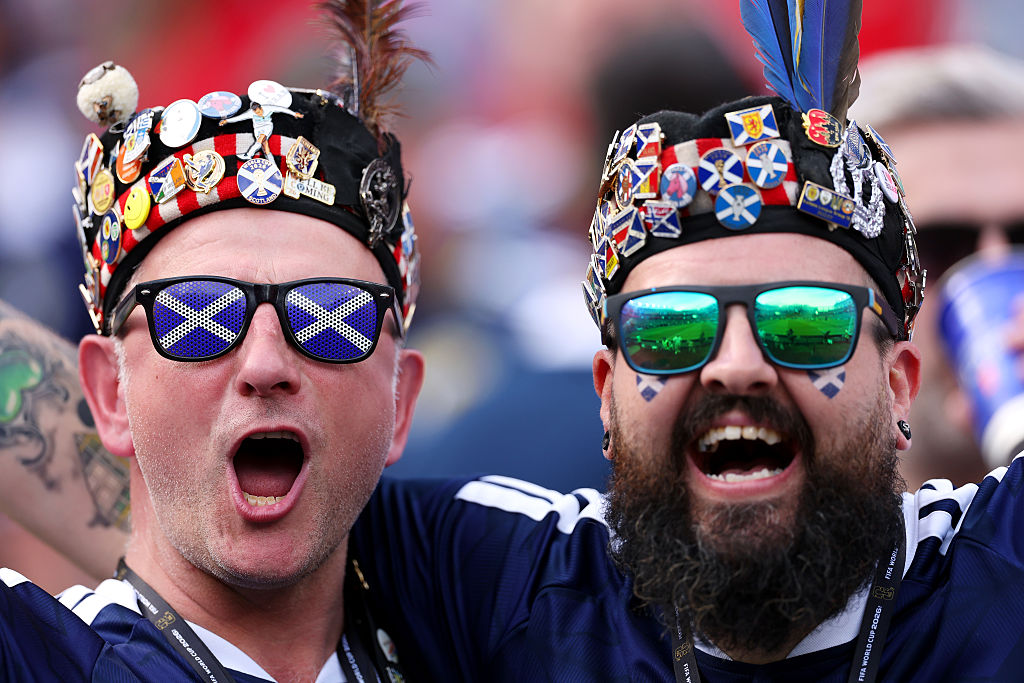
Following a welcome parade with bagpipes in Boston, the Scots staged a takeover of the city. They planted traffic cones on the heads of multiple monuments (the Duke of Wellington in Glasgow has worn such a crown since the Eighties). They set the record for the loudest crowd noise ever recorded at the World Cup, then turned up en masse to watch a baseball game, then drank the pubs dry, then started handing out Irn Bru in a local park.
The conquest of Boston is especially significant because the city is the epicenter of Irish American culture. In the US it is the Irish who wear kilts and play bagpipes, the Irish who drink more than anybody else. Not anymore. And now, Boston and Glasgow are set to be formally made twin cities.
Expatriate Scots, meanwhile, have another reason to be grateful to members of the Tartan Army: they have instigated a return to a cultural norm. When I moved to the US 20 years ago, I quickly discovered that there were no disadvantages to being Scottish in America, besides the inability to make myself understood at a drive-thru. Americans didn’t know much about us, but what they did know — Braveheart and Craig Ferguson, whisky and golf — they really, really liked. They even had a special word for Celtic accents: “a brogue”.
For a long time, then, we could coast along on Sir Walter Scott’s two-century-old branding job. But in the last five years or so, a different and less appealing image of Scotland has emerged.
It may have started when Nicola Sturgeon justified putting a burly male rapist in a women’s prison on the grounds that he had declared himself a lady. It continued when her successor, the hapless Humza Yousaf, was reported to the police under his own hate crime law. Just the other week, my Texas born-and-bred son walked into my office to show me a clip of Sturgeon explaining that she had not noticed the massive camper van parked in her mother-in-law’s driveway in Dunfermline — which, coincidentally, is my hometown. As he has visited numerous times and is well aware of the complete absence of luxury American-style RVs from the (very narrow) streets, he thought this was hilarious.
From romantic Highland warriors to patient zero for woke excess and general laughing stock is not a great arc. Thanks to the Tartan Army, the texts from friends linking to the latest scandal or absurdity have stopped and I am receiving heart-warming videos instead. Alas, given my homeland’s track record for winning at football, I am doubtful that the Scottish fans will be around for much longer. But in Boston at least, the memory of this most good-natured of invasions will surely endure. And one day, perhaps, Americans might even be blessed with the taste of real haggis — sheep’s lungs and all.
Daniel Kalder is an author based in Texas. Previously, he spent ten years living in the former Soviet bloc. His latest book, Dictator Literature, is published by Oneworld. He also writes on Substack: Thus Spake Daniel Kalder.
 DanielKalder