









April 22 2026 - 7:00am
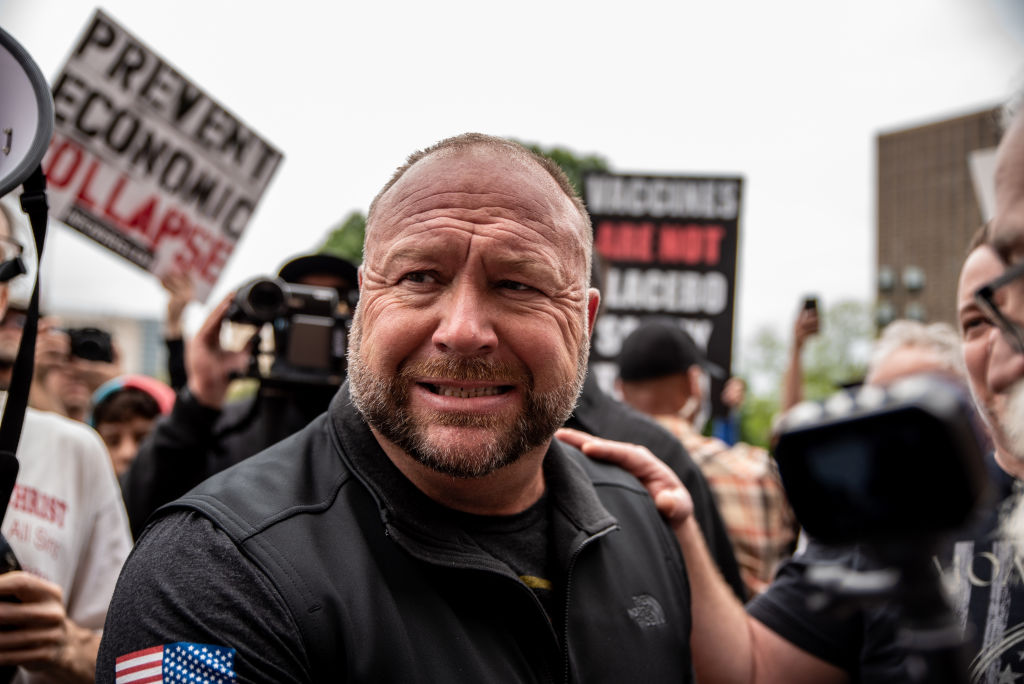
The list of MAGA boosters thrown under the bus seems to grow longer by the day. This time it’s the turn of Alex Jones, the roaring, ruddy-faced king of conspiracy media. After a long wrangle over the bankruptcy sale of his website Infowars, Jones, who last month turned publicly against Trump, is now claiming that the President is joining the Democrats in supporting its handover to Left-wing satirical website The Onion.
If this deal goes ahead, it will be the closing chapter of a saga that has dragged on for more than a decade. It began shortly after the Sandy Hook school shooting in 2012, in which 20 children and six adults were killed, when Jones claimed the murders were faked as part of a government plot to introduce gun control. The victims’ families brought a lawsuit against him, and won. In 2022, Jones was ordered to pay them $1.5 billion and subsequently declared bankruptcy.
Since then, Infowars has been the subject of ongoing wrangles as to who, if anyone, should take over the site. After a judge ruled that Jones’s assets could be sold to fund the claim, The Onion won the auction for Infowars in 2024, in a bid supported by the victims’ families. But a month later a federal judge overturned the bid, citing concern about collusion between bidders in the auction process. Further wrangling followed, leading to a new ruling that the site would be sold. All the while, Jones continued to broadcast from Infowars, playing the same campaign booster role for Trump that he did in 2016.
However, his support began to wobble last year over Trump’s handling of the Epstein files. After officials announced they’d found no evidence of an incriminating Epstein “client list”, a weeping Jones berated the DOJ for “running cover for the CIA and Mossad”. The White House decision to attack Iran in February, in a joint US-Israeli mission, was the final straw. Since then, Jones has joined Marjorie Taylor Greene, Candace Owens and Tucker Carlson, also former Trump loyalists, as a full-throated critic. He even inquired earlier this month about the process for removing a president for health reasons: “How do we 25th Amendment his ass?”
Perhaps one way to understand this phenomenon might be in the context of the competing incentives in, on the one hand, conspiracy media and, on the other, political organizing. Katherine Dee has written about Candace Owens’s commitment to the conspiracy theory bit: a stance in which critique and suspicion are permanent features of the epistemology, and answers do not settle anything. When something appears to resolve a question, it is recast as a psyop and becomes the basis for further inquiry. Within this digital fandom, victory is not the goal. Nor is building anything that follows from it. Resolution holds little appeal; the process of searching sustains the audience.
And so perhaps it’s unsurprising to find that each of the MAGA influencers most deeply committed to this kind of critique has already turned against Trump. The President, for his part, has denounced these former allies, calling them “stupid people” and declaring that “nobody cares about them.” The Onion now plans to turn Infowars into a parody of itself, which Jones has ascribed to a larger plot, suggesting that Trump has “openly joined forces with the Democrats to shut down Infowars” as punishment for Jones’s reporting on the Epstein files.
Is this true? Jones is in this position because he said some things that were demonstrably false. But in the conspiracy register, truth and falsity are of secondary importance. So it’s unlikely we’ve seen the last of Jones, who will soon be found volubly offering his interpretation of events from a new platform, according to the same hermeneutic of perpetual critique.
Of course, none of this is to say anything about the political wisdom of Trump’s policy decisions. But the point is this: there are doubtless many in his coalition who have private doubts, but who still see pressing ahead as the best way to advance their agenda. For someone whose income rests on critique, though, the incentives press the other way.
Perhaps Trump’s coalition was always contradictory, and these phenomena are simply exposing this reality, like water seeping through cracks that were already there. But these events also point to a structural instability baked into political organizing in the digital age. If there is a lesson for either political tribe, it is the same one many on the Left missed after the collapse of Occupy: when media outriders are committed to permanent critique, a movement cannot build.
