




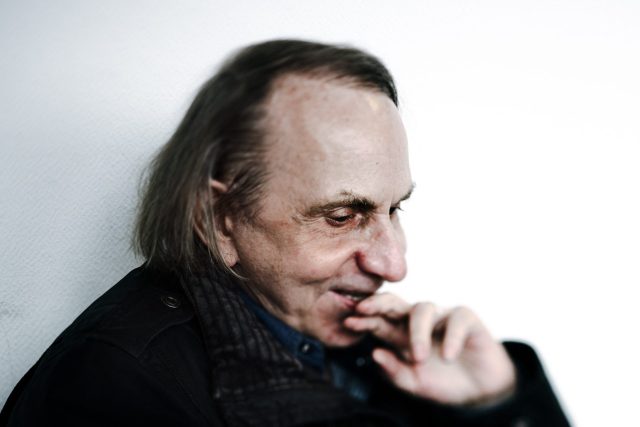
(Benjamin de Diesbach/Getty)





Michel Houellebecq is in trouble again. Prosecuted in 2002 for insulting Islam, he was acquitted. After Soumission, the novel many of his devotees — of whom I am one — felt was his masterpiece, he had to go into hiding for a time for once more being less than complimentary about Islam. Now, after four years of procedural table-tennis, he is accused of complicity in incitement to discrimination, hatred or violence against a specific group of people, in an interview with the magazine Front Populaire, given in 2022. Houellebecq’s original alleged offense in 2002 was to call Islam “the stupidest religion”: he doesn’t do understatement or subtlety. This time the remark that threatens to get him into trouble is that “when entire territories come under Islamist control, I think acts of resistance will take place. There will be attacks and shootings in mosques, in cafés frequented by Muslims, in short, Bataclans in reverse,” he said, referring to the murderous Islamist attack in Paris in November 2015.
The decision to charge Houellebecq has been criticized as a freedom of speech issue; and so, to an extent, it is. French law in that respect differs somewhat from English, but doubtless his lawyers will have hours of lucrative fun arguing over the difference between inciting people to do something unspeakable and simply warning that society is moving in a direction where something unspeakable is likely to happen. Nearly 60 years ago Enoch Powell was in the same position over dire prophecies he made in his so-called “Rivers of Blood” speech.
But this prosecution of Houellebecq provokes concerns that go far beyond freedom of expression. In just over 30 years as a novelist writing mainly about the misery of bourgeois French life, he has lifted up a number of stones and allowed some pretty unsavory things to crawl out from under them. In no particular order these include sex tourism, paedophilia, mental illness, rampant narcissism, family breakdown, betrayal, social alienation, self-hatred, nihilism, prostitution and, inevitably, racism. But then anyone who understands what French society is really like will find none of this surprising. It is not the mark of a happy country when the two people most likely to end up competing in the final round of next year’s presidential elections are Marine Le Pen and Jean-Luc Mélenchon. Years of decadence and failure under the Fifth Republic — conditions about which Houellebecq has written extensively in all his novels — have led to an embrace of one form of extremism or another as a means to counter or, at least, manage them. That, if you like, is the end product of the society about which Houellebecq has spent all these decades writing.
If he is not allowed to be himself, to express what he feels, his natural powers of observation will be suppressed. No-one sensible can defend incitement, but was the novelist really inciting anyone in that 2022 interview? Was he not merely simply presenting another aspect of a deteriorating society, in which the people have failed themselves through their willful decadence and whose traditional political class has not even dared to try to treat the underlying problems? Houellebecq’s lawyers have on his behalf issued a statement in which it is claimed he feels manipulated and exploited by those to whom he gave the interview. Maybe he does, but he should have seen it coming. Again, this is not simply about free speech: it is about a creative artist having the permission to express the depths of his creativity in order accurately to reflect his society or, in this case, his fears for his society. If others have chosen to exploit that then it may be, as the statement also said, out of greed — Houellebecq is probably France’s greatest and most famous living novelist and therefore big box office — but it might just as plausibly be that they shared his fears, and saw no reason not to share them with a wider public. In the present unhappy state of France this is inevitable.
But then French writers have often courted trouble for displaying radicalism or for perceived insult. Molière scandalized polite society with Le Bourgeois Gentilhomme; Flaubert was rude about Norman peasants (and the middle class) in Bouvard et Pécuchet and quite shocking in Madame Bovary; Zola was prosecuted for criminal libel over J’Accuse; Céline was fascist but still one of the most glittering writers in the French canon. Houellebecq has long been in a distinguished Gallic tradition of saying the unsayable, but saying it beautifully; all that is shocking is that a feeble and gutless French state is once more trying to punish him for it.
I recall being in my office on a January morning in 2015, reading an article about Houellebecq in Le Figaro about his new novel, Soumission, published that day. The novel’s action was set seven years later at the 2022 presidential election. As usual, the two highest-scoring candidates in the first round contest the prize in the second: and Houellebecq imagines these to be Marine Le Pen and a fictional creation, Mohammed Ben Abbes, leader of the Muslim Fraternity. The leaders of the main parties, frozen out of the contest by their poor performances in the first round, meet to decide where to advise their voters to go. They agree that Mme Le Pen cannot possibly be allowed to win, and tell their followers to vote for Ben Abbes. He wins; France is Islamified. The anti-hero of the novel, a lecturer at the Sorbonne who, in true Houellebecqois style seems most attracted to his vocation because of the opportunity it gives him to sleep with his young female students, flees Paris for a time and wanders aimlessly around a country in ferment. Returning to his faculty — now part of the renamed Islamic University of Paris — he is welcomed back to his job by his (ethnically French, formerly Catholic) superior, who has himself converted to Islam and is very much going with the flow. He tells him Islam isn’t too bad, not least because he now had four wives, and the youngest is only fifteen.
Reading the Figaro interview, I looked up from my newspaper and saw something shocking happening on the television in the corner of my office. A news channel was relaying, live from Paris, the immediate aftermath of the Charlie Hebdo massacre. The coincidence of this horrific event and the publication of Soumission was not lost on the French media in the succeeding days. Once more, Houellebecq had shown he was not only a great novelist but a great prophet. However, the controversy over that magnificent book continues to this day.
It is a book that takes us to the heart of Houellebecq, and reminds us why for the sake of France and for those who, like General de Gaulle, have a certain idea of France, he must be preserved and allowed free rein. He said at the time that he was not attacking Islam: he was attacking the so-called custodians of France’s glorious culture for being willing to abandon it, which he was convinced they were. He was attacking, in that regard, not merely the cynics and self-servers of the political class, but many French people themselves, who took their way of life and their freedoms for granted. It appears that, still, no lessons have been learned. With luck Houellebecq’s lawyers will see him safe: but what this climate of suppression will mean for the mood of France in the imminent presidential election one dreads to imagine.