




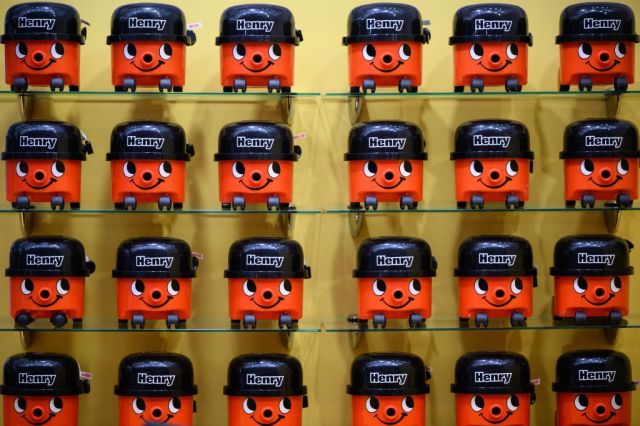
Are you a Dyson or a Henry? (Leon Neal/Getty)





Rather than progressives or conservatives, or Roundheads or Cavaliers, a more compelling barometer of intrinsically opposing worldviews might be whether you identify more with a Dyson vacuum cleaner or with Henry the Hoover. The Dyson represents technological advance for its own sake: expensive products of highly sophisticated engineering, produced at the end of long supply chains in the Far East. The brand increasingly incorporates robotics and AI at every stage from manufacture to consumer use, with online apps for software updates and user personalization. You would not, however, risk kicking it down the stairs.
On the other hand, the cheap and needlessly cheerful Henry, as any builder or renovator knows, will accept any amount of punishment with its trademark idiot smirk. Originally designed to clean out commercial boilers, the Henry is a second-order product of Britain’s lost age of heavy industry, still assembled by hand in a Somerset factory. It does one job, sucking up dirt and dust, and does it as well as it needs to do, without communicating its performance, or user data, or its first flickering doubts and anxieties of consciousness, to distant data centers. When it comes to it, I don’t need my hoover to decide what to clean, or how to do so most efficiently, or act as a high-performance showcase for innovation, but just to perform a simple task, well and reliably. It is more reliable, more robust, simply, because it is less complex. If only the British state were a Henry, we would all be in a much better place.
For there is, we are reminded by the barrage of warnings on domestic preparedness for some dread coming event issued by the state with increasing regularity, really only so much we can do, as individuals or households, when presented with the sudden breakdown of complex systems. It is often, rightly, said of much of modern environmentalism that it places the burden of responsibility on the individual consumer, and not on the giant corporations and national governments most culpable for ecological harms, and most capable of resolving them. What is the point, I ask myself weekly, of carefully sorting and separating my household rubbish and trundling it to the street for collection when I know that the likelihood is that it will end up on the far end of the world to be flung haphazardly in a river? If my carefully washed bottle cap ends up wedged in some Pacific turtle’s gullet, it is not my fault, I tell myself as I consign it to its final journey: all the right boxes were ticked at every stage, and compliance was carefully assured. It is similarly intolerable cheek of BP to popularize the environmental guilt complex of the carbon footprint, when its own sins are far greater than my modest peccadilloes. If we accept this principle, then the same criticism must be leveled at the government’s increasingly panicked warnings to prepare for — well, what exactly we should prepare for is not made clear, nor the reasons why, but we should expect it to be bad, and get in a stock of drinking water and torches and tinned food just in case. Fine, we say, as we browse jerry cans on Amazon and contemplate the threatened 72 hours of heating sardines over a candle, but what have you done to prepare?
Being a simple man, I do not expect Britain’s National Grid to be the envy of the world, nor a showpiece of global climate leadership, but merely to ensure that whenever I choose to flick a switch in the dark, the light will turn on. If it cannot reliably be predicted to do so — and it increasingly appears it cannot — then this is nothing less than a failure of governance. I expect water companies to ensure that when I turn on the tap, water pours out in consequence. If necessary, this may entail them digging large holes in the ground to collect water falling from the sky, and then to keep it there in case of subsequent need. Neither aspiration would require any great technological leap: they are both the very basic functions of their role. If they are unable to do this, or if they are prevented from doing so by political demands, or simply political fancies, then this too is a failure of governance. Like the power companies, or water companies, the state itself, though richly compensated by the taxpayer for its task, seems to have neglected its ability to manage its core function, of reliably delivering the basic utilities of daily life.
Burnham’s recent, limited pivot on North Sea gas drilling was correctly framed as “boosting our energy security”, noting that “at a time of global instability, homegrown energy can be a source of national strength”. But this rare outburst of Westminster common sense, swiftly undercut by a new ban on any further North Sea exploration, would be better applied to Net Zero as a whole. Even in a far more clement geopolitical climate, the idea that Russia or China or the United States would look on any aspect of modern British governance, let alone its economy-hobbling energy policies, with a jealous aspiration to follow our lead would be a delusion. But the idea that Britain can single-handedly lead a historic energy transition at the same time as the great and middle powers of the world are hoarding and fighting over their actual, in-use energy sources, building up and hardening their vital industries at a time of global re-ordering that already bears many of the hallmarks of a world war, is nothing less than madness. We could renounce any interest in world affairs, distance ourselves from the great geopolitical dramas of the day, and quietly count our windmills: but as long as Britain faces the threats it does, from the international situation that already exists, actively weakening Britain’s energy security in pursuit of second- or third-order moral aspirations is an act of reckless irresponsibility.
Behind the recent flurry of warnings over preparedness, it is increasingly clear that the Government’s overriding fear is of looming cyberattacks, in which the interconnectedness of modern life has itself become the primary risk. Last week’s continent-wide attacks on supermarket refrigeration systems, and seemingly now bloodbanks, like that on commissary stores in US military bases in August, shows this is not an abstract threat. The ability to monitor and amend fridge temperatures remotely is, no doubt, useful in assuring quality control and optimizing energy usage. But by linking these widely distributed systems to a public-facing internet, innovators have introduced a single, catastrophic point of failure harmful to the core function of refrigeration — the simple business of keeping items cold, a problem our civilization solved a century ago. The American military is now planning to ensure its bases can generate their own power, water and electricity for a 90-day period, essentially functioning as self-contained fortresses, disconnected from the wider world. Security is to be found in reducing complexity: what is simplest is safest of all.
In just such a way, the apparent “Black October” paradigm shift in hacking abilities enabled by generative AI has produced a welter of cybersecurity advice for panicked users. Some are predicting a massive consumer growth in defensive AI agents battling AI hackers across the internet, much as a medieval peasant imagined giant armies of angels and demons warring invisibly for his soul. But the opposite advice, of “reducing attack surfaces”, possesses the more instinctive security of simplicity. If you will shortly require a physical hardware key, and a complex and easily-forgotten algorithmically generated password to mindlessly scroll Instagram, then isn’t it easier to just not have Instagram at all, and no longer have to worry about it? The explosion of personal portals into the internet, manifest in past decades, looks less attractive when every electronic device, from your television to your fridge, must now be assumed to contain a malicious gremlin wishing to do you harm. The future tendency then, is surely a series of tactical withdrawals from the web, on the level of individuals, reducing their exposure, and of governments, tightening their control of ever-smaller and more easily managed internet realms. Like the growth of dumb phones, expensively allowing consumers to return to the level of disconnectedness from the world they enjoyed for free a generation ago, we should expect a revival of dumb fridges, dumb cars and dumb central heating systems which perform their core function reliably in a closed loop isolated from the outside world. It is no less than the fortification of our daily lives, like the transmutation of Roman villas, built for a world of frictionless, peaceful commerce, into the stockaded compounds of the Dark Ages — ruder and simpler but clearly preferable in their security.
Yet a sudden reduction in complexity is the very definition of collapse. Indeed, in his great work The Collapse of Complex Societies, the American anthropologist and historian Joseph Tainter observes the fact that societal complexity by itself increases the risk of collapse. “As systems develop more parts,” he argues, “and more complex interactions among these parts, the potential for problems, conflicts, and incongruities develops disproportionately.” Writing in 1988, Tainter did not have the example of 2020s Britain to hand when he warned, “Consider, for example, the plight of a society that must simultaneously face declining marginal productivity in any combination of the following: agriculture, minerals and energy extraction, science, education and information processing, size and costs of civil and military organizations, upkeep of capital stock etc. As each of these spheres requires an increased proportion of the society’s budget, the portion available for investment in future growth must decline.”
These are all the problems Britain’s recent carousel of prime ministers has tried, and failed to resolve; these are the problems Britain’s voters now live with. It is often the logical solution, Tainter observes, to accept a reduction in complexity as the safer, cheaper option. Many of the ordinary subjects of Rome, he notes, welcomed the barbarians as a relief from the onerous burdens of an empire that could no longer handle its own complexity: Rome’s collapse, devastating on a civilizational level, may have often been personally experienced as a form of liberation. Indeed, the archaeologist Bryan Ward-Perkins suggests that, had the Roman Empire been less complex, the collapse would have been less catastrophic. Instead, by transferring the functions of trade and production to ever-higher levels of sophistication, beyond the grasp or control of ordinary consumers, when the legions left, the inhabitants of Britain found themselves left with a lower level of material culture than they possessed when they arrived.
The argument presents itself, then, that carefully and consciously reducing complexity now is preferable to having it reduced for you by a malicious line of code. In its inability to be hacked, the dumb National Grid of the Fifties must be considered more secure than the smart one of this decade: it performed one simple function, generating power, using domestic resources, and did so in a way difficult to interrupt. Yet there is entirely another way of looking at the problem: if the risks are of catastrophic failure at a single, centralized point, then security would also be found in dispersal of assets, like the advice, of cybersecurity pessimists, to distribute your wealth across multiple bank accounts in case any single one is hacked, or the practice of Air Force planners, in time of war, of dispersing their aircraft across multiple bases. If the risk is of grid failure at a single vulnerable point, then both energy security and environmental aspirations would be better met by subsidizing solar panels and batteries to individual households, than transforming the entire grid at the cusp of war.
The Government’s vague but increasingly shrill warnings about the forthcoming Event are not wrong in themselves. The assumption being made is of a three-day disruption to the national grid or the internet, after which the state will reboot and resume normal service. A more realistic possibility than total collapse is one of regular low-level disruptions, of brief power cuts and outages rather than civilizational meltdowns. It is entirely sensible, if this is the Government’s fear, to ensure that you are able to heat your home, and cook, in the event of power loss, or to be able to collect rainwater in a butt so that you can at least flush your toilet. But if we are to accept this reduction in societal complexity, then it is only right to ask our rulers to accept their own reduced circumstances. If the state cannot reliably deliver its basic functions, it cannot demand adherence to its ever more refined whims.
If we should all acquire woodburning stoves, then it would be helpful if government bodies did not simultaneously mutter about banning them to fulfill environmental aspirations. If we should secure our own personal food supply in the event of supermarket distribution failure, then the Government should be expanding access to allotments and not selling already existing allotments off, as Jeremy Corbyn rightly warned last year. In the Second World War, when the government urged households to keep chickens and rabbits in their back gardens for protein, it encouraged their keepers to feed their domestic livestock on kitchen scraps, where today it would prosecute them. Even as the state’s ability to deliver basic services has waned, its desire to regulate, and enforce, and ensure compliance with ever-more refined best standards still grows exponentially. This is unsustainable: if we are being asked to do more ourselves to fill in for what the state is increasingly incapable of doing, then the state must accept it must ask less of us, and stand out of the way.
As with the internet, as with Net Zero, the obvious solution, in times of threat, is to harden security by reducing the attack surfaces. That which is necessary to the core function of any system should be hardened, and made secure: that which is not a core function, and offers new vectors of risk, should be examined carefully for its utility, with an eye to being cut. The managers of the British state have grown too comfortable imagining themselves at the helm of a sophisticated piece of machinery, inspiring the envy of the world through its acquisition of new and fundamentally unnecessary functions.
We would all be much safer if they saw themselves as a Henry, reliably and capably performing the basic functions we demand of it, and left the rest to us. But as it stands, and the Government tells us what to stockpile, and warns us in panicked voices not to panic, a level of unnecessary complexity has been added to something that is, at core, extremely simple: keep the lights on, keep the water running, keep the country safe. If the British state is not confident it can do so, then what is it for?
