




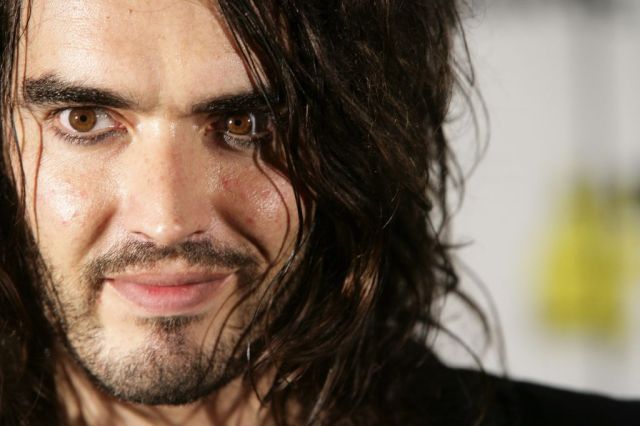
“Brand has been unmasked and carries a warning.” (Claire Greenway/Getty)





Does it start with Panto Dames? At Christmas, in flighty old Blighty, little Brit girls are introduced to the idea of a matronly man in a dress who gets most of the laughs and isn’t remotely interested in any of that soppy love stuff that the plucky heroine and the principal boy (played by a girl, of course) get up to. The Pantomime Dame is a place of safety in the dark-scary-forest-world of “Behind you!” that little girls are already aware of at this early age.
And then, when we’re older, pop culture takes over. The Gay Best Friend is the natural go-to for the female casualties of the Love Wars; think of Sex and the City’s Stanford Blatch, always there for Carrie to cry on when Mr Big treats her like a side-piece.
But we’re on trickier territory when it comes to what might be called “fauxmosexuals”, straight men who act gay to get girls. Before Russell Brand was found guilty of one count of rape and three counts of sexual assault, his trial featured a telling moment. After hearing that one of the complainants testified that she had presumed Brand to be gay when they met at a Labour Party conference and thus felt “safe” asking him back to her hotel room, the prosecutor Riel Karmy-Jones KC whipped out the accused’s unfortunately-titled 2007 memoir My Booky Wook and confronted the leering Lothario with a photograph of himself at the age of seven, with the caption: “This is the exact moment when I decided to act gay to attract girls. It took 15 years to produce results.”
Though he claimed under cross-examination that this was a “joke” (wouldn’t be the first unfunny joke he’d told in his long career of alleged comedy — the only time he made me laugh was when he couldn’t find the verse from Isaiah he was looking for on Piers Morgan Uncensored, while thumbing through the Bible for close to two minutes) and denied he had ever pretended to be gay in order to put women at ease, it wasn’t as convincing as it might have been. There is a long tradition of such behavior in this country although, of course, not necessarily leading to any crime. Indeed, one of Brand’s comedic contemporaries — who most people believed to be gay because of the flagrant way he camped it up — is currently undergoing a right royal canceling due to his highly “bloke-ish” attitude towards women.
It doesn’t help that Brand has presented himself as the Rock Star of comedy, right down to the dalliance with Kate Moss and the drug dependency, as it has always been rock stars who have pioneered the false-flit fandango. The first person I ever heard about it from was the late Johnny Thunders, explaining the rationale of the New York Dolls. They would smother themselves in Panstik and stagger about on six-inch heels — to get girls. They were inventing a new definition of sexy but were rabidly heterosexual. Over here, the burgeoning of Glam Rock gave us Marc Bolan, among others. King (or queen) of them all was David Bowie, an enthusiastic and dedicated “swordsman”, who cut a swathe not just through the women of London but the underage groupies of LA, all while wearing dresses, pretending to fellate his guitarist onstage and proclaiming “I’M GAY!” (“And I always have been, even when I was David Jones”) on the front of Melody Maker, conveniently as he launched his Ziggy Stardust shtick in 1972.
Bowie’s career of reverse-coming-out was a comical one to behold over the decades. In a 1976 interview with Playboy he called himself a “bisexual”. It took him until 1983 to tell Rolling Stone (in an interview sternly entitled “Straight Time: No more masks or poses”) that he had always been “a closet heterosexual” and that claiming to be gay had been “the biggest mistake of my life”. Many of his homosexual fans reportedly felt very “let down”; one would need a heart of stone not to laugh. Imagine mistaking David Bowie, the ultimate double-dealing showbiz chameleon, for someone who was going to be sincere.
Meanwhile, the distaff are at it too. Many a lesbian might ruefully remember a straight lady who led her on in a club only to go home with the man she had her eye on after the girl-on-girl snog worked its magic. Men are notoriously keen on the idea of lesbians; not ones who wear check shirts and like to go hiking at weekends, but ones with tousled blonde manes and three-inch fingernails. (The latter is probably a bit of a giveaway that they’re not serious about their endeavor when the camera stops rolling.) But it’s an uneven playground. It’s hard to think of any worldly female luring an innocent young man back to her hotel while pretending to be gay — and then pouncing. Except me, when I was courting my husband 30 years ago.
As if things weren’t spicy enough, in recent years a new development in the world of sexual shape-shifting has taken place. A couple of years ago, I was surprised to see a massive queue at my local children’s bookshop. Interestingly, most of the queuers were girls in their late teens and early twenties; they were there for an author called Alice Oseman, who created Heartstopper, a romance between two teenage boys, published as multiple graphic novels (the UK’s fastest-selling ever, and moving more than eight million copies worldwide) and adapted into an award-winning Netflix series. “We could not be prouder to publish the Heartstopper series,” smugged the chief executive of Hachette Children’s Group. “Heartstopper is published for teenagers but seems to have a huge appeal for older readers too. It’s for everyone.”
Who it is particularly for is young women who get off on the idea of gay male relationships, both romantic and sexual, having largely given up on men themselves. It’s as if only by removing (hetero)sexual politics from sex can sex be fun again, hence everything from Saltburn to “shipping” in which (mainly) women force (mainly) male characters, real and imaginary, from Kirk and Spock to Harry Styles and his former bandmates, into sexual scenarios. To misquote Shakespeare, some are born gay, some achieve gayness — and now we find that some have gayness thrust upon them.
Half a century after Bowie was plowing through London, the beat goes on. A friend told me the other day of a teenage boy evicted from her daughter’s friendship group for pulling a routine straight out of the play-gay playbook. It does feel more like grooming than gaming, she says. It’s like each generation has to find a new way of confusing itself.
But there will always be wolves in sheep’s clothing. Now, Brand has been unmasked and we see what big teeth Grandma has: back in your hotel room, some men don’t actually want to borrow your mascara and listen to your Glee soundtrack, but do something far more primeval. For now the forest is darker and scarier than ever, and the beast really is behind you.
