




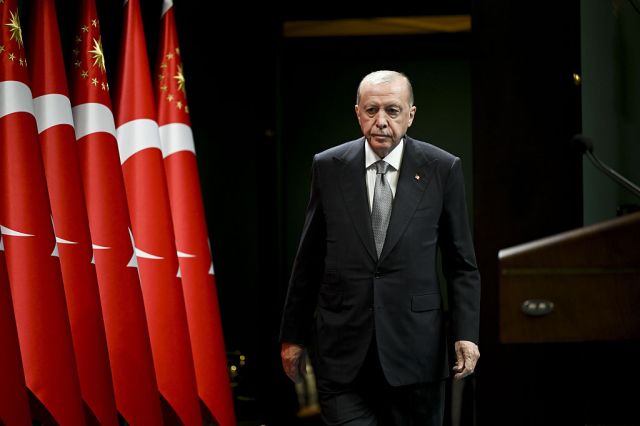
“Turkey is already entering a post-Erdoğan era.” (Utku Ucrak/Anadolu /Getty)





Rip Van Winkle slept for only 20 years and missed the American Revolution. In November 2024, İlhan Sami Çomak emerged, blinking, after 30 years in a Turkish prison to a country that had similarly changed beyond all recognition. In 1994, he had been arrested for terrorism offenses that could only have been committed by traveling 1,000 miles in a single day — along a railway line which did not exist. A promising student from a village in eastern Turkey, Çomak discovered politics and a Kurdish identity at Istanbul University in the early Nineties. He was tempted, he says, but never recruited, by the armed Kurdistan Workers’ Party insurgency, then near its zenith. That did not prevent his arrest and confession, extracted after 19 days of torture, for two separate arson attacks at opposite ends of the country. The European Court of Human Rights declared his trial unlawful, but he served a full three decades.
The pre-smartphone Turkey that Çomak left behind had been dominated by a military determined to tame the religious populism of its politicians. The Instagram-crazed country he re-entered is dominated by the very politician the military failed to tame.
In 1994, Istanbul had half of its present population of 16 million, but was already growing, largely through migration from Anatolia, at the rate of one Newcastle a year. No politician understood that human tide better than Recep Tayyip Erdoğan — street hawker, semi-professional footballer, hard-boiled party boss — who, that year, elbowed his way through a crowded field to become mayor of Istanbul for the pro-Islamic Welfare Party. Erdoğan, too, would see the inside of a Turkish prison: four months in 1999 for reciting a poem at a rally.
But he and Çomak drew very different lessons from injustice. Çomak taught himself poetry, and the writings he smuggled out of his cell have won him international fame. Erdoğan learned that power punishes weakness, and that victimhood is a potent political tool. Donald Trump said that the only reason he attended July’s Nato summit in Ankara was out of respect for the strongman president who shares his skepticism of the Western alliance. And, even though Turkey was among the last of the G20 to ratify the Paris Agreement, Antalya is now hosting dozens of world leaders at the COP31 climate summit, Andy Burnham among them. But which Turkey will they be visiting? The “New Turkey” that a younger Erdoğan once promised, or merely a stale caricature of the ancien régime he set out to replace?
No longer in a cell, Çomak talks of the marvel of regaining an unobstructed view of the horizon, of being able to lose himself in a crowd. Erdoğan built a 1,150-room palace. That palace has become a monument to an epoch bearing his name. There is little question that Erdoğan’s Turkey has grown in prosperity and self-esteem. In the early aftermath of the Cold War, the country was desperate to join a European Union that didn’t want it, all while promoting a Turkic identity that might win influence (and the odd contract) in former Soviet Central Asia. Today, it is nothing if not confident. A republic founded over a century ago from the ashes of empire is again redefining its region.
Turkish diplomats once cited the country’s “difficult neighborhood” as a shackle on its ambitions, and as a reason to preserve the military’s role in civilian politics. Erdoğan’s great achievement has been to tame the generals and transfer their power to himself. His growing international influence has become a source of national pride but also a useful distraction from his own retreat from democratic accountability.
That neighborhood, though still difficult, has become a kind of portfolio: mediating between Russia and Ukraine, helping to see off the hostile Assad regime in Syria, even locking horns with Israel, albeit in a contest unlikely to draw blood. Turkey once boasted of having Nato’s second-largest army, though large cohorts of conscripts were kept busy whitewashing fences. Now it boasts of drones and a growing defense industry, driven in large part by Baykar, the company chaired by Erdoğan’s son-in-law.
Even so, Turkey has not entirely abandoned the dictum of the country’s founder, Mustafa Kemal Atatürk: “Peace at home, peace in the world”— a principle that translates as “don’t mess with me and I won’t mess with you”. Turkey has the industrial and scientific base to be a nuclear power but has so far refrained from pursuing one. In the summer, it joined Saudi Arabia and nuclear-armed Pakistan in a mutual defense pact. Yet even after Houthi missile strikes on Riyadh in October, the government seems happier selling arms than sending troops into harm’s way.
When Erdoğan came to national prominence, the great divides in Turkish politics were between Left and Right, civilian and military. Erdoğan exposed a deeper fissure in Turkish society: the resentment of newly urban, pious and provincial Turks towards a Western-facing secular elite. The founding republican settlement subordinated religion to the state. The bureaucracy, courts and universities saw themselves as guardians of secularism, and the generals saw themselves as guardians-in-chief. The ban on devout women wearing headscarves at university became one of the grievances upon which Erdoğan’s Justice and Development Party (AKP) was founded in 2001.
“Erdoğan’s style is very similar to Trump’s,” says Daron Acemoğlu, the Istanbul-born economist and Nobel laureate. “The secular establishment in Turkey made the same mistakes as the liberal establishment in the US or the UK, but without any of its liberalism.” He argues that it’s impossible to understand the AKP without understanding the contempt that the secular establishment has traditionally shown towards conservative provincials. “Erdoğan is good at propaganda, but when he said ‘in this country there are white Turks and black Turks’, that wasn’t just made up.”
The headscarf may have been the most visible grievance, but the deeper one lay in people’s wallets. Erdoğan, running for the Welfare Party, the movement from which the AKP would later emerge, was boosted into the mayoralty by a collapse of the currency in January 1994, followed by an inflation rate of over 100%. An even worse economic crisis brought his newly formed party to national office in 2002. By sticking to an IMF program negotiated by its predecessors, the new government nursed the economy back to health. For the first time, ordinary families could get a credit card, or a loan to buy a house. In 2019, the six minarets of a vast new mosque appeared on Istanbul’s Bosphorus skyline, but shopping malls, highways and sprawling public housing estates became equally prominent symbols of AKP rule.
Yet the machine that built this loyalty is running out of fuel. The liberalization that marked the start of AKP rule in 2002 has long since come unstuck or else has been corrupted. Arguably, the great accomplishment of post-war Turkish politicians was to oversee the mass movement of people from the countryside into the big cities. But that movement also created social fault lines which, a few generations later, are set to shift again. Today’s voters want more than neighborhood-level favors. They aspire to the good life and opportunities once enjoyed by the old urban elite. They also know that to be successful you need to have the right political connections. The A in AKP stands for adalet or “justice”. For a growing number, that letter has gone missing.
That Erdoğan’s AKP fared so badly in the 2024 local elections — coming second with some 35% of the national vote, failing to win back Istanbul and Ankara, and losing a string of other big cities — is a symptom of that disillusionment. Panic that it was losing control is the driving force accelerating the government’s slide into unfettered autocracy. Hence the response to the recent discovery of a Ponzi-like scheme that has left some £13 billion of savers’ money in limbo, was to arrest the messengers. Five journalists were charged over their coverage of a scandal that extended up the ladder to AKP higher-ups. Accused of spreading false information, two are still in custody, joining 23 other journalists behind bars on assorted charges. Yet the fallout of the scandal is proving harder to contain, undermining even further the integrity of the government and eroding individual saving after sharp losses in other financial markets.
And the government still can’t arrest the price of tomatoes. “How happy is the one who says ‘I am a Turk’,” runs another much-quoted Atatürk maxim. But the all-too-common conversation among today’s struggling middle-class parents, throttled by inflation of around 30%, is how to build a life for their children abroad.
While the reforms after the 2001 crisis opened up a new world of consumer credit and mortgages, a disastrous macroeconomic experiment, pairing low interest rates with high inflation, has now left those managing the economy with only one real option: muddling through. The notion that people could put up with the AKP’s brand of autocratic piety because at least it could manage the economy is long gone. The cliché among Istanbul’s chattering classes had always been that, no matter how bad the economy, the restaurants were always full. “They’re not full anymore,” says Ekin Şahin, whose family is in the trade. “People need a handful of reasons to eat out. No one goes out on a whim.”
Just as New York Times leader writers struggled to explain how Trump was elected not once but twice, a large segment of the Turkish population despairs at what it sees as the cognitive dissonance of fellow citizens who still believe Erdoğan is leading the country in the right direction. Increasingly, however, loyalist support is being whittled away. More than half the electorate declined to back Erdoğan in the first round of the 2023 presidential election, and the 2024 local elections confirmed the drift. As in Trump’s America, loyalty is not inexhaustible. The AKP once sold its campaign for Islamic rights as part of a process of democratization. Whether or not that was ever the case, few believe it any more.
Erdoğan has proceeded methodically, transferring an already powerful state apparatus into his own hands. As mayor, he learned how public contracts could be used to build a base. He defanged the military through the high-profile “Ergenekon” trials of senior officers that began in 2008. He also sidelined senior figures in his own party who still regarded him as primus inter pares rather than top dog. The Gezi Park protests of 2013, a vast spontaneous protest to stop a central Istanbul park being turned into a shopping mall, taught him another lesson; he set about systematically capturing not just the legacy media but newly powerful social media too. The attempted coup of 2016 provided an opportunity to move against vocal opponents. The popular Kurdish politician Selahattin Demirtaş was arrested — he remains in jail despite a ruling by the European Court of Human Rights — and the government set about dismantling a rival religious movement, and former ally, led by the exiled cleric Fethullah Gülen. A referendum in 2017 abolished the office of prime minister and completed the transfer of power to a virtually unchecked presidency.
Unlike Trump, Erdoğan has held sway for almost 25 years, long enough to fine-tune a system of censorship and repression. Control of the courts has allowed his government to upend the legal process and divide the opposition. This took on fresh momentum with the arrest in March 2025 of Ekrem İmamoğlu, the Republican People’s Party (CHP) mayor of Istanbul, days before he was to be anointed the opposition’s presidential candidate. He now faces charges across several indictments, including bribery, embezzlement, leading a criminal organization, espionage and insulting public officials, which together carry a notional sentence of some 2,400 years. Halk TV — a channel that supported the opposition — was put under the control of a court-appointed trustee as İmamoğlu’s defense in court was about to begin. There is now a long list of mayors and elected officials under threat. It remains to be seen whether the fate of his fellow mayors — over 30 are still in detention — will be raised by another great proponent of devolved government and former mayor, Andy Burnham at this week’s summit. The mayor of Antalya, the host city, is also in jail.
One explanation for this mounting insecurity is that even paranoiacs have enemies. But while the ruling party may have scored substantial successes in its kulturkampf with the old republican elite, it may now be losing the war. It is not so much that the other side is winning as that Erdogan’s politics of confrontation is wearing thin. Turkish social media hums with clips of schoolchildren, some still in headscarves from after-school Qur’an classes, singing and dancing along to Manifest, a girl band who have just played Wembley Arena after their sentences for obscene behavior at an Istanbul concert were suspended. Survey after survey shows that while the overwhelming majority of Turks identify as Muslim, most agree with Atatürk that religion should be a private affair. Erdoğan set out to mold a pious generation, but young Turks would prefer a decent job.
The possibility, then, is that Turkey is already entering a post-Erdoğan era, even with him firmly in control. As the old sources of popular loyalty weaken, the struggle within the ruling establishment may be less about governing Turkey than about controlling what comes next. One sign of a brewing succession war is that the revolution is now devouring its own. Where repression was once reserved for the regime’s opponents, pro-government pundits and well-connected business cronies are discovering that they, too, can be picked up. Former AKP mayors have been arrested in municipal corruption probes, while the Ponzi scandal has put a former deputy minister and the fund’s AKP-connected chief executive behind bars. These cases look less like a purge than a scramble for position among factions in the presidency, the prosecution service, the security apparatus and the business world. If so, Erdoğan may stay in power long enough to see his own accomplishments unravel.
Where, then, will change come from? Çomak, having given the state 30 years, is not waiting to find out. “I have changed. Life has changed,” he says. “But it cannot be said that there has been any fundamental change in the mentality of power.” Çomak sees little option but to plow his own furrow, to keep writing, and to enjoy the solidarity of a literary community that supported him in prison. He repeats Nietzsche’s old saw that what does not kill you makes you stronger. “Perhaps everyone should spend a month or two in prison,” he adds. “Then they would understand better that there is no room for hopelessness. Just don’t stay as long as I did.”