




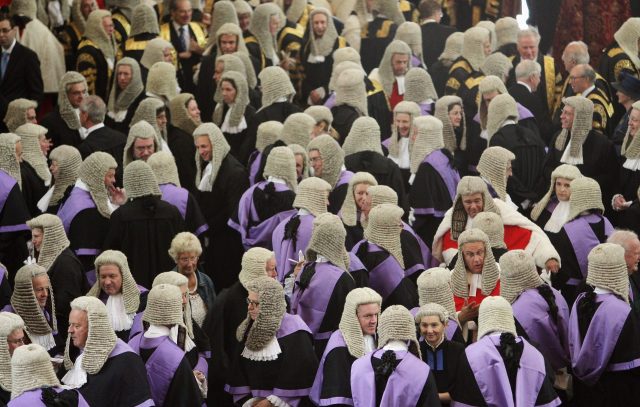
Is AI coming for the cloistered elite? (Dan Kitwood/Getty)





When I graduated from law school, I reveled in joining a profession steeped in mystique and intellectual prestige. Becoming a lawyer promised distinction, initiation into an inherited practice, and the quiet vanity of possessing knowledge impenetrable to others. This calling, with its own vestments and punctilious gradations of address, offered a world in which one’s adversary became “my learned friend” and arguments, like incantations, roused the accumulated judgments of the dead to resolve the disputes of the living.
Perhaps, though, we could just chuck it in ChatGPT? According to a 2025 LexisNexis survey, 61% of UK lawyers have used generative AI for work, with 49% relying on general-purpose chatbot programs rather than specialist legal tools. On the consumer end, “robo-lawyers” are finding clients aplenty. A study by JUSTICE, a legal charity, and the Administrative Fairness Lab found that one-in-six respondents who had experienced a recent legal dispute had consulted an AI chatbot for help.
No longer the exclusive preserve of a cloistered elite, meanwhile, legal research now appears within the competence of sophisticated large language models. A September 2026 report evaluated AI models on practical Dutch legal research. Its best-performing model, Claude Fable 5.1, satisfied 75.7% of individual legal and citation criteria.
One can envision a near future where much lawyering is undertaken by AI. Perhaps clients interact with an interface, which then turns their conversation into a formal submission to the court. Human judges, retained for tradition, then provide desk-based assessments, with neither counsel nor client required to appear. If this premonition is accurate, lawyers are looking increasingly obsolete.
At the risk of breaking the magician’s code, the legal profession has been obfuscating how simple legal argument is for centuries. Behind all the Latin conjurations and private-school wankery, much lawyering involves rote syllogistic reasoning. A general legal rule (“drivers owe a duty of care to other road users“) is applied to the facts of a particular case (“the defendant was driving and the claimant was another road user”) to reach a conclusion (“the defendant owed the claimant a duty of care”).
Once you know the elements of a cause of action or criminal offense, applying the relevant rules to the available facts supplies a framework for assessing probable legal liability and what legal arguments could prove fruitful in court. Ambiguities may exist, particularly when legislation or case law contains open-textured phraseology like “reasonable” or “ordinary”. Yet the arguments that can be put forward follow fairly consistent conventions.
Even attempts to soften the law’s rigidity have produced new forms of it. “Equity” emerged in the Court of Chancery to alleviate injustices caused by the strict application of common-law rules. This allowed litigants to seek injunctions restraining immoral conduct, or the rescission of a contract induced by undue influence or misrepresentation. Over time, however, these remedies became governed by elaborate doctrines with strict conditions on how and when courts would intervene.
It has never been easier for amateurs to approximate “black-letter” lawyering: a term for the routine application of well-established principles and rules, named after the heavy Gothic type face used by medieval scribes. “Plain-language” reforms in the last century stripped legal drafting of unnecessary obscurity (“Anton Piller orders” became “search orders”; “Mareva injunctions” became “freezing injunctions”), while widespread digital archiving has brought statutes and case judgments within reach of anyone with an internet connection.
This was not always so easy. As legal scholar Desmond Manderson has noted, for much of common law history legal principles appeared to the public “as runes”, “priestly signs” whose authority was heightened by mystery. The Magna Carta addressed the world firstly in Latin, then French, languages understood by only tiny minorities at the time. The first complete English translation appeared in 1534, three centuries later, and was still largely unintelligible to a mostly illiterate public. The rise of the machines, therefore, is part of a welcome democratization of legal knowledge and expanded access to justice.
So what place is there for counsel in carne in this Brave New World of automated lawyering? In my view, it is precisely in those aspects of advocacy often argued to be archaic and questionable, in the deeply human practice of veiling conflict in ceremony and adorning argument with eloquence.
Legal rationality — rule-bound and amenable to syllogism — may be susceptible to mechanical imitation. That, however, is merely the science of legal practice, not the art. Logical propositions are just part of the advocate’s repertoire. The true power of the legal profession is found not in judgments but in pageantry.
Philosopher Michael Oakeshott’s Rationalism in Politics offers a useful lens in his distinction between knowledge that can be gained from textbooks and the kind of experiential understanding which constitutes cultivated connoisseurship. Oakeshott calls the first technical knowledge, whose chief characteristic is that it is susceptible to “precise formulation”. The second, practical knowledge, “exists only in use” and “cannot be formulated in rules”.
Oakeshott’s distinction is familiar enough in any solicitor’s office. Taking instructions from a client is about more than simply extracting facts and applying rules. The solicitor must receive a client’s account with sufficient sympathy to encourage candor but with sufficient skepticism to discover what has been omitted. One’s role is part social worker, part detective. For a barrister, an entire dramaturgy attends the presenting of one’s case. Like a grand Shakespearean director, counsel orchestrates the show: whether it’s concessions negotiated with opposing counsel, witnesses brought back to inconvenient particulars, or gentle corrections of judicial misapprehensions. Merely knowing the rules encyclopedically, as an AI program will soon be able to, can never capture the talents for commanding a room and furthering an argument.
Viewed with an eye for performance, the spirit of lawyering is centered around a choreography of manners. For Manderson, a true apologist for the occult features of law, a lawyer of substance must attend to “the ambient, the metaphorical, and the rhetorical effects of language”. Take Cicero’s defense of Quintus Ligarius, prosecuted for supporting Caesar’s opponents in Africa during the civil war. In Plutarch’s retelling, Caesar had already condemned Ligarius in his own mind as “a villain and an enemy”, but agreed to hear the celebrated orator out. As Cicero spoke, Caesar’s face “changed color” when he recalled that Ligarius’s prosecutor had fought against him in the Battle of Pharsalus. In the end, Caesar “was so greatly affected that his body shook and he dropped from his hand some of his documents”. Ligarius was spared, as Caesar would soon have cause to regret, given he joined the conspiracy to assassinate him.
Whatever allowance we make for Plutarch’s exaggeration, the scene captures advocacy as an art of dramatic revelation and an appeal to the passions. Voice, gesture, stillness and the ordering of disclosures shape how a story unfolds, helping give a client’s perspective presence before strangers. Romanticization is weaponized in the service of empathy and understanding.
In recent times, “rhetoric” has acquired an unfortunate reputation as trickery and, when applied to legal practice, often conjures up images of sleazy hired guns willing to argue — in the words of Jonathan Swift — “that white is black, and black is white, according as they are paid”. But true rhetoric concerns the means by which one person makes something intelligible and persuasive to another. This goes deeper than doctrinal analysis, to decisions of emphasis and allusion. As literary theorist and legal scholar Stanley Fish has argued, the meanings of legal arguments are not “embedded in words but emerge and are perspicuous in the light of background conditions of intelligibility”. Whether one’s audience is judge or jury, a cutting distinction can make an overlooked experience legally significant while a well-crafted analogy can move others more than cold deductive reasoning.
Though much of the pomp and ceremony of the courtroom can appear terribly old-fashioned, even the quaintest rituals serve a purpose, one foundational to civilization. In Aeschylus’s Eumenides, Athena establishes a court to judge Orestes for killing his mother. His acquittal leaves his accusers, the Furies, threatening vengeance upon Athens. Peace comes only when Athena persuades them to accept an honored place within the city, to be seduced into civility. This “show” of authority gives adversaries a way to submit their quarrels to judgment without surrendering their dignity. Ornate performance, whether the supplicant bow before an elevated bench or the regality of judicial attire, signals that trial and judgment are public acts delivered with restraint.
This is natural justice, a practice more conventional than “rational”. Philosopher Roger Scruton famously understood the common law as an inheritance formed through particular disputes, remaining “close to human life and bound up with a given history”. Such experiential nuances are unlikely to be appreciated by an AI which, rather than grounding its decision on the tangled particulars of human circumstance, is designed to string words together on the basis of static, narrow learned parameters.
To ground lawyering in rhetorical artistry necessitates a shift in legal education. If AI can handle the drudgery of locating authorities and assembling arguments, then the human element becomes even more central. Future generation of lawyers will require a capacity for cultivated passions, what C.S. Lewis called the chest: the seat of “emotions organized by trained habit into stable sentiments”. It also requires a magnanimity of character sufficient to captivate and seduce an audience. Literature, history and poetics deserve a place alongside doctrine. An education devoted exclusively to producing correct answers prioritizes “technical knowledge” over the sensitive, well-rounded soul required for legal practice. We can leave the grunt work to AI, in short, but the delicate business of civilizing conflict still calls for a human touch.
