




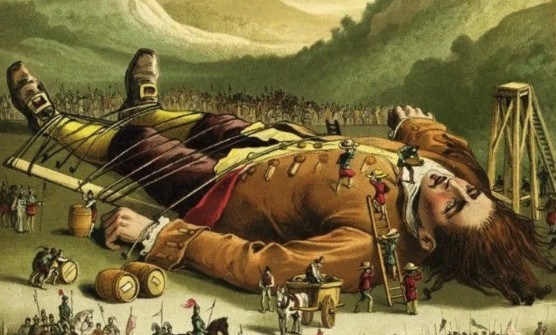
“Everyone knows Lilliput: the tiny people in Gulliver’s Travels who tie down a giant.” (Creative Commons License)





Everyone knows Lilliput: the tiny people in Gulliver’s Travels who tie down a giant. I recall the image from childhood toyshops; more recently, I encountered it in the form of a biscuit in an Irish café. The miniature world has proved commercially irresistible. There are models, illustrations and countless appropriations of the word “Lilliputian” to advertise anything small. This has been going on for centuries: in Victorian London, the children’s outfitter Swears & Wells even commissioned a model of Gulliver and his captors associated with the Great Exhibition of 1851.
But what about Brobdingnag, the land of giants? Three hundred years after the publication of Jonathan Swift’s masterpiece, Brobdingnagian giants have had nothing comparable to Lilliput’s commercial success. I know of a singular exception: Gulliver’s Restaurant in Irvine, California, has advertised a Brobdingnagian prime-rib steak, its largest bone-in cut. Beyond this, who remembers Gulliver’s humiliation at the hands of creatures for whom he is a plaything?
Walking in a field in Brobdingnag, Gulliver tries to leap over a cow-pat, only to land in it: he has “found myself just in the middle up to my knees”. He is then “filthily bemired”. The joke is not just scatological. The man who had been a giant among the Lilliputians is now reduced to a tiny, helpless creature, unable to preserve even his bodily dignity. In another scene, Gulliver is placed close against the enormous bodies of the maids of honor and confesses that “a very offensive smell came from their skins”. Their skins appear “so coarse and uneven, so variously colored”, with a mole “as broad as a trencher” and hairs “thicker than packthreads”. As a midget, Gulliver sees what ordinary human vision edits out: pores, blemishes, hair and smell. He discovers the repulsiveness of the human body at close range. Scale turns beauty into grotesquerie, and human self-regard into a matter of perspective.
You wouldn’t see this scene in toyshops. In fact, the novel’s afterlife has been strangely selective: posterity has preserved the spectacle while avoiding its prophetic and satirical edge. Modern adaptations have sanitized Swift’s original text. The 1939 Fleischer cartoon, produced in competition with Disney’s Snow White, turns the Lilliput voyage into a colorful musical romance between rival kingdoms. In the 1960 movie The 3 Worlds of Gulliver, Gulliver extinguishes a fire in the Lilliputian palace by spilling wine on it, rather than by Swift’s less decorous method. In the original, the wine he has drunk “made the wine begin to operate by urine”; he voids it “in such a quantity, and applied so well to the proper places, that in three minutes the fire was wholly extinguished”. His giant’s intervention saves the palace but enrages the empress, since making water within the royal precincts is a capital offense. Gulliver’s salvific piss becomes a breach of etiquette leading to the charge of high treason.
Like Lilliput, Laputa, the flying island, has also enjoyed a colorful afterlife. Hayao Miyazaki’s celebrated Japanese animated film Castle in the Sky (1986) borrows Swift’s name and image, turning the floating island into a world of lost technology, robots and adventure. The change is revealing. Swift’s Laputa satirizes intellectuals so absorbed in abstract speculation that they lose touch with the practical world below. Miyazaki makes the image more enchanting, though his floating civilization retains a darker dimension: the dangers of technological power detached from ordinary human needs.
It is Gulliver’s fourth and final voyage, to the land of the Houyhnhnms, that left the strongest impression on my memory. It is here that Swift turns his satirical gaze most directly on humanity. This land is also home to Yahoos, who resemble human beings but are presented as filthy, greedy and aggressive animals. The Houyhnhnms, by contrast, are horses whose reason appears to have freed them from the passions, prejudices and delusions afflicting humankind. Gulliver admires the horses and recoils from his own species.
Swift makes the contrast physical before it becomes philosophical. The Yahoos are not merely morally ugly: they are repellent to the eye and touch. Gulliver describes their coarse bodies, hair, claws and animal appetites, concluding that he had never seen “so disagreeable an animal”. Their bodies — and their “strange disposition to nastiness and dirt” — seem to embody the nastiness of their dispositions. The Houyhnhnms, conversely, possess a cleanliness and composure that Gulliver finds almost exemplary. Their very name, he learns, signifies “a Horse” and, in its etymology, “the Perfection of Nature”. The opposition is deliberately disconcerting: the creatures we call beasts display a natural grace and order, while the animal most like ourselves appears degraded.
The ugliness of the Yahoos makes visible the greed and violence that polite society disguises. They clutch and hoard bright stones, digging for them “for whole days” and hiding them in their kennels, anxiously watching lest their fellows discover the treasure. Swift’s master also describes their “undistinguishing appetite to devour every thing that came in their way”. The image reaches beyond the animal enclosure to human acquisitiveness, status competition and consumer culture. It gives the name Yahoo, later adopted by an early internet giant, a rather less innocent resonance.
The Houyhnhnms’ virtues are described in equally uncompromising terms. “Friendship and benevolence,” Gulliver says, “are the two principal virtues” among them; these are not restricted to intimates, but extend to the whole race. They preserve “decency and civility in the highest degrees”, while remaining “altogether ignorant of ceremony”. Their reason is not the egotistic cleverness of human argument; instead, it “strikes you with immediate conviction” because it is not “mingled, obscured, or discolored, by passion and interest”. This is the clean, austere elegance of a society apparently free from vanity, faction and self-deception.
Yet Swift does not allow the reader to settle comfortably into admiration. The Houyhnhnms’ rational order has a chilling aspect, particularly in its treatment of the Yahoos. They debate “whether the Yahoos should be exterminated from the face of the earth”; one advocate argues that they are “the most filthy, noisome, and deformed animals which nature ever produced”. The very clarity of the Houyhnhnms’ reasoning threatens to turn cruelty into policy. Read after the genocides and campaigns of ethnic cleansing that scarred the 20th century, the passage seems chillingly prophetic. Swift may not have anticipated these later horrors literally, but he exposed how the language of rational order can be used to justify the elimination of a population declared inferior. Swift’s rational horses are not a utopia for human beings to imitate; their perfection may require the suppression of sympathy, attachment and individuality. The cleanly ordered society is categorically inhuman. Gulliver’s final voyage is not simply an endorsement of rational horses over irrational men: it is also a warning about what happens when reason, purged of fellow-feeling, becomes an absolute principle of social organization.
The Yahoos also suggest that beneath our elaborate claims to superiority, we remain animals, driven by appetites and rivalries. Here Swift, the Anglican clergyman who served as Dean of Dublin’s St Patrick’s Cathedral from 1713 to 1745, anticipates the challenge that Darwin would pose more than a century later to believers everywhere: how secure is the boundary between human beings and other animals? Swift’s challenge, unlike Darwin’s, may have been theological rather than biological. But his questioning of the prevailing assumption that humanity ranks above animals because it was created in the image of God is startlingly prophetic.
In a New York Review of Books essay, “All of Us Yahoos”, Aaron Matz makes a useful case for taking Swift’s vision seriously. Reviewing Dan Sperrin’s history of English satire, Matz objects to the tendency to treat satire chiefly as a political intervention tied to particular rulers, parties and crises. Swift certainly had his political targets, but the fourth voyage, especially, confronts us with what he called the “great foundation of Misanthropy” on which he had erected the whole book. The Yahoos are more than coded references to political opponents. They raise the possibility that the vices Swift anatomized in public life — vanity, greed, self-deception — are inseparable from human nature itself.
There is a distinctly Anglo-Irish edge to Swift’s misanthropic vision. In his magisterial biography of Yeats, R.F. Foster describes what he calls “the laconic, visceral, uncompromising edge of the Anglo-Irish mind”. Swift exemplifies that quality: his impatience with cant, his relish for exposing pretension, and his refusal to spare the society in which he himself was formed. Yeats recognized a related quality in Éamon de Valera, whom he compared to Swift as an emblem of Ireland’s “turbulent self-assertion”. In Swift’s case, this self-assertion takes the form of a satire so corrosive that it turns against humanity itself.
It is hardly surprising that this aspect of the book has proved resistant to the toyshop. A cuddly horse is easy to manufacture; a Houyhnhnm is another matter. Yet Swift’s horses have a positive resonance in Ireland. In August 1972, while my infant daughters were enjoying the pony rides at the Dublin Horse Show with their mother, I wandered towards the entrance and witnessed a scene that has stayed in my memory.
An ancient blue Rolls-Royce drew up, and an elderly man in military uniform helped a passenger out of the car. The passenger was Éamon de Valera, now President of Ireland, aged 90: the great surviving nationalist icon of the 1916 Easter Rising against British rule. The setting was striking. The formerly Royal, now simply Dublin Horse Show, had long been associated with Anglo-Irish society, its equestrian traditions and the ascendancy of horse-mounted Protestants. Here was de Valera, whose political career had been forged in opposition to the British Crown, arriving in a world that might still have seemed the preserve of his adversaries. This was 1972, the year of Bloody Sunday, when the divisions between nationalists and loyalists, Catholics and Protestants, Ireland and Britain, in Northern Ireland were being irrigated with blood.
While I do not believe horses possess magical powers, there is a sense in which Swift’s Houyhnhnms point towards future reconciliation. In Ireland, the horse occupies a shared cultural world, crossing boundaries of class, political allegiance and religious tradition. The spectacle of de Valera at the Dublin Horse Show suggested a form of coexistence that political argument alone could scarcely achieve. The animal world offered a zone of connection beyond the sectarian ideological quarrels through which human beings define and divide themselves. Swift’s Houyhnhnms invite a radical vision of this thought.
What if humanity’s capacity for reason does not make it the pinnacle of creation? What if our ideological commitments, our self-righteousness and our belief in progress are precisely what make us ridiculous? An even darker twist to Swift’s prophetic connection between humans and animals came three years after Gulliver. In his Modest Proposal, published in 1729, Swift took the connection to its reductio ad absurdum. The Irish poor, an enduring burden on the landowners, are treated as livestock, their children converted into a commodity for consumption by the better-off. The bureaucratic tone adopts the language of economic rationality to expose a society whose treatment of the poor has already abandoned elementary human decency.
In our own time, documented cases of trafficking in human organs for transplantation offer a grim echo of Swift’s satirical nightmare. The UN Office on Drugs and Crime, in its Global Report on Trafficking in Persons 2024, records 175 detected victims of trafficking for organ removal across 25 countries during 2017-23. Swift’s Yahoos and the proposed consumption of Irish infants may belong to different satirical registers, but both unsettle the distinction between civilized human beings and animals fit for exploitation.
Perhaps this is why the horses matter more than the merchandise. They force us to question the assumptions on which we construct our claims to superiority. Gulliver’s fourth voyage leaves us with an uncomfortable question: if we judge humanity by its actual behavior rather than its claims about itself, would we find much to distinguish us from the Yahoos?
Gulliver himself supplies a devastating answer. Thinking of “my family, my friends, my countrymen, or the human race in general”, he sees them as “Yahoos in shape and disposition, perhaps a little more civilized”, who make no other use of reason “than to improve and multiply those vices” found among their animal counterparts. When Gulliver returns home, he is so alienated from humanity that he prefers the company of horses. And yet, would we really wish to live in a society governed by the Houyhnhnms’ austere rationality?
John Gray’s Feline Philosophy offers a quieter counterpoint to Swift. Gray finds in cats a form of animal wisdom that has little to do with reason, at least as humans understand it. We need not choose between the Yahoos’ appetites and the Houyhnhnms’ austere rationality. Cats neither aspire to rule the world nor feel obliged to justify their place in it. Animals may flourish without our destructive rivalries or our grand schemes for perfecting ourselves. In this view, we have much to learn from creatures that are not forever trying to improve themselves, or the world, in their own celestial image. Gray’s cats suggest that the lesson of Gulliver’s Travels is less about becoming rational than about abandoning our conviction that humanity is the measure of all things.