









October 20 2026 - 2:00pm
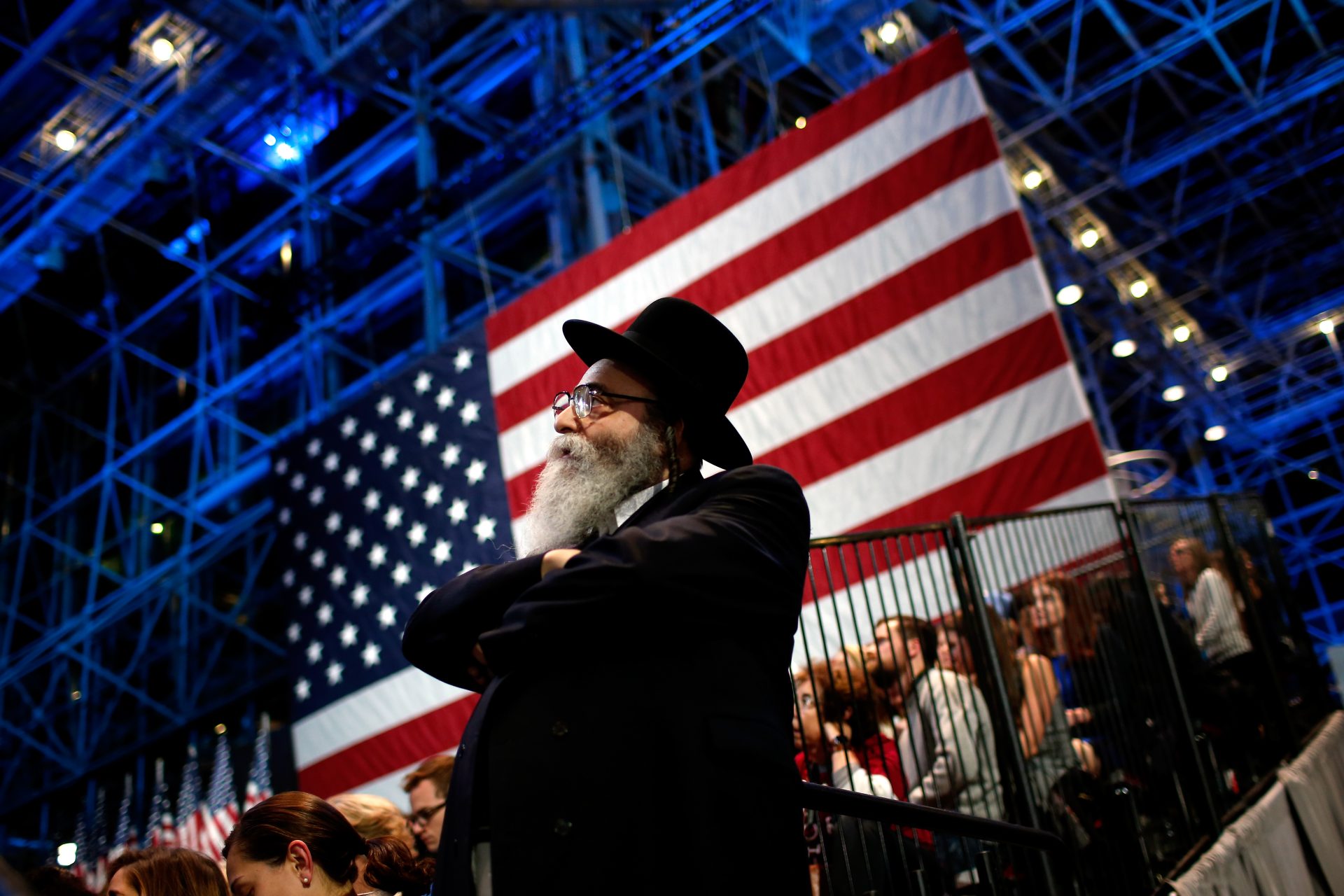
It’s perhaps one of the most consistently Democratic voting blocs in American politics: Jewish voters. In 1932, Franklin Roosevelt picked up 82% of the Jewish vote. By 1940, it had risen to 90%. That number dipped to 45% for Jimmy Carter in 1980 (although still ahead of Reagan) before returning to 80% for Bill Clinton and around 70% for most Democratic candidates since then.
But for the first time ever, there’s a possibility that the Jewish vote may be in play. Kathy Hochul — no Left-wing firebrand — has, according to recent polling, suffered a 38-point drop among Jewish voters in New York State between her gubernatorial run in 2022 and today. The pollster David Shor found that the Democratic vote share in America’s most Jewish neighborhoods dropped from 57% to 46% between 2016 and 2024, with an even steeper drop in Haredi neighborhoods. These developments led the Wall Street Journal’s Zach Kessel to argue that a larger exodus is imminent and “American Jews may finally be making the long, hard walk from the political Left to the political Right”.
The basis for that is the emergence of a zealously anti-Zionist Left, particularly in the Democratic Socialists of America (DSA). Michigan Senate candidate Abdul El-Sayed had to apologize after seemingly evincing sympathy for the perpetrator of a terrorist attack on a synagogue in West Bloomfield. New York City Mayor Zohran Mamdani was similarly soft on the pro-Palestinian chants of “globalize the intifada” and “from the river to the sea” during his election campaign. New York congressional candidate Darializa Avila Chevalier attended a pro-Hamas rally on October 8, 2023, while Melat Kiros, a Democratic congressional candidate in Colorado, called the October 7 attack “the inevitable consequence of apartheid”.
Anti-Zionism is increasingly becoming not only a viable political position on the Left but a litmus test for ideological purity. It seems natural then that a party with 100 representatives voting to end US military aid to Israel can’t ultimately sustain a voting electorate that identifies 86% as pro-Israel. But there is a major caveat here. Kessel’s piece concludes that if these trends hold up, Republicans stand to benefit so long as they “keep antisemitic kooks out of their own coalition and avoid screwing it up”.
But that’s a very tall order. Not so long ago, former Republican congresswoman Marjorie Taylor Greene speculated that Californian wildfires might have been caused by “Jewish space lasers”. A Senate candidate in Georgia, or one of his subordinates, artificially elongated the nose of his Jewish opponent Jon Ossoff in a campaign ad. The sitting Republican president has repeatedly used the term “Shylock,” met with the Holocaust denier Nick Fuentes and the Nazi sympathizer Ye (Kanye West), and is viewed by 52% of Jews as antisemitic.
The MAGA Republicans, then, are not really in a position to pick up the Jewish vote, and what we can expect is a period of homelessness — as the Democratic Party becomes increasingly inhospitable to Jews but Republicans are unable to banish antisemites from their own coalition. Support for Israel seems likely to become even more of a political piñata, especially with the DSA cohort entering the Democratic caucus — and it may well flare into a party-breaking issue if Alexandria Ocasio-Cortez, who has called Israel’s war in Gaza “a genocide” and pledged to oppose all military aid to Israel, runs for president and, as expected, performs well in the primary.
But none of that by itself guarantees a significant shift in the Jewish vote. According to a poll conducted in spring 2026, only 23% of American Jews support the Israeli government’s policies, with 63% critical — figures very close to that of the American population as a whole. What may well be happening isn’t a divide so much around Israel as around Netanyahu and his campaigns in Gaza, Lebanon, and Iran. If Netanyahu is defeated in the upcoming Israeli elections, it could be an opportunity for a reset — a chance for a new coalition to distance itself from the hyper-aggressive policies of the current regime and, in so doing, to bolster Israel’s relationship with American Jews.
If that doesn’t happen, then everything starts to get really shaky. Jewish voters increasingly have to balance support for Israel with conscientious critique of its government’s policies. On top of that are the concerns that the Democratic Left is moving in an extreme “anti-Zionist” direction while conspiracy theories and antisemitism foment among the Right. More than anything, the result of all of this will be political homelessness — Jewish voters, arguably the most stable voting bloc in American history, suddenly finding themselves without a clear space in the political landscape.