




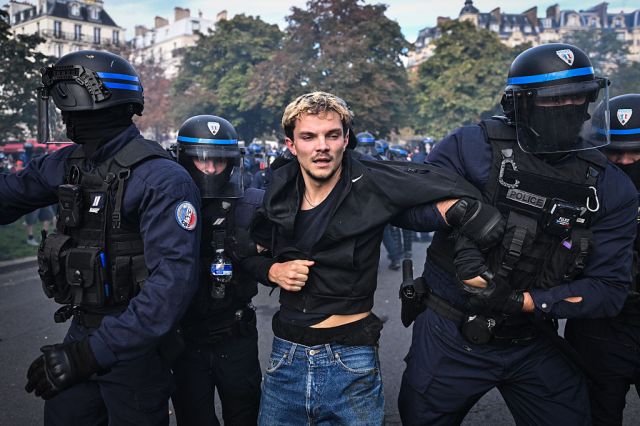
“The canary is singing again. This time, let us not wait until it falls silent.” (Firas Abdullah/Anadolu/Getty)





French youth have always been the canary in Europe’s coal mine. Whenever the continent is about to turn a historic corner, they take to the streets, mostly unwittingly, to sound the alarm. They did it in 1789, when feudalism was in its death throes. They did it in 1871, when the Paris Commune foreshadowed the rise of big business and big finance. They did it in May 1968, just before the Bretton Woods system was blown up. And the gilets jaunes, whose ranks were swollen with the young and the left-behind, did it again, in 2018, to put Macron’s government on notice as it was busily shifting more wealth from the poor to the rich. Like tragic heroes whose demands fall by the wayside, but whose actions power up History, the French youth are back.
It began in mid-September in Créteil, in the suburbs of Paris, with lycée students marching in solidarity with their striking teachers. Three weeks later, hundreds of schools are closed, the Place de la Bastille has filled again, and the protests have spread to Belgium, Italy and now Greece. The demands are embarrassingly modest: enough teachers; classrooms that are not overcrowded; buildings that are not falling apart. The state’s response has not been modest at all. Almost 7,000 arrests, 86% of them minors. A 15-year-old lost his left hand to a stun grenade. A 16-year-old was partly blinded by a rubber bullet. Meanwhile, the Prime Minister lectures them against “violence” and lambasts politicians who “use this anger to conduct their electoral battles”.
I keep watching the videos. Many of the students could put our parliamentarians to shame with their free-flowing speeches. Others cannot string two sentences together. And, to be fair, some indulge in ugly violence. As I watch them, my mind races back to my own student days in England. To our rage at Margaret Thatcher’s determination to slash and burn our universities’ budgets. And to my friend Fiona — whom I wrote about in my last book as well as in my last piece. As student activists, Fiona and I shared one political defeat after the other, from the Miners’ Strike to the Wapping Dispute. One day, exhausted, I asked Fiona if it was time to surrender, to give up. Her answer has stayed with me for 40 years: when you join a good struggle, she said, you learn to live in near proximity to giving up without ever actually doing so.
That’s the political passion that can beat in young chests. It is not always articulate, it is rarely disciplined and, as I learned in Thatcher’s England, it is usually on the losing side. Fiona’s one regret was that we were fighting splendidly to defend communities that deserved defending, but for causes that screamed anachronism. “Why can’t we bring the country to its knees to demand clean energy and a free press?”, she asked, as we fought in solidarity with coal miners and printers whose labor resulted in abominable rags like The News of the World and The Sun.
The French lycéens have no such problem. Their cause is anything but anachronistic. They are demanding the one thing that every social economy needs, and which ours have refused to fund since at least 2008, well before that in Britain and my native Greece: investment in the future, beginning with the people who will live in it.
Here is the cruel irony. For 15 years, centrist politicians have been telling French families that there is no money: for teachers, for classrooms, for anything that does not yield a quick rent. Yet after 2008, that same center found unlimited sums for the bankers and, today, finds gargantuan sums for armaments. Even Renault is at it, pivoting from quirky cars to killer drones. For almost two decades, austerity for the masses and “socialism” for bankers and corporations choked investment.
There is no puzzle here. Why would big business invest the rivers of money the central bank was providing them for free: when the masses were too impecunious to purchase high-end goods? Naturally, big business took the funds and bought back their own shares. As these shares skyrocketed in price, so did the managers’ bonuses, house prices in Paris’ leafier neighborhoods, and the price of everything — from crypto to art — that the rich buy when they have money to burn. And here’s the rub. In the midst of all this money-making, productive investment collapsed. Why invest productively when you can make more by buying houses, paintings and Bitcoin?
This is why German industry is withering, why France’s schools are crumbling, and why so many young people wonder what life will look like in a decade, especially now that AI is pulverizing entry-level jobs hitherto reserved for the “good” kids who did their homework and followed the proscribed bourgeois path. It is bizarre for the grown-ups to dismiss the students blocking their lycées as rebels without a cause. They are the first generation to receive the sky-high bill for the combination of austerity for the many and socialism for the very few that their parents bequeathed them.
As I watch them, a darker thought creeps in. The incredible youth uprising of May 1968, when students urged us to demand the impossible, ended up reinforcing conservatism. Will today’s uprising end up feeding the extreme Right that loathes them, the very forces that thrive on their despair? Six months before the presidential election, Marine Le Pen leads in the polls. We have already seen how her side will play this.
The demonstrators from the banlieues of Créteil and Seine-Saint-Denis are being painted as black and Arab hooligans, foreign bodies burning the Republic. As for the furious white bourgeois kids of central Paris, they are portrayed as spoilt brats, too clever by half, privileged products of elite lycées who understand nothing of what it means to work to put food on the table, to be real victims of mind-numbing inequality. The far Right’s strategy is tried and tested: divide the youth along the lines of race and class; set the frightened middle classes against both; then walk into the Élysée promising order. It seems the young cannot win. Or can they?
Seeking hope, I turned to an article by novelist Arundhati Roy, describing another youth uprising half a world away. In India, the Chief Justice contemptuously dismissed unemployed young Indians as “cockroaches”. A student, Abhijeet Dipke, replied on Instagram with a single question: “What if all cockroaches come together?” Millions answered. The Cockroach Janta Party was born, first demanding the resignation of an education minister whose ministry had allowed exam papers to leak, devastating the lives of millions. On 20 July, tens of thousands of young “cockroaches” descended on Delhi and marched towards parliament, through tear gas, batons and the barrels of assault rifles. Months on, they are still out on the streets.
The parallels with France are striking. In Delhi, as in Paris, it began with education: with the state’s contempt for the young people it was meant to prepare for the future. In Delhi, as in Paris, the demand that sparked the fire quickly became, in Roy’s words, “small change”. The real target was the rot across the entire system of governance. And in Delhi, the police reportedly prepared trucks of stones and pre-damaged vehicles so that the young would look violent and the state would look as if it were acting in self-defense. Remember that the next time a French minister speaks about “violence”.
But the most important lesson from the cockroaches is what they got right. Instead of lecturing, Roy writes, they showed Indians what their country could look like: Muslims, Hindus, Christians, Sikhs, people of every caste and class protecting each other as they faced down the police. Dipke, a Dalit, dared say out loud what cautious opposition politicians would not: that if his name had been Khalid, he would already be in jail. In short, the cockroaches refused to be split along the fault lines that the Modi government has spent a decade deepening. They did what my friend Fiona always demanded of us: they stopped explaining oppression and started practicing solidarity.
By looking to India, I feel I now have an answer about France. The Republic’s youth can win if the kid from Créteil and the kid from the Lycée Henri-IV refuse the roles that the far Right and the extreme center have written for them. If they see that the crumbling classrooms of the banlieue and the overcrowded ones in central Paris have the same author. If they understand that their dignity is indivisible, that, as Solomon Burke once sang, “none of us are free if one of us is chained”.
But Roy also issues a warning, one that we, the adults, must heed. Spontaneous rage dissipates, she writes, unless accompanied by real political work. “States have the power to wait. People don’t.” The French government is already waiting, promising a “plan” by the end of October and hoping the students will be back in class, exhausted, by Christmas. Here I find myself closer to my mother, a second-generation feminist, than my friend Fiona. Whereas Fiona distrusted every organization, as a finishing school for future bureaucrats, my mother, who for years faced down organized misogyny alone, knew that without organization, life is dreary and struggles are short.
The young have lit the fire. It is now the duty of trades unions, teachers, parents and, yes, the parties of the Left to stop jockeying for position and to turn this moment into a program: money for schools; an end to the austerity that starves them; and a public-investment drive in the sectors of the future, funded by the means some of us have been proposing for years.
If the Left fails them, the far Right will harvest their anger, just as it harvested the anger of the gilets jaunes. Yet get it right, and France’s young cockroaches will achieve more than what their predecessors did in 1789, 1871 and 1968: not merely warning Europe, like a thermostat, that a boiling point has come, but helping us turn away from fascism, racism and mindless conflict. The canary is singing again. This time, let us not wait until it falls silent.
Yanis Varoufakis is an economist and former Greek Minister of Finance. He is the author of several best-selling books, most recently Raise Your Soul! A personal history of resistance.
 yanisvaroufakis