




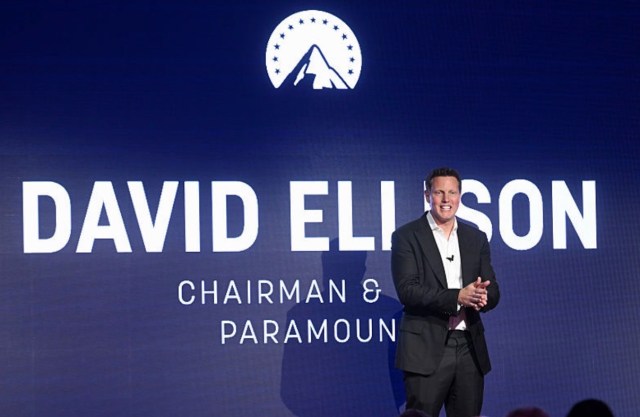
David Ellison’s latest merger indicates the managed decline of Hollywood. Credit: Getty





Every July, a handful of the richest people in America fly private into Idaho, zip up their fleece vests, and decide the future of American media over breakfast. The Allen & Company conference in Sun Valley, which NPR once dubbed “summer camp for billionaires,” is a secretive summit where tech and entertainment CEOs, politicians, and investment bankers gather to wheel and deal.
For a generation, the gathering has led to media companies being bought, sold, and traded like so many Pokémon cards — part of Hollywood’s wholesale merger with Wall Street. Disney’s purchase of ABC grew out of a conversation at the conference in 1995, for instance, and Steve Case and Gerald Levin floated the ruinous AOL-Time Warner marriage there in 1999. The difference from Pokémon, of course, is that Wall Street decides what each card is worth, and Allen & Company, the investment bank throwing the party, is among those who take a cut.
“That summer camp,” a veteran Hollywood producer told UnHerd, “led to this.” This arrived on Monday, when a settlement cleared the last major legal hurdle to Paramount’s $110 billion takeover of Warner Bros. The transaction would bring Paramount and Warner Bros., CBS and CNN, and HBO Max and Paramount+ under the same corporate roof. That means Superman, the Teenage Mutant Ninja Turtles, and Wolf Blitzer would share a common landlord. Fittingly, Paramount boss David Ellison had turned up at Sun Valley in July with Bari Weiss, his handpicked editor-in-chief of CBS News, while the deal was still tied up in court.
Much of the alarm over the deal has focused on CNN and CBS, and the prospect of a mega-network beaming Bari Weiss Thought into every Boomer’s living room. But this is also a bigger Hollywood story. Beyond deciding who gets to lecture geriatric Americans on television, the merger will help determine which films and shows get made, who gets paid to make them, and how much of the industry survives the next round of cost-cutting.
President Trump’s Justice Department approved the merger in June, reportedly to the surprise of its own lawyers. Last week, the Federal Communications Commission approved foreign investment in the transaction, including non-voting stakes totaling up to 49.5% for sovereign wealth funds from Saudi Arabia, the United Arab Emirates, and Qatar. That means — yes — the America First administration has cleared the way for the Persian Gulf monarchies to own up to half of the company that makes Top Gun.
Almost nobody in California is happy with the deal publicly, even with the concessions: Paramount will spend an extra $300 million a year on American production, promises not to sell its studio lots, and will set up an independent board to protect CNN and CBS News from corporate meddling. But the media-reform group Free Press — no relation to Weiss’s newly Paramount-owned outfit — called the concessions “empty Paramount promises.” Sen. Elizabeth Warren said handing a bigger part of the news industry to a “Trump-aligned entity” would be “disastrous.” And former Federal Trade Commission chairwoman Lina Khan said the deal “seems facially illegal.” Meanwhile, studio staffers are bracing for multiple rounds of layoffs in the corporate consolidation.
The critics are right about almost all of it, but it’s wrong to think of Hollywood as a healthy organism about to be poisoned by a bad merger.
This is vulture capitalism working as intended. When an industry can no longer grow, the smart money consolidates it, offshores what it can, cuts the rest, and milks the remaining cash flow until the lights go out. American newspapers already went through this: hedge funds like Alden Global Capital bought regional dailies, sold the downtown buildings, gutted the newsrooms, creating what scholars call “ghost papers”: local outlets are still published, but they barely field any reporting staff, and much of the content is syndicated — and, therefore, not really the sort of local news healthy democracies need.
In a sense, Paramount-Warner is the Alden-ization of TV and movie production by way of Sun Valley. The Financial Times reports that the acquisition would leave Paramount with about $80 billion in net debt, while management promises $6 billion in annual savings.
The movie producer I spoke with, who asked to remain anonymous given his proximity, dates Hollywood’s spiritual death to a Sun Valley conference in the 1990s, when the tarmac was crowded with tech and Wall Street jets. Steven Spielberg’s plane, he recalled, “was parked down by the losers.” Even Spielberg had discovered a world in which $400 million counted as small potatoes (as of 2026, he’s worth more than $7 billion). Likewise, Michael Ovitz arrived as Hollywood’s most powerful man, clearing only $30 million a year at Creative Artists Agency, so he left for a stock payday at Disney, was fired barely a year later, and walked away with a severance package worth north of $100 million. “It was the moment,” the producer told me, “Hollywood realized real wealth is stock-market wealth.”
Over the last two decades, what was once seen as a creative industry has become a financialized one. In his 2024 essay headlined “The Life and Death of Hollywood,” the historian Daniel Bessner traced an industry in which cheap money after the Great Recession turned studios into playthings for asset managers. By the end of 2023, Vanguard Group, a massive investment manager with $13 trillion in assets, became the largest shareholder in Disney, Netflix, Comcast, Apple, and Warner Bros. These owners, he wrote, have no real stake in Hollywood itself. Thus, the logic of maximizing shareholder returns explains why every other movie or TV show became a sequel or a spinoff. Creative risk means financial risk, especially at a time when YouTube — and now TikTok — keep tearing viewers’ eyeballs and attention spans elsewhere.
The contrast in priorities is striking. Comcast’s spending on buybacks and dividends spiked to more than $18 billion in 2022, up from $3.2 billion in 2008. The new owners, Bessner wrote, were “stripping value from the production system like copper pipes from a house.” These days, there’s less and less left to strip. The biggest film and TV companies were more than $20 billion in the black in 2013; by 2022, those profits had roughly halved. Box-office revenue in 2023 was still 22% below what it was in 2019, and cable revenue has fallen an estimated 40% since 2015. Between August 2022 and the end of 2023, industry employment declined by a quarter.
It’s no coincidence that the industry keeps racing to the bottom, seeking out jurisdictions willing to hand out the most generous tax incentives. In the last decade, Atlanta became the “Hollywood of the South,” and by 2021, Georgia’s share of tax money to subsidize Hollywood topped $1 billion annually. Now much of that work is being shipped to England, where the tax credits are even bigger. The Hollywood Reporter has anointed London “the new Hollywood,” and one insider called the city “more Hollywood than Hollywood.” Trump’s threatened 100% tariff on foreign-made films has, so far, changed nothing.
Since the 2023 writers’ strike, American production is down roughly 40%. That puts Paramount’s $300 million pledge in context: it’s a reshoring clause for a company town already half abandoned by the companies. But the threat of even more capital flight explains why Gavin Newsom and California Attorney General Rob Bonta folded in their initial opposition to the deal: the threat of departure gave the Golden State a painful choice — challenge the consolidation, or risk losing more of the industry itself.
None of this makes the merger harmless. Managed decline is still decline. The pressure will bear down most heavily on the people still struggling — against all odds — to do creative work. If you’re a rising screenwriter, your bargaining power slips if, as a result of consolidation, there are fewer firms competing over your hot spec script. The public also loses, just more slowly and in ways that are harder to see. The Wall Street model is risk-averse to the extreme and thus likely to discourage gambles on mid-budget prestige dramas and original content. Instead, producers will greenlight Batman Versus SpongeBob and umpteen sequels to the same. At home, HBO Max and Paramount+ will be folded into a single service, and anyone who has watched streaming prices over the past five years knows which way the monthly bill goes when competition disappears. Viewers will end up paying more for less, and most of the “more” will be sequels.
Not everyone is complaining. Warner Bros. shares jumped 10.8% to close at $30.80 on Monday. Hollywood may be slowly dying, but at Sun Valley, there’s always room on the tarmac for more winners.
