




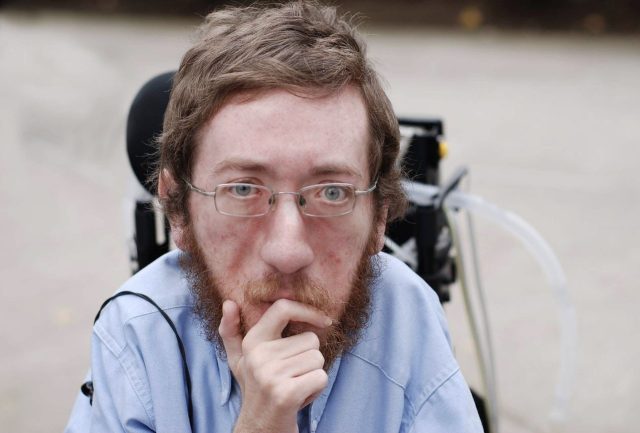





“I didn’t like what you wrote about….” That’s how Dov Paul Eisner greeted me nearly every time we met up. It grated the first few times. Here I was, having arranged a dinner or drinks, bringing together other “mutuals” in addition to dispatching a specialty rideshare to carry his motorized wheelchair from his place in deep Brooklyn to Midtown, where I live. And Dovie (as we called him) opened by rebuking my recent work.
It took me a little while to figure it out. More than just a way to establish closeness, Dovie’s intellectual ribbing shattered the pitying mentality and saccharine tone — the false piety — that can sometimes characterize the way we relate to people with severe disabilities. It was as if to say: here I am, no different from you — unable to walk or to breathe unassisted, yes, but capable of disagreeing and being disagreed with. Have at me.
Dovie, who died last week while in a coma at age 35, spent his last conscious days railing against the assisted-suicide and euthanasia laws sweeping the democratic West. When New York state lawmakers took up an assisted-suicide bill last year, he published a viral essay in UnHerd urging Gov. Kathy Hochul to veto it. “As a young man with disabilities,” he wrote, “I fear what this state should become if suicide-by-doctor becomes law.”
He worried that with doctors authorized to prescribe death, people like him would be nudged to choose suicide by health systems and public attitudes that view some lives as too difficult and too painful to be worth continuing. He saw this culture of death menacing his own existence.
Dovie’s life was difficult and painful in many ways. He was born with a genetic disorder called nemaline myopathy. It basically meant that he had catastrophically low muscle tone, leaving him unable to walk. Speaking was only possible in between drags on an air tube, and then in a voice that barely rose above a thin rasp. Yet his life — his indefatigable, irrepressible drive to partake of all that it means to be human — bore witness against the culture of death.
I first met him through a mutual friend — Professor Robert George, the great Princeton ethicist — after an event on the rise of anti-Semitism, held at New York’s Center for Jewish History in 2017. As I would soon learn, he had very little patience for small talk and pleasantries. That first time, he cut to the chase. “We’ll never have a proper discussion about anything,” he began, “until we learn that rational people may have perfectly rational reasons for believing things we find horrible.”
OK, but what are you talking about?
“Gun control and abortion,” he shot back. “According to one side of these debates” — a deep drag on the air tube — “I have blood on my hands for supporting the Second Amendment” — another drag — “and I’m only motivated by the Bible to oppose abortion.”
Dovie debated vigorously, on first principles — rare among our cohort but natural for one reared on traditional Jewish learning. In those days, both of us still adhered to the tenets of traditional Reaganite conservatism. In the decade that followed, he stayed there, more or less, only becoming slightly more Trump-friendly. Whereas I gradually shifted to a more heterodox position that embraced labor unions and thicker welfare nets — conservative social democracy or blue Labour are probably the best labels for it.
Dovie would have none of it. “Unions?” he scoffed. “That’ll just mean the people who care for me will cost more and work less!” And he wouldn’t relent in such discussions, no matter the social context. It’s what made his company equal parts maddening and enjoyable. Dovie offered no deference to social rank or politesse, and he expected none for his disability. He would have been disappointed in me if I backed away from my pro-labor position on account of his needs. And so we argued, by phone and in person, almost to the end.
Dovie befriended with no less vigor. Typical for a Millennial and one with his physical limitations, many of his friendships took shape online. But as much as possible, he tried to drag them into the real world: to force his e-friends see the man behind the tweets. He unburdened himself with relative ease — “Am I likable? Like, do you grit your teeth around me?” Yes, you are — and invited similar openness. He drank life fully, somehow, and strong bourbon, too.
Dovie fell in love. Attending conservative galas, he’d often come accompanied by young women who were all too happy to assist him. Sometimes, though, he wanted more than assistance. He wondered out loud to me if he had a shot with some of them. “I need to get married, dude,” he’d say. His romantic side attested to Aristotle’s observation that man’s domestic impulse is even stronger and more foundational than his political impulse. But in Dovie’s case, that impulse would remain frustrated, as far as I know. I could help him get published, but I couldn’t help him there. Here, I may have succumbed to that pity I knew he hated.
And Dovie believed. Though born to an Orthodox rabbinic family, he began exhibiting a strong attraction to the Christian faith in the late 2010s. At first, it was merely a civilizational draw. “I do not know whether or not there is a God,” he wrote to me. “I am inclined to think so. Yet I think that atheism is an absolutely untenable philosophy for society even if it is the truth.”
But as is often the case, his “I am inclined to think so” led him to “mere Christianity.” He had himself baptized as an Episcopalian, but I could sense he was heading Rome-ward. “I HAVE CATHOLIC QUESTIONS,” he texted me in 2018. Dovie, I think, was one of those people for whom the Catholic Church is its own proof: the sheer fact of an institution that has persisted for two millennia, teaching the same thing — not least when it comes to the value of life, all life.
When he was ready to be received in the Church, I served as his confirmation sponsor at a Mass celebrated in Latin at a church in Brooklyn on April 17, 2022 — Easter.
As the years wore on, it was hard to avoid the impression that his condition was worsening. When we’d go out to dinner, he could only manage soup, having once relished grilled chicken. Later, just the bourbon. Eventually, not even that. Then, in late May 2025, days after his UnHerd essay appeared and was adapted into a New York Post column, he had an apparent mishap with his breathing device. I visited him at the Brooklyn hospital where he was initially treated, said several decades of the Rosary, held his hands.
Early on, there were little signs of movement under the eyelids, but these apparently proved illusory. Dovie stayed in a coma, lovingly cared for by his family at multiple facilities, for more than a year. My final text to him — “Hey, dude, still basking in the afterglow of publication?” — went unanswered. Then again, at his confirmation Mass, the words of the Introit reassured both of us: Resurréxi, et adhuc tecum sum, alleluia.
Sohrab Ahmari is the US editor of UnHerd. His next book, on The Triumph of Normal, is forthcoming from HarperCollins.
 SohrabAhmari