







 Prefer us on Google

September 4 2026 - 10:00am
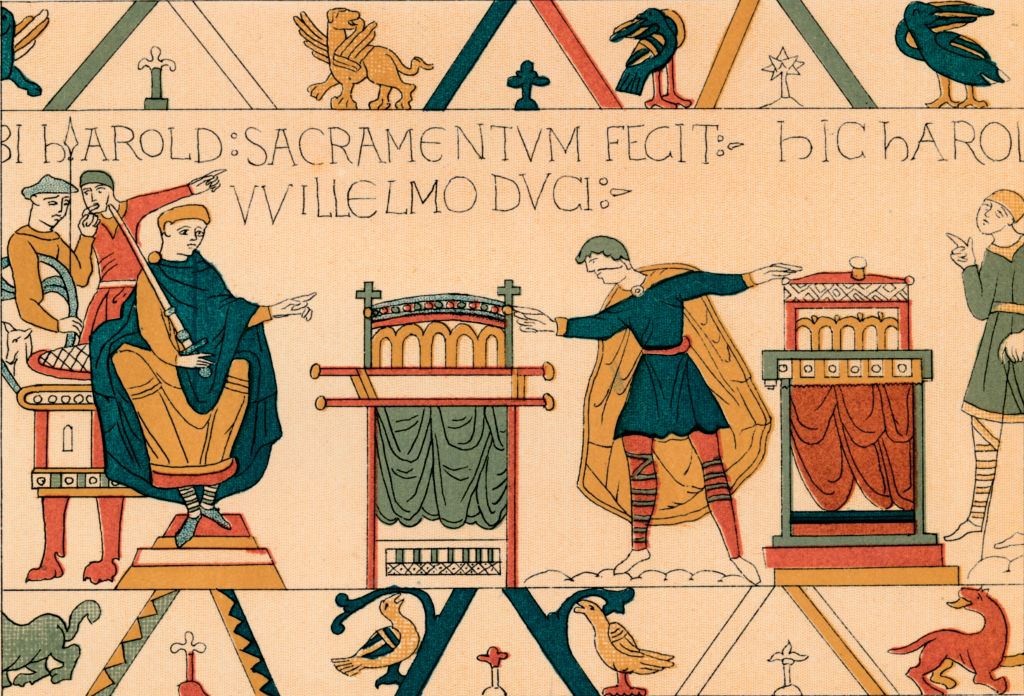
There is an apocryphal anecdote about an arrogant landowner insisting that one of his tenant farmers should know his place. “My ancestor came over with the Conqueror,” boasts the haughty aristocrat. “And my ancestor was there waiting with his axe,” mutters the countryman. The divisions between Saxon and Norman — real and supposed — have been part of the background of English culture for almost a thousand years. Perhaps the arrival of the Bayeux Tapestry will spark a resurgence of interest in the Norman Conquest, one of the most impactful events in Britain’s history.
Gerald Grosvenor, sixth Duke of Westminster, when asked what advice he would offer to a young entrepreneur, is supposed to have replied: “Make sure they have an ancestor who was a very close friend of William the Conqueror.” The joke reflected an underlying reality about wealth and power over the last millennium. The invaders of 1066 — “the first date in English history”, as W.C. Sellar and R.J. Yeatman memorably called it in 1066 And All That — were extremely small in number, barely 1% of the contemporary population. However, by the time of the Domesday Book in 1086, Anglo-Saxon names such as Aelfric, Wulfstan and Godwin had largely disappeared, to be replaced by endless Roberts and Henrys and Williams.
Their descendants have shown remarkable tenacity. Even today, if you ask someone to think of “posh” names, they are very likely to pick out the ones that were common among the retainers of the man whom the Anglo-Saxons called William the Bastard: Hugh, Geoffrey, Roger. In his fascinating 2014 book The Son Also Rises, Gregory Clark provides detailed evidence of how certain family names crop up repeatedly in high-status roles across hundreds of years.
Notwithstanding a century and a half of mass democracy, much of Britain is still owned by a relatively small number of families. The Grosvenors trace their ancestry to one Hugh d’Avranches, Earl of Chester and a crony of the Bastard. At Kedleston Hall in Derbyshire, ancestral seat of the Curzons, there are several enormous family trees that trace their lineage all the way back to Hubert de Courson, another 11th-century nobleman. The family motto — “Let Curzon hold what Curzon held” — is a small masterpiece of stubborn reaction, reflecting the persistence of Norman elites.
At the time of the Civil Wars, parliamentarians often drew on an idealized vision of Saxon liberty as the philosophical foundation for their opposition to excessive royal power. In this view, the Conquest had replaced robust self-government and representative institutions with feudal tyranny. The concept of the “Norman yoke” was admittedly simplistic, but it had enormous rhetorical power.
Radicals such as the Diggers and the Levellers drew a line from the irresistibly romantic figure of Hereward the Wake — last seen vanishing into the Fenland mists after the Normans defeated him at Ely in 1071 — through the legends of Robin Hood and the Peasants’ Revolt of 1381, all the way to their own rebellion against Charles I. The symbolism has cropped up again and again: 18th-century radicals such as John Wilkes and Tom Paine used it, as did the American Founders. It can be found among agitators for reform in the 19th century.
Britons might even detect a hint of Norman yoke-inflected rhetoric in the self-consciously Northern posturing of their new prime minister. Andy Burnham’s apparent belief that crossing the Trent takes you into a region that has been done down by remote and callous elites would not seem out of place in a Roundhead pamphlet, looking back with indignant horror towards William I’s brutal Harrying of the North.
