




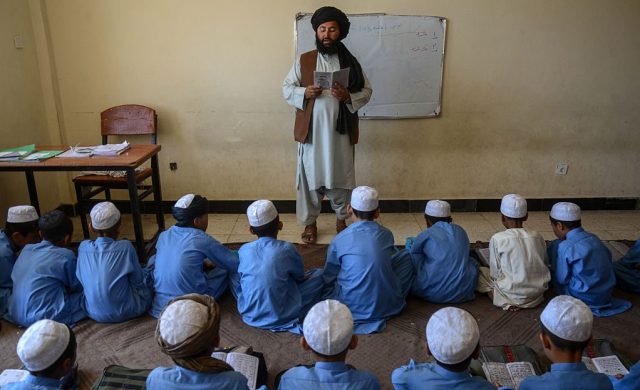
Thousands of female teachers have been banned from Afghan schools. (Sanaullah Seiam/AFP/Getty)





A few months ago, Manizha’s eight-year-old son came to her with a question. “What,” he asked, “is jihad?” His words left Manizha speechless — especially when the former Kabul office worker heard what came next. “He wanted to know how he could fight the enemy,” the boy’s mother explains, the disbelief still echoed in her voice. She sat there stunned, unable to reply.
Five years on from the Taliban’s return, and life for Afghan women like Manizha has become a kind of hell. Banned from schools, universities and even parks, they need a “male guardian” to travel more than 70 kilometers from home. And now, the mother of three fears for her children’s future too. Taught that unbelievers should be killed, and that women’s rights are mere Western propaganda, young Afghans are being groomed to become the extremists of tomorrow — with worrying implications for their country and the world.
Since returning to power in 2021, the Taliban has become infamous for its restrictions on female education, locking over two million girls from the classroom. But that still leaves millions of boys, and millions more girls under 14, in the regime’s pedagogical clutches. Certainly, it’s clear that the Taliban itself understands its power here. As far back as 2022, a 78-page leaked document outlined a raft of changes to what was dismissively called the “modern curriculum”. Instead, the document argued, schooling should be transformed in line with the Taliban’s radical interpretation of Islamic law, suggesting, among other things, that natural disasters should be explained both scientifically — and in terms of “Allah’s will and power”.
If that’s the theory, the practice is equally grim. “They asked schools not to teach some parts of certain books to the students,” explains one anonymous educator. “They’ve also removed subjects such as civic education, life skills and a subject about loving the homeland.” In its place, the teacher adds, schools now hold classes on the Quran, with textbooks reviewed by UnHerd exhorting battle against “invaders” and “apostates”. Other subjects, including English and biology, are no longer covered for lack of teachers, unsurprising when the Taliban has banned thousands of female staff.
Not that the curriculum is the only thing to change. Boys, after all, are now expected to wear a beard — or at least try to — while girls as young as six now attend class in the burka. That, in turn, reflects the spread of out-and-out madrasas, the religious schools common across the Islamic world. According to research by the Hamrah Network, a cohort of Afghan organizations, there were 23,000 such schools in Afghanistan last year, up from just 5,000 in 2023, with some 3.65 million Afghans now enrolled in madrasas or Islamic seminaries.
The Taliban has achieved this growth by operating what the Hamrah Network calls a “franchise model” — whereby private madrasas are nationalized in return for government salaries and a formal certification. With the Afghan economy in a state of near collapse, it’s little wonder that everything from broadcast facilities to guest houses have taken up the offer. One notable example is the Abdul Hai Habibi High School in the east of the country. Once among the most progressive institutions in Afghanistan, it became a madrasa in 2022, displacing 6,000 students and 130 teachers.
If anything, meanwhile, Afghanistan’s burgeoning madrasa system is even more extreme than regular schools. Framed around the hardline Deobandi movement — a revivalist form of Islam founded in India — it brings extremism to the heart of every classroom. Manizha has witnessed this firsthand, and not only in her son: her young daughter has been taught about marrying a jihadi fighter. “What place does jihad have in the 21st century?” the girl’s mother asks. “Why does a 10-year-old need to know about participating in the war or killing people? How do you expect a kid to have a bright future if all they are being taught is killing and bloodshed?”
They’re all good questions — with a depressingly plausible answer. Experts speculate that reshaping young minds is the very reason the Taliban are consolidating their control over Afghan schools. In this, the militants have history, shadowing other Islamist insurgencies in recruiting almost exclusively from religious institutions. More than that, the emirate continues to maintain a militant insurgent group, complete with suicide bombers on call, with the madrasas ensuring a steady stream of brainwashed recruits.
If this obviously has domestic implications — Dr Timor Sharan, co-founder of the Hamrah Network, suggests it deepens the subordination of women and girls across Afghan society — this matters beyond the country’s borders too. After all, the Taliban continues to support terror groups across the region. That includes the remnants of al-Qaeda, which has been blamed for a number of recent atrocities in India and Pakistan, as well as Tehrik-e Taliban Pakistan (TTP), which wages war on Islamabad from bases inside Afghanistan. The East Turkestan Islamic Movement (ETIM), a Uyghur group battling China, also enjoys training grounds in the emirate.
Yet whatever the geopolitical implications here, it’s hard not to return to the plight of Afghanistan’s children, with parents suggesting that the steady drumbeat of extremist content is affecting the younger generation’s mental health. “The way the teachers behave with the students, my children now dislike going to school,” Manizha says. “Especially my older son, who has experienced schooling in better days.” Other evidence supports this claim: the student dropout rate, even among boys, is rising, perhaps also a symptom of the rise in corporal punishment since 2021.
Of course, it’d be wrong to suggest that the Taliban invented these schools wholesale. Afghanistan was a deeply conservative country long before they returned. All the same, locals suggest one key difference, in that regressive ideas are now lauded by the state.
“The funny thing is I grew up in a community where we already experienced having that one family member, an uncle who was a little too conservative, who would get mad if women in the family went out or they wore clothes he considered inappropriate,” explains Pashtana Durrani, founder of Learn Afghanistan, which runs underground classes for girls banned from school. “We know that type in all South Asian communities”.
But now, Durrani suggests, these attitudes are “celebrated” in public — even as they’re seeping into formerly liberal, urban areas too. Given the already-shocking rates of gender violence in Afghanistan, this could have disastrous consequences, as whole new cohorts of boys grow up thinking that women are there to submit.
There are, to be sure, glimmers of hope, and Durrani’s Learn Afghanistan project is one. Operating covertly, it follows the pre-2021 curriculum, educating some 400 students in everything from history and geography to robotics, AI and even feminist literature. At one point, Durrani’s team held discreet lessons in person, but Taliban crackdowns forced them to go almost entirely online. It’s a move that poses problems all its own, obliging Learn Afghanistan to invest in new laptops, and the solar-powered batteries to run them during power cuts.
That’s better than nothing — but hardly enough to stem the extremist tide. Indeed, though Manizha says her family tried to complain about her children’s curriculum, they were dismissed out of hand. “We can’t raise our voice because we know the outcome could hurt the kids and also the family members within the community,” she says, adding that she works to counter the Taliban’s educational extremism once her children return home every evening.
That might explain Manizha’s remarkable optimism in light of everything that’s happened. “We are Muslim,” she says, “and we will be Muslim with or without the Taliban, and are capable of teaching our kids about Islam. Everything comes to an end eventually. People won’t always tolerate this form of extremism.” Perhaps — but, for the moment, the Taliban and their madrasas remain.
Ruchi Kumar is an independent journalist reporting on conflict, politics, climate and gender stories from South Asia, Middle East and Eastern Europe.
 RuchiKumar