




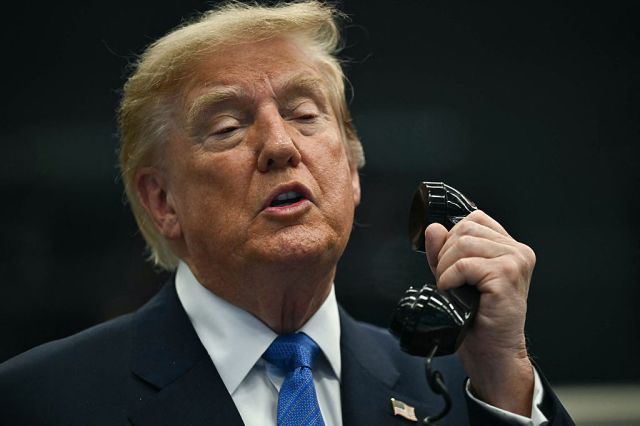
It may be time to call off the strikes on Iran. (Kent NISHIMURA / AFP via Getty Images)





Improbable though it may seem, a bombing raid on Iran may, like the proverbial Chinese butterfly flapping its wings and causing faraway chaos, trigger disparate distant ructions. Not only could the US’s November elections be upended, and the political honeymoon of Andy Burnham brought to a halt. The chaos could also trigger a fall in global stock markets and possibly a slide into recession.
Donald Trump’s latest attempt at escalating to de-escalate in the Middle East conflict has not had the desired effect. Since the bombing began over the weekend, bond yields have been rising across the world, the price of oil has shot back up and stock markets have turned shaky.
On Tuesday, the conflict deepened further, with Iran launching missile and drone attacks at multiple American bases in the region. On Wednesday, Iran accused America, whose strike was reported to have hit a wedding party, of a “war crime”. If the exchange continues, with neither side making a show of retreating, the effects could multiply in severity. That’s because all of this is happening at a time when financial strains are beginning to become visible in the world economy — in both stock and bond markets, and in economies where growth is slowing but inflation remains stubborn.
The AI bubble had already moved into a delicate phase. The hyperscalers who have driven the investment boom sustaining the US economy — counting among their number Anthropic, OpenAI, Amazon, Google and Microsoft — have burned through their ample reserves of cash and, to maintain the massive build-out of data centers and infrastructure, have now started turning to credit markets. They’ve been able to borrow on favorable terms because the rapid rise of their share prices has provided them with ample collateral. Those rising share prices have, in turn, been swollen by huge profits, creating a virtuous upward cycle which makes the new debt being taken on appear eminently manageable.
Unfortunately, though, all is not as it appears. A close look at the numbers reveals that tech leaders are making big money only because they’re spending big money. The actual rate of return on their investments is so far barely sufficient to cover the cost of depreciation of their assets, and from a long-term perspective they are essentially breaking even. Meanwhile, to justify their current very generous share valuations, the hyperscalers would need to see continued rates of profit growth that would amount to more than a doubling every year. This may be too much to ask: total revenues (not profits) from global AI sales have only just begun to surpass depreciation costs, which suggests that margins remain very tight.
Most importantly, the hyperscalers’ ascent has been underwritten by a massive expansion in the US national debt, with federal fiscal deficits expanding faster than the economy itself. More than half of US corporate profits have been funded by these deficits. Further flattering profit growth is that many more companies are today private than was the case a few decades ago, funded by private equity and venture capital, where creative accounting can keep weak performance “off the books”. But as depicted in Warren Buffett’s famous analogy of skinny dippers being exposed by a retreating tide, that sort of sleight of hand gets quickly exposed in a downturn.
Two things could bring the blistering AI rally to halt: a drop in demand for its products, or a drop in the supply of the credit sustaining the boom. It is the latter which may now be coming into play. The fundamental driver of rising bond yields is falling bond prices, since the two move in opposite directions to one another: as bond investors demand lower prices on the bonds they buy, the effective rate of interest paid by the issuer goes up.
Over the last few years, Western governments have issued so many bonds to fund their spending that investors are getting stuffed to the point they can take no more. It began during the Covid pandemic, when governments borrowed an average fifth of GDP just to keep their economies from collapsing. It then continued during the recovery phase, and in the US was turbocharged by a bipartisan consensus to thereafter throw caution to the wind. Through both the Biden and Trump administrations, the US government ran large fiscal deficits in order to fund an investment boom, the former directly through government programs and the latter through tax cuts. But the end result is a national debt that has doubled in just the last ten years, and whose growth shows no signs of slowing down.
Add to that mix, then, the shift of hyperscalers from investing their savings to raising money in corporate bond markets, and the global demand for credit now exceeds its supply by a significant margin. Central banks could plug the gap by “monetizing” the debt — essentially, printing new money and then using it to buy government bonds — but are reluctant to do so because inflation remains above their target rates. And inflation has remained so sticky in large measure because of the same fiscal stimulus that is pumping money into the economy without producing equivalent growth.
Inflation had, however, shown signs of moderating over the summer, in part because the ceasefire between the US and Iran had allowed energy prices to fall back down. Had that continued into the autumn, we might have seen central banks lower interest rates further. Instead, due to the resumption of hostilities in the Middle East, oil prices are once again rising. Although this will raise gas prices, the greater damage will come through the prices of distillates like diesel, which are driving up transportation and farming costs just as the northern harvests are coming in. So the fertilizer shortages caused by the war are now starting to turn up in food prices on store shelves.
This price resurgence comes at a most inopportune time. If it persists, the autumn inflation readings could prod central banks to further raise interest rates, raising credit costs for everyone. No G7 country will feel the weight of this expense more acutely than Britain. UK gilts have carried a premium for the last few years, imposed initially after the 2022 Liz Truss moment and then worsening after the 2024 election, when the incoming Labour government’s implausible tax and spending commitments caused investors to doubt the financial acumen of the British Treasury. The impact of perceived British mismanagement is that UK gilt yields are now the highest of any G7 country, and each day’s inching further upwards makes the government’s difficult situation even worse.
So pity the Chancellor, John Healey, who at the end of October will deliver his first Budget. Healey’s fiscal headroom, the gap between revenues and budgeted expenditure that he can “play with”, was tight to begin with and is now narrowing towards zero. At this rate, come Budget day, he will have to deliver bad news — either further spending cuts or tax increases. Either would probably bring an end to Andy Burnham’s honeymoon period, which has seen his net approval rating rise steadily since he became Prime Minister.
And if Andy Burnham faces a cold new reality, Donald Trump may become a lame duck. The odds of a Democratic sweep of Congress in the November elections, currently tilted slightly in their favor, will probably lengthen if gas prices go back up, inflation rises and credit card costs become more burdensome. Inflation that has been running over 3% has now begun to erode the incomes of ordinary Americans, and the bottom half of the economy can be forgiven for thinking there’s already a recession.
What has kept the economy from contracting has been the heavy consumption of the top half, fueled by the wealth effect of the stock market rally. So, if interest rates were to choke off the supply of credit and slow that growth, the market might fall as prices realign with the new reality. In that event, the reversal of the wealth effect could tip the US economy into recession, accelerating slowdowns elsewhere.
Worryingly, the capacity of Western governments to tackle recessions is not what it once was. As the Bank for International Settlements noted in its annual report, recent years have seen government debt rise during downturns, but without a concomitant decline during economic recoveries. The rainy-day funds of Western governments have then been further depleted by the rising demands of defense expenditure, aging populations and adaptation to climate change.
It seems unlikely that the rise in bond yields we’ve seen over the last week could continue much longer without something cracking. As debt-laden governments are forced to commit ever more of their revenues to interest payments — in the UK, they now suck out more money than the defense and Home Office budgets combined — they will have to either cut spending or raise taxes.
In the US, such fiscal austerity would drain the supply of money that has kept the economy revving. That, in turn, would hit the profits of the tech companies inflating the bubble just as their access to credit dries up. In short, the scale of the recession could stand in direct proportion to the scale of the boom which preceded it, at a time western governments would be more constrained in their ability to engage in counter-cyclical policies. With the American economy already slowing and the job market at a virtual standstill, a slide into negative territory could deepen the hardship already being felt by many working people, strengthening the wind now filling the sails of political populists.
Thus, between the limited fiscal firepower of Western governments and the chariness of their central banks, reluctant to stimulate amid persistent inflation, this is not the time for a recession. Let us hope that Trump soon finds a different way out of his Middle East quagmire.
John Rapley is an author and academic who divides his time between London, Johannesburg and Ottawa. His books include Why Empires Fall: Rome, America and the Future of the West (with Peter Heather, Penguin, 2023) and Twilight of the Money Gods: Economics as a Religion (Simon & Schuster, 2017).
 jarapley