




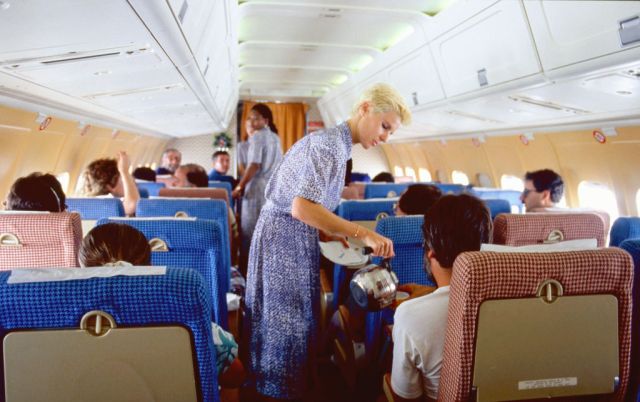
Air travel is becoming less and less glamorous. (Photo by Gianni Ferrari/Cover/Getty Images)





It’s easy to forget that the war with Iran was supposed to be a cinch. To say that it has not worked out that way would be an understatement. While most headlines are focused on the damage to America’s military and economic credibility, there is another big loser: the airline industry.
Indeed, the war has already claimed its first casualty in this field: the US budget airline Spirit, which went bankrupt at the start of the conflict. It’s true that Spirit had been plagued with problems for a long time and wasn’t exactly a healthy company, so the massive increase in fuel costs was only the final nail in the coffin. Then again, most airline companies aren’t very healthy. During the Covid pandemic, much of the global airline industry had to be bailed out by national governments in order to avoid collapse. In the US alone, Congress authorized roughly $54 billion in direct payments to the big carriers; many more billions were spent in Europe and elsewhere by governments intervening to save their own flag carriers from fiscal ruin. Beyond the pandemic, however, there lurked a real and serious issue with the airline industry itself. Over the years, commercial air travel has become harder and harder to run at a profit, mostly for reasons that are out of anyone’s hands.
The decline of affordable air travel may herald a far greater historical and economic shift: the decline of the Western middle class itself. Not that long ago, even a humble Swedish or British working-class family might have found the occasional charter trip to Mallorca or Ibiza affordable. In 2026, those kinds of luxuries are growing more distant.
There is, of course, no rule that human society must have a middle class to begin with. Indeed, most societies throughout history have consisted of farmers and laborers at the bottom and a thin slice of rulers and nobles at the top. Clerks, bureaucrats, merchants, crafters and artisans formed tiny minorities in and around the towns and manor houses, usually with very little in the way of cultural, social, or political power. The state of affairs that we consider normal today is really anything but.
Only in the 20th century did the West experience the rapid growth of the first truly majoritarian middle class in human history. Consider John Steinbeck’s 1939 novel, Grapes of Wrath. The Joad family in that novel are certainly not part of the middle class — they are poor, uneducated tenant farmers without indoor plumbing, who are made homeless by economic forces far beyond their control. But indoor plumbing and higher wages were coming even for the Joads. The integration of Tom’s children into the post-1945 American middle class is essentially a foregone conclusion before Steinbeck’s novel even begins.
This massive social transformation was only made possible thanks to the rise of what we can call “technologies of mass affluence”. Luxury, of course, is as old as civilization itself. But until the 20th century, practical limitations meant it was enjoyed only by the few. Ice cream was eaten in the Middle Ages, and various recipes for sherbet go back thousands of years. But until the advent of modern refrigeration, getting fresh ice in the middle of summer involved cutting out a huge block from a suitable lake during winter, before stuffing it in a purpose-built, insulated cellar, where it would then melt slowly enough to still be intact half a year later. A medieval duke who wanted to impress his dinner guests might press-gang enough peasants to perform the massive amounts of labor required to serve iced desserts. But few others could. With the advent of the freezer, though, what was once an impossibly decadent luxury became accessible even to the poor.
Commercial air travel is one of the youngest technologies of mass affluence. The Wright brothers flew their first successful prototype airplane in December 1903, but it would take until after the Second World War for the aviation industry to start truly flourishing. Boeing’s iconic 707, the first “modern” commercial jetliner, appeared in 1957. In the four decades that followed, air travel and international tourism would go from being the preserve of the very rich to something even a working-class family could save up for.
Today, however, that picture looks set to change. Many oil refineries across the Middle East have been shuttered or hit with missiles, and the Strait of Hormuz is likely to remain closed for the foreseeable future. Many European airlines are already hiking ticket prices or grounding planes and cutting capacity. But again, the airline industry’s woes did not start with the Iran war, nor with the Covid pandemic; this is an industry that has been structurally weak and hard-pressed to make decent profits for years.
The primary culprit here is energy. It’s not just that planes require fossil fuels to fly, though that is certainly a part of it. On a societal level, the more energy there is available, the easier it will be to perform most kinds of economic activity. The airline industry saw its golden period of explosive growth in the United States during an equally explosive growth of per-capita energy production and consumption. But that period of growth is now over. US production of conventional (read: cheap) oil peaked in the Seventies. The much-touted shale revolution has brought the total level of US oil production back to where it was 50 years ago, but it has done so by replacing cheaper and better grades of oil with worse grades that cost many times more to extract from the ground. And regardless, the shale revolution itself is now ending, with US unconventional production set to peak in the very near future.
More dramatically, the total amount of energy produced and consumed in the United States has actually been stagnant since the turn of the millennium. But because the population of the United States has naturally continued growing since then, energy per capita has begun to decrease. If we’re talking purely in terms of access to energy, the last time the average American grew richer was sometime in the Seventies; since the 2000s, people have been getting significantly poorer with every passing year.
This is an economic shift with huge implications, but its effects on people have been surprisingly easy to hide from view. Like most other parts of Western society, the way the airline industry dealt with this reality of stagnant or shrinking energy availability was by becoming vastly more efficient. Once, the list of major airplane manufacturers included names like Convair, McDonnell Douglas, Vickers-Armstrong and Fokker. Now, the civilian industry is essentially down to two big survivors: Airbus and Boeing. Similarly, the airlines themselves have undergone a big process of consolidation, cost-cutting, and efficiency-maximizing. The big trend in plane design ever since the Seventies has been to chase fuel efficiency and cost savings above all else. But as with every process of slow starvation, there comes a time when the body actually runs out of fat, and all that’s left to consume is muscle.
For airline companies, and for the two big remaining aircraft manufacturers, the slow-rolling economic crisis unleashed by the Iran war looks akin to a perfect storm. Consumers around the world are already struggling to deal with increased prices on everything from groceries to rent to energy. They have very little spare capacity to pay higher ticket prices, even as airlines themselves are facing much higher operating costs. Nor can they meaningfully cut costs, as the low-hanging fruit in that department has long since gone; Spirit airlines was the best cost-cutter on the American market, and it was also the first airline to go.
The aircraft manufacturers, for their part, can barely justify making new models of planes anymore. The costs of trying to launch a new plane are astronomical, meaning that even a single model with bad sales — like the Airbus model A380 — puts you at serious risk of bankruptcy. And even if you do well, the airplane industry had truly atrocious profit margins to begin with; Boeing currently struggles to make a net profit at all.
Air travel is also expensive for the state. In 2025, the US saw its worst aviation disaster in more than two decades, when a military helicopter crashed into a regional jet approaching Ronald Reagan Washington National Airport. Though the investigation found that the helicopter had used to a dangerous route, the major contributing factor in the accident was plain overwork: too much traffic, too few air traffic controllers to handle the workload. This story is becoming increasingly common at airports in the US: last year, much of the equipment at Newark Liberty Airport malfunctioned, leading to massive delays and problems but thankfully no accidents. The FAA, though it has acknowledged there is currently a huge lack of air traffic controllers, recently slashed its recruiting targets by nearly 10%, justifying it by saying that modern data-driven tools allow fewer people to work more than was previously thought possible (or safe). Given the current economic situation, with Europe rapidly deindustrializing and America edging closer to bankruptcy, chronic underinvestment in airport infrastructure will likely grow worse in the years ahead.
The commercial airline industry is in some sense a microcosm of our broader cultural moment. The economic gravity that traps the airline industry is unrelenting, and it is basically unsolvable: for how are you supposed to keep offering more and better services in a world where resources are not, as it turns out, infinite? Today, we drill for ores that contain just a fraction of the metal content that earlier generations were used to; the really good ores were all depleted decades ago. So were most of the good and cheap deposits of oil, meaning that for every year that passes, we have to drill a bit deeper and pay a bit more just to get the same amount of oil out of the ground. Like Alice trapped by the Red Queen’s mirror, it takes more and more running just to stay in one place. Today, we hear innumerable stories of families approaching exhaustion, forced to borrow increasingly unsustainable sums of money to buy a car, to afford education, or just to pay for their groceries. But rarely do people stop to consider that entire industries, like the airline industry, are also stuck in the same miserable trap: that Boeing and JetBlue and Spirit Airlines have also been reduced to metaphorically maxing out all their credit cards at the end of the month just to make it to next payday.
This is not a problem that can be solved by voting for socialism, fascism, nationalism, or conservatism. Nor is it the end of the world. At the tail end of the current global economic crisis, what remains of the airline industry will pick itself up from the ground as best as it can. Tickets will still be sold, though they’ll be even more expensive; airports will still be open, though they’ll be more grimy than before. As the number of people who can still afford to travel slowly shrinks, the economics will keep getting worse, leading to higher prices, and so the vicious circle will continue. Fewer people will consider air travel to be something normal or expected, and life will simply move on. More than 1,000 years ago, an Englishman, reflecting on the woes of his own time, wrote thus:
Nearon nu cyningas ne caseras
ne goldgiefan swylce iu wæron.
“Today there are no kings, nor Caesars / nor gold-givers as there once were”. In time, the children of today’s children might write similar poetry: lamenting, or maybe celebrating, the demise of annoying charter tourists and globetrotting baby boomers.