




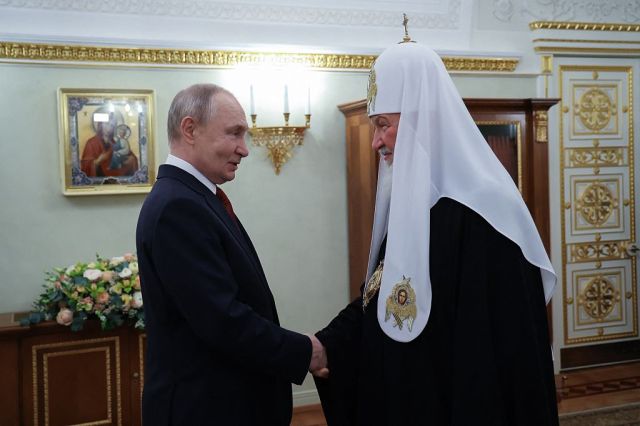
Vladimir Putin meets Patriarch Kirill. (Vyacheslav Prokofyev/Pool/AFP/Getty)





Women in white headscarves selling festive decorations, floral teacups, Orthodox icons and matryoshka dolls were once a familiar sight at Christmas markets across Europe. But ever since Russia’s full-scale invasion of Ukraine, the Belarusian nuns behind these stalls have been a source of controversy rather than holiday cheer. In 2022, they were barred from selling their handicrafts at Winchester Cathedral once it emerged that they supported Vladimir Putin’s invasion. They took their lead from the head of the Russian Orthodox Church, Patriarch Kirill, who declared that Russian soldiers who fall on the battlefield will be washed of their sins. He has silence published a book on the “redemptive meaning” of what he has called a “Holy War”.
As the fighting grinds on, the backlash against the pro-war nuns has continued. At a Christmas fair in the Polish city of Szczecin, Belarusian pro-democracy activists protested in front of the nuns’ stall, accusing shoppers of “supporting torture in Belarusian prisons and Russian aggression against Ukraine”. Ukrainians in Belfast warned of the nuns’ ties to the Kremlin and urged the city council not to host them again. Last Christmas, in the parish of Täby, a suburb of Stockholm, the rector allowed the nuns to flog their wares in the church corridor. But the Church of Sweden later warned that the nuns “use their income to support Russian nationalism” and “have close ties with GRU”, referring to Russia’s military intelligence service. It advised its believers “against supporting their activities in any way”.
The Saint Elisabeth Convent in Minsk refutes such claims. On its website, it says money from the sales helps orphans and funds “humanitarian aid” for residents of Russian occupied Donbas. Yet Archpriest Andrey Lemeshonok, the convent’s spiritual father, has made no secret of his backing of the invasion. He once boasted that his nuns were part of “a combat unit”, fighting for Russia’s future. Saint Elisabeth nuns, with flak jackets over their habits, have been photographed in occupied Ukraine and posing with Russian flags decorated with the pro-war Z symbol.
Four and a half years ago, when Russia launched its full-scale invasion, Kirill did not call for peace. Instead he called Russia’s opponents in Ukraine “evil forces”, casting the war as a metaphysical battle against what he labeled the corrupting values of the West. Since then, his rhetoric has only hardened, sanctifying the bloodshed in Ukraine. But his hawkishness is nothing new: a poisonous co-dependency between church and state has existed for centuries. Many of the patriarch’s predecessors were under the Kremlin’s thumb and in hock to the secret police. In Soviet times, not a single bishop was appointed without the blessing of the KGB. But today, more than ever before, the church acts as an instrument of Moscow’s geopolitical power projecting influence, and posing a growing threat, across Europe.
European security agencies increasingly view Russian church networks with suspicion. An open-source investigation by the Kyiv-based Molfar Intelligence Institute in late 2024 concluded that the ROC “constructs churches near strategic facilities, government institutions, and military bases across various European countries” in a systematic effort to use religious outposts for espionage. In Bulgaria, Czechia, North Macedonia and elsewhere, “spies in cassocks” have been used as an alternative to diplomatic cover after the expulsion of Russian embassy staff following the invasion of Ukraine. In 2024, a priest from a Russian church in the Czech resort town of Karlovy Vary was expelled over suspicions of hostile activities. “We would be particularly foolish,” said one Czech MEP, “if we did not recognize that Russia is undeniably using the Orthodox Church to carry out its hybrid warfare.”
Russia’s church has even tried to sway elections. Ahead of Moldova’s 2024 presidential poll and EU integration referendum, Russian state officials funded all-expenses-paid “pilgrimages” to Moscow for dozens of Moldovan Orthodox priests and gave them debit cards loaded with hundreds of dollars as going-home presents. In exchange, the clerics were instructed to create channels on the Telegram messaging app warning against joining the EU.
Moscow has also been quietly hoovering up strategic real estate. In Vardø, a remote Arctic town close to Norway’s GLOBUS radar station, the Moscow Patriarchate secured local approval, and even Norwegian state funding, to build a chapel. Clergy from the nearby Russian diocese of Plesetsk and Kargopol, including its bishop, made frequent visits to Vardø to unveil monuments to Norwegian partisans and consecrate Orthodox crosses. They said the chapel would serve Orthodox sailors and be a reminder of the cultural ties between Russia and Norway. But when the proposal was eventually submitted, the chapel had grown to 17 meters in height and, according to Vardø’s current mayor, the Russian bishop insisted the exact location under Nato radars had been “dictated” to him “by God himself”. Following the full-scale invasion of Ukraine and growing scrutiny of Moscow-linked institutions, the plans were shelved.
But many Russian churches have been built in sensitive spots, including in neighboring Sweden. The Church of the Holy Mother of God of Kazan in the town of Västerås, west of Stockholm, built and consecrated in 2024, is near a major airport, a water treatment works and a network of energy companies. Markus Göransson, a researcher at the Swedish Defense University, felt it was too close for comfort. “When Sweden’s defense forces undertake exercises on or near the airport… they do so under possible surveillance from the church,” he complained. Moreover, locals discovered that the plot of land for the church had been bought by Rosatom, Russia’s state-owned nuclear corporation which also, through an intermediary, funded the construction. Last August, the agency overseeing non-state religion funding in Sweden cut off state subsidies to the Västerås parish citing security concerns.
Finland, meanwhile, knows Russian pressure only too well. It shares an 833-mile border with its eastern neighbor, the longest in the EU. Decades of conflict and more recent hybrid tactics have fueled deep distrust. After the invasion, officials in the Finnish city of Turku moved quickly to close a Moscow-linked Orthodox church near a naval base, the port, government offices and Russia’s consulate. Governments in other countries have also wised up. Following the open-source intelligence findings of the Molfar report, governments across Europe are responding with sanctions, security investigations and pressure on Moscow-linked churches to cut ties with the Kremlin.
The issue is especially acute in the three Baltic states, where the Orthodox Church has become a flashpoint between a Soviet past and a European future. Estonia, Latvia and Lithuania are firmly anchored in the West through Nato and the EU, but all have sizable Russian-speaking populations, many descended from the Soviet era. Few attend church regularly, yet for many, Orthodoxy remains closely tied to Russian identity. In Estonia, where more than a quarter of the 1.4 million population are native Russian speakers, that makes the issue particularly sensitive. Parliament has now ordered Orthodox churches to sever ties with Moscow or face closure by the end of the year.
The sharpest confrontation to date in Estonia has been with the Pühtitsa Convent, which is a stavropegic monastery, meaning it comes under the direct authority of Patriarch Kirill rather than the local diocese. Pühtitsa’s abbess, Filareta Kalatšova, argues that the convent cannot unilaterally drop its subordination to the Moscow Patriarchate without breaking Church law. In an open letter to Parliament, she accused Estonian MPs of forcing her to commit a canonical crime. Though Martin Tulit, the Estonian official in charge of religious affairs, pointed out that the 134-year-old convent has changed its canonical affiliation before — including during the nation’s period of independence between the two world wars.
Outside Russia and occupied Ukraine, some Orthodox clerics who refused to follow Moscow orders eventually found they had other options. In January 2023, in Vilnius, Lithuania’s capital, I met five unemployed priests who had been serving in a diocese linked to the Moscow Patriarchate but were defrocked for opposing the war. One had become a taxi driver to feed his family. The clerics were in limbo until the following year when Patriarch Bartholomew of Constantinople agreed to reinstate them under his jurisdiction. Not all the parishioners reacted well to the swap. Father Vladimiras Seliavko said many cold shouldered him and even relatives viewed him as a traitor but he “could not remain with a patriarch who blessed war criminals”. Although the Orthodox have no Pope, the Constantinople Patriarch, based in today’s Istanbul, is the closest equivalent. He is also known as the Ecumenical Patriarch and — much to Moscow’s annoyance — is seen as primus inter pares: first among equals and senior among all Orthodox bishops. Some Russian priests defrocked and forced into exile for refusing to read Kirill’s mandatory Victory Prayer have also been transferred to Bartholomew’s jurisdiction.
In northern Europe, Poland and the Baltics, where Catholicism and Protestantism dominate, Russia’s church is widely seen as an arm of the Kremlin rather than a religious institution. The picture is very different in Orthodox eastern Europe, particularly in Serbia, Bulgaria and Georgia, where Moscow retains far deeper religious and cultural ties. Indeed, one of the challenges in countering the Russian Orthodox Church’s political influence is the hold it still has over its believers and its propensity to treat any criticism as tantamount to religious persecution. Last month, Bulgaria successfully blocked the European Union’s attempt to sanction Kirill. “The era of the Crusades is over,” said the country’s prime minister, Rumen Radev. He said he was wary of alienating millions of Eastern Orthodox believers. The Bulgarian Orthodox Church is administratively self-governing but its patriarch, Daniel, has aligned himself with Kirill’s position on the war. He warned his clergy against “inciting hatred” by labeling Russia as the “sole and unprovoked aggressor”.
Then there is the fraught question of the church in Ukraine. The establishment of the self-governing Orthodox Church of Ukraine in 2018, with the blessing of Bartholomew, was a slap in the face to Putin and his vision of the Russian World. But it was also a humiliation for Kirill. His Church, the biggest and the richest in the Orthodox world, stood to lose at least a fifth of its 150 million members, thousands of parishes and several hundred churches and monasteries. Nato encroachment aside, Ukraine’s desire to cut ties with the mother church in Moscow, to which it has been linked for three centuries, became a casus belli.
Disagreements over which Orthodox church in Ukraine is the most legitimate have not gone away. Even today, as bombs rain down on Ukrainian cities, many parishioners are reluctant to change jurisdictions to the autonomous Orthodox Church of Ukraine. They believe that it is uncanonical and that joining it means that they will be deprived of divine grace. This agenda is relentlessly pushed by the Kremlin. Foreign Minister Sergey Lavrov, hardly an authority on matters ecclesiastical, routinely invokes “canon law” to condemn Ukrainian and Western action against the branch of the church historically linked to Moscow.
Such talk leaves parishioners particularly open to manipulation. “The church is very convenient for dictatorships”, says Father Vladimiras, one of the five Lithuanian priests defrocked by Moscow, “because any propaganda can be spread through its channels. Believers are accustomed to trusting their clergy and rarely doubt the statements of their patriarch, bishops or priests.” Recent reports in the Ukrainian media suggest Orthodox parishes in Western Europe are being used to recruit Ukrainian refugees. It is not clear how these refugees would be deployed, but it’s not unimaginable they could become Russian intelligence assets.
Throughout the Cold War, Soviet propaganda relentlessly targeted Uncle Sam. Now, Europe has morphed into Russia’s main enemy. And the Russian Church is key to Putin’s plan to destroy European liberal democracy and the institutions underpinning it. According to Kirill, the continent is mired in moral decay thanks to its acceptance of LGBTQ+ rights; Orthodox politicians and talk show hosts often use the pejorative term “Gayropa” instead of Evropa.
The war has given the Patriarch a chance to reassert his authority in a post-Soviet world as he championed the twin causes of Orthodox unity and Russian imperialism. Since the Western world “has fallen into Satanism”, in Kirill’s view, Russia functions as the Katechon — the biblical force that restrains the Antichrist. In a recent sermon he praised Russia’s atomic bomb for thwarting its enemies plans to “to destroy and enslave the Motherland”. In other words, massive military destruction is justified as an act of cosmic purification.
Europe may now have to confront this increasingly aggressive alliance of “the missile and the incense burner”, as one French theologian put it, with little help from across the Atlantic. If previous US administrations made equality for sexual minorities a pillar of American diplomacy, Donald Trump’s National Security Strategy, published last November, puts “traditional values” at its heart instead. On a trip to Texas last year for the BBC, I was struck by how some ultra-conservative Americans now see Russia as a Christian bulwark — even a model to emulate. The strategy contains little criticism of Moscow despite the mounting death toll, while voicing support for “patriotic parties”, several of which enjoy the Kremlin’s favor and, in some cases, the backing of its pliant church. For a continent already facing a resurgent Russia, Europe’s isolation on this issue is an uncomfortable prospect and one it can no longer afford to ignore.